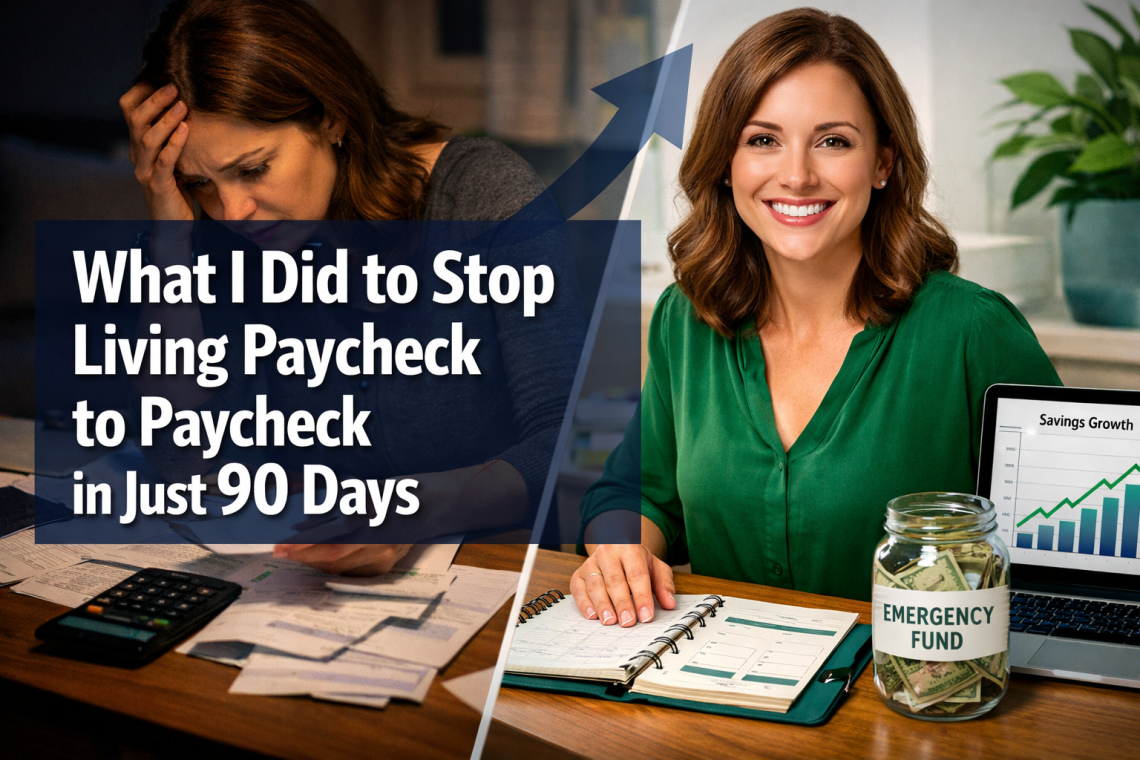

I’ll never forget the panic I felt when my car broke down in March 2025, and I had exactly $47 in my checking account. That moment—staring at a $600 repair bill with no emergency fund—became my wake-up call. I was earning a decent salary, yet somehow I was trapped in the exhausting cycle of living paycheck to paycheck. Sound familiar? If you’re nodding your head right now, I want you to know that breaking free is absolutely possible, and it doesn’t require winning the lottery or landing a six-figure job. In just 90 days, I completely transformed my financial situation, and I’m going to share exactly what I did so you can do it too.
Key Takeaways
- Creating a zero-based budget was the foundation that gave me complete control over every dollar I earned
- Cutting unnecessary expenses by 42% freed up hundreds of dollars monthly without sacrificing my quality of life
- Building multiple income streams increased my monthly earnings by $1,650 within the first 60 days
- Starting with a small emergency fund of just $1,000 broke the paycheck-to-paycheck cycle and provided immediate financial breathing room
- Addressing the psychological barriers to money management was just as important as the tactical financial strategies
Understanding Why You’re Stuck Living Paycheck to Paycheck

Before I could stop living paycheck to paycheck, I needed to understand why I was stuck in this exhausting pattern. According to recent 2026 data, approximately 78% of American workers live paycheck to paycheck, including 36% of those earning over $100,000 annually[1]. This isn’t just a low-income problem—it’s a money management crisis affecting people across all income levels.
The Real Culprits Behind Financial Stress
Through my journey, I identified several key factors that kept me financially trapped:
Lifestyle inflation was my biggest enemy. Every time I got a raise, my spending magically increased to match it. That extra $200 per month? It disappeared into nicer dinners, upgraded streaming services, and “small” purchases that added up fast.
Lack of financial awareness meant I genuinely had no idea where my money went each month. I’d check my bank balance, see money there, and spend it—only to be shocked when bills came due.
The psychological weight of financial stress created a vicious cycle. Feeling stressed about money led to emotional spending, which created more stress. I was literally spending money to cope with the stress of not having money.
Hidden expenses and subscription creep were silently draining my accounts. I discovered I was paying for seven different subscription services I barely used, totaling $143 monthly.
My 90-Day Roadmap to Stop Living Paycheck to Paycheck
Let me walk you through the exact three-phase approach that transformed my finances. This isn’t theory—these are the specific actions I took, in order, with real results.
Phase 1: Days 1-30 – The Foundation Phase
The first month was all about gaining clarity and control. Here’s what I did:
Creating My Zero-Based Budget
I started by implementing a zero-based budget, which means every single dollar I earned had a specific job. This was completely different from my previous “budgeting” attempts where I’d vaguely track spending.
My zero-based budget process:
- Calculated my exact monthly income: $3,200 after taxes
- Listed every expense category: rent, utilities, groceries, transportation, insurance, debt payments, everything
- Assigned every dollar: Income minus all expenses and savings = $0
This approach forced me to be intentional. Instead of wondering where my money went, I told it where to go before I spent it.
| Budget Category | Previous Spending | New Budget | Monthly Savings |
|---|---|---|---|
| Dining Out | $420 | $120 | $300 |
| Groceries | $380 | $280 | $100 |
| Subscriptions | $143 | $35 | $108 |
| Entertainment | $180 | $60 | $120 |
| Shopping | $315 | $100 | $215 |
| Total | $1,438 | $595 | $843 |
By avoiding common budgeting mistakes, I saved $843 monthly right from the start.
Tracking Every Single Expense
For 30 days straight, I tracked every purchase—and I mean every purchase. That $2.50 coffee? Logged it. The $1.99 app download? Logged it. This level of awareness was eye-opening and honestly a bit embarrassing.
I used a combination of tools:
- Mint for automatic transaction categorization
- YNAB (You Need A Budget) for zero-based budgeting
- A simple notebook I kept in my pocket for cash purchases
The psychological impact was immediate. Knowing I’d have to write down that impulse purchase made me pause and reconsider. I avoided dozens of unnecessary purchases simply because I didn’t want to log them.
Building My Initial $1,000 Emergency Fund
This was non-negotiable. Before paying extra on debt, before investing, I needed a basic financial cushion. That $1,000 emergency fund became my buffer against life’s unexpected expenses—the very thing that had kept me trapped before.
How I found $1,000 in 30 days:
- Sold unused items: $340 (old electronics, clothes, furniture I didn’t need)
- Cut expenses: $843 from my budget overhaul (first month)
- Worked overtime: $150 (two extra shifts)
- Total: $1,333 (I put $1,000 in emergency fund, $333 toward debt)
Having that $1,000 sitting in a separate savings account completely changed my psychology. I finally had breathing room.
Phase 2: Days 31-60 – The Acceleration Phase
With my foundation solid, month two focused on aggressive expense reduction and income increase.
Slashing Expenses Without Feeling Deprived
I needed to cut costs sustainably, which meant finding ways to reduce spending without feeling like I was punishing myself. Here’s what worked:
Housing costs (my biggest expense):
- Negotiated with my landlord for a $50 monthly reduction by signing a longer lease
- Found a roommate for my spare bedroom: +$400/month
Utilities and services:
- Called my internet provider and negotiated from $89 to $55/month: $34 saved
- Switched to a cheaper cell phone plan: $28 saved monthly
- Bundled car and renters insurance: $43 saved monthly
Transportation:
- Started carpooling three days per week: $65 saved on gas
- Did basic car maintenance myself (oil changes, air filters): $35 saved monthly
Food expenses:
- Meal prepped every Sunday for the week
- Used grocery store apps for digital coupons
- Switched to store brands for staples
- Implemented frugal living strategies that saved $120 monthly
Subscription audit:
- Canceled six subscriptions I rarely used
- Shared streaming services with family
- Used the library instead of buying books
- Total monthly savings: $108
The key was finding realistic money-making and money-saving opportunities that didn’t make me feel deprived. I kept one streaming service I truly enjoyed and budgeted for occasional dining out—just much less frequently.
Launching My First Side Hustle
Cutting expenses only gets you so far. To truly stop living paycheck to paycheck, I needed to increase my income. I started with skills I already had.
My side hustle journey:
Week 5-6: I identified my marketable skills (writing, basic graphic design, social media management) and created profiles on Upwork and Fiverr.
Week 7: Landed my first client—a small business needing blog posts. Payment: $150 for three articles.
Week 8: Added two more clients through referrals. Monthly recurring income: $450
I also explored money-making apps for quick cash:
- Rover for dog walking on weekends: $200-300/month
- Instacart for grocery delivery during slow evenings: $150-200/month
By day 60, I had added $850-950 monthly to my income through side hustles alone. Combined with the roommate income, I was bringing in an extra $1,250-1,350 per month.
Tackling Debt Strategically
With extra money coming in, I attacked my debt using the avalanche method (highest interest rate first):
My debt situation on Day 1:
- Credit Card 1: $3,200 at 22.9% APR
- Credit Card 2: $1,800 at 18.5% APR
- Personal Loan: $4,500 at 12% APR
- Total debt: $9,500
My debt payoff strategy:
- Made minimum payments on all debts
- Put every extra dollar toward Credit Card 1 (highest interest)
- Once CC1 was paid off, rolled that payment into CC2
- Applied proven debt paydown strategies
Results after 60 days:
- Credit Card 1: Paid down to $1,850 (saved $84 in interest)
- Total debt reduction: $1,350
- Monthly interest savings going forward: $28
Phase 3: Days 61-90 – The Momentum Phase
The final month was about building sustainable systems and creating long-term financial security.
Automating My Financial Success
I set up automatic systems so I didn’t have to rely on willpower:
Automatic transfers I implemented:
- Emergency fund: $200 transferred every payday to high-yield savings account
- Debt payment: $500 automatic payment to highest-interest debt on the 1st of each month
- Retirement: Increased 401(k) contribution from 3% to 6% to capture full employer match
- “Fun money”: $100 to separate checking account for guilt-free spending
This automation removed the temptation to “just this once” skip savings or debt payments. The money moved before I could spend it elsewhere.
Expanding Income Streams Further
By month three, I was ready to explore passive income opportunities:
What I started:
- Created digital products (budget templates, meal planning guides) and sold them on Etsy: $150-200/month
- Started affiliate marketing with a personal finance blog: $50-100/month initially
- Rented out my parking space (I didn’t have a car): $125/month
These passive income streams started small but required minimal ongoing effort. The key was starting them while maintaining my active side hustles.
Building My Three-Month Emergency Fund
With my $1,000 starter emergency fund complete, I worked toward a full three-month emergency fund. Here’s how I calculated my target:
Monthly essential expenses:
- Rent: $650 (with roommate)
- Utilities: $85
- Groceries: $280
- Insurance: $145
- Minimum debt payments: $285
- Transportation: $120
- Total: $1,565/month
Three-month emergency fund goal: $4,695
By day 90, I had saved $2,340 toward this goal—halfway there! I committed to continuing my $200 automatic transfers until I hit the full amount.
The Psychological Shift That Changed Everything
Here’s something most financial advice articles won’t tell you: the mental and emotional work was just as important as the tactical strategies.
Confronting My Money Mindset
I had to address some uncomfortable truths about my relationship with money:
Scarcity mindset: I grew up hearing “we can’t afford that,” which created a weird compensation pattern as an adult. When I had money, I spent it immediately because part of me didn’t believe it would last.
Emotional spending: I used shopping as therapy. Bad day at work? Online shopping. Stressed about bills? Treat myself to dinner out. The irony wasn’t lost on me.
Comparison trap: Social media made me feel like I needed to keep up with friends who seemed to have it all together financially (spoiler: many of them were also living paycheck to paycheck).
Building New Mental Habits
I started practicing gratitude for what I already had instead of focusing on what I lacked. This sounds cheesy, but it genuinely reduced my urge to buy things to feel better.
I unfollowed accounts that triggered spending urges and followed personal finance creators who inspired better money habits.
I reframed “budgeting” from restriction to empowerment. My budget wasn’t limiting me—it was giving me permission to spend guilt-free within my means while building toward my goals.
I celebrated small wins. Every $100 saved, every debt payment, every side hustle dollar earned—I acknowledged these victories instead of only focusing on how far I still had to go.
Technology and Tools That Accelerated My Progress

The right tools made this transformation significantly easier:
Budgeting Apps I Actually Used
- YNAB (You Need A Budget): Best for zero-based budgeting and the methodology that changed my financial life ($14.99/month, worth every penny)
- Mint: Free option for expense tracking and getting started
- EveryDollar: Simple interface, great for beginners
Expense Tracking
- Truebill/Rocket Money: Automatically identified and helped me cancel subscriptions I forgot about
- Personal Capital: Free tool for tracking net worth and seeing the big picture
Side Hustle Platforms
- Upwork & Fiverr: For freelance work
- Rover: For pet sitting/dog walking
- Instacart & DoorDash: For flexible gig work
- Etsy: For selling digital products
Savings Optimization
- Marcus by Goldman Sachs: High-yield savings account (4.5% APY in 2026) for emergency fund
- Digit: Automatically saves small amounts based on spending patterns
Common Obstacles and How I Overcame Them
This journey wasn’t smooth. Here are the challenges I faced and how I pushed through:
Obstacle 1: Unexpected Expenses
What happened: In week 6, my laptop died. Repair cost: $280.
How I handled it: Used $280 from my emergency fund (this is exactly what it’s for!), then rebuilt it over the next month. This was actually a victory—old me would have put it on a credit card and paid interest.
Obstacle 2: Social Pressure
What happened: Friends wanted to go on an expensive weekend trip I couldn’t afford.
How I handled it: I was honest. I said, “I’m working on some financial goals right now and can’t swing this trip, but I’d love to plan something more budget-friendly in a few months.” Real friends understood. I also learned to suggest free or low-cost alternatives for socializing.
Obstacle 3: Motivation Dips
What happened: Around day 45, I felt exhausted from being so disciplined and wanted to give up.
How I handled it: I revisited my “why.” I wrote down the stress I felt when my car broke down and I had no money. I visualized the freedom I’d have with an emergency fund and no debt. I also gave myself permission to use my budgeted “fun money” guilt-free, which helped me feel less restricted.
Obstacle 4: Income Fluctuations
What happened: My side hustle income varied significantly week to week.
How I handled it: I budgeted based on my lowest expected monthly income (my full-time job only). All side hustle income was “extra” that went straight to debt and savings. This prevented me from counting on variable income for essential expenses.
Long-Term Strategies Beyond the First 90 Days
Stopping the paycheck-to-paycheck cycle isn’t just a 90-day project—it’s a lifestyle change. Here’s what I continued doing:
Continuing to Build Wealth
After establishing my emergency fund and making significant debt progress, I focused on achieving financial freedom through:
Investing for the future:
- Maxed out employer 401(k) match (free money!)
- Opened a Roth IRA and started contributing $200/month
- Began learning about investing in stocks with little money
Building additional income streams:
- Scaled my freelance business to $800-1,000/month
- Developed passive income ideas that grew over time
- Explored high-income skills to increase earning potential
Maintaining good financial habits:
- Continued zero-based budgeting every month
- Kept tracking expenses (it became automatic)
- Reviewed and adjusted my budget quarterly
- Practiced habits that keep you debt-free
Credit Score Improvement
As I paid down debt and made consistent on-time payments, my credit score improved dramatically:
- Day 1 credit score: 612
- Day 90 credit score: 668
- Six months later: 720
I learned about proven ways to raise credit scores fast and avoided things that hurt your credit score.
Tax Optimization
I also discovered I was leaving money on the table with taxes:
- Contributed to tax-advantaged retirement accounts
- Tracked business expenses from side hustles for deductions
- Adjusted my W-4 withholding to stop giving the government an interest-free loan (previously got $2,400 refunds, now get $200-300 and have that money throughout the year)
Your 90-Day Action Plan to Stop Living Paycheck to Paycheck

Ready to start your own transformation? Here’s your step-by-step roadmap:
Week 1: Assessment and Planning
- Calculate your exact monthly income (after taxes)
- Track every expense for 7 days to understand current spending
- List all debts with balances, interest rates, and minimum payments
- Identify your “why”—write down why you want financial freedom
- Set up a basic budgeting system (app or spreadsheet)
Week 2-4: Foundation Building
- Create your zero-based budget
- Open a separate savings account for your emergency fund
- Set up automatic transfers to savings ($50-200 depending on income)
- Audit all subscriptions and cancel unused ones
- Start tracking every expense daily
- Goal: Save first $250-500 toward $1,000 emergency fund
Week 5-8: Expense Reduction
- Negotiate bills (internet, phone, insurance)
- Implement meal planning and grocery strategies
- Try a no-spend challenge for one week
- Sell unused items for quick cash
- Review and optimize transportation costs
- Goal: Reduce monthly expenses by 20-30%
Week 9-12: Income Acceleration
- Identify marketable skills for side hustles
- Create profiles on freelance or gig platforms
- Apply for 5-10 side hustle opportunities
- Start your first side hustle project
- Explore home business ideas
- Goal: Earn first $200-500 from additional income sources
Week 13: Momentum and Systems
- Complete $1,000 emergency fund
- Automate all savings and debt payments
- Review progress and adjust budget as needed
- Plan for months 4-6 with specific goals
- Celebrate your wins!
Real Numbers: My 90-Day Transformation
Let me show you the actual financial transformation in concrete numbers:
Day 1 Financial Snapshot
- Monthly income: $3,200
- Monthly expenses: $3,180
- Left over: $20
- Emergency fund: $0
- Total debt: $9,500
- Credit score: 612
- Net worth: -$9,500
Day 90 Financial Snapshot
- Monthly income: $3,200 (primary job) + $1,350 (side hustles and roommate) = $4,550
- Monthly expenses: $2,337 (reduced by 26%)
- Left over for savings/debt: $2,213
- Emergency fund: $2,340
- Total debt: $7,180 (paid off $2,320)
- Credit score: 668
- Net worth: -$4,840 (improved by $4,660!)
The Real Impact
Beyond the numbers, here’s what changed:
✅ Stress levels: Dramatically reduced—I could sleep at night
✅ Confidence: Skyrocketed—I felt in control for the first time
✅ Relationships: Improved—financial stress wasn’t affecting my mood
✅ Future outlook: Optimistic—I could actually envision financial freedom
✅ Decision-making: Better—I made choices based on goals, not desperation
Frequently Asked Questions
How much should I save before paying off debt?
Save $1,000 first (or one month of essential expenses, whichever is less). This prevents you from going further into debt when unexpected expenses arise. After that, focus on high-interest debt while continuing to build your emergency fund gradually.
What if I have irregular income?
Budget based on your lowest expected monthly income. In high-income months, put the extra toward savings and debt. Consider using a budgeting method specifically designed for biweekly paychecks or variable income.
Can I really stop living paycheck to paycheck on a low income?
Yes, though it may take longer than 90 days. Focus on the fundamentals: track spending, cut unnecessary expenses, and find even small ways to increase income. I’ve seen people making $25,000/year break the cycle by being incredibly intentional. Check out strategies for paying off credit card debt with low income.
What if I don’t have skills for a side hustle?
You have more skills than you think! Can you clean, organize, run errands, walk dogs, or babysit? These require minimal special skills. You can also learn high-income skills through free online resources. Start with what you can do now while building new capabilities.
How do I stay motivated when progress feels slow?
Track and celebrate small wins. Every $50 saved, every expense reduced, every side hustle dollar earned is progress. Take before-and-after snapshots of your finances monthly. Join online communities of people on similar journeys for support and accountability.
Conclusion: Your Financial Freedom Starts Today

Looking back at that moment when my car broke down and I had $47 to my name, I barely recognize that version of myself. The person who felt helpless, trapped, and stressed about money has been replaced by someone who feels empowered, in control, and genuinely excited about the future.
The truth is, you don’t need to be perfect to stop living paycheck to paycheck. You don’t need to follow every piece of advice in this article. You don’t need to cut out all fun or work 80 hours per week. You just need to start.
Start with one thing today:
- Download a budgeting app
- Track your spending for one day
- Cancel one unused subscription
- Sell one item you don’t need
- Apply for one side hustle opportunity
That single action creates momentum. Momentum creates confidence. Confidence creates more action. Before you know it, 90 days have passed and your financial life looks completely different.
The paycheck-to-paycheck cycle isn’t a life sentence—it’s a pattern, and patterns can be broken. I broke mine, and you can break yours too.
Your next step: Choose one action from the 90-day plan above and do it today. Not tomorrow, not next week—today. Your future self will thank you.
Remember, financial freedom isn’t about having millions of dollars. It’s about having control, options, and peace of mind. It’s about not panicking when unexpected expenses arise. It’s about making decisions based on your values instead of your bank account balance.
You’ve got this. Start today, stay consistent, and in 90 days, you’ll be writing your own financial transformation story.