How to Payoff Credit Card Debt Fast with a Low Income: Your Complete 2026 Guide

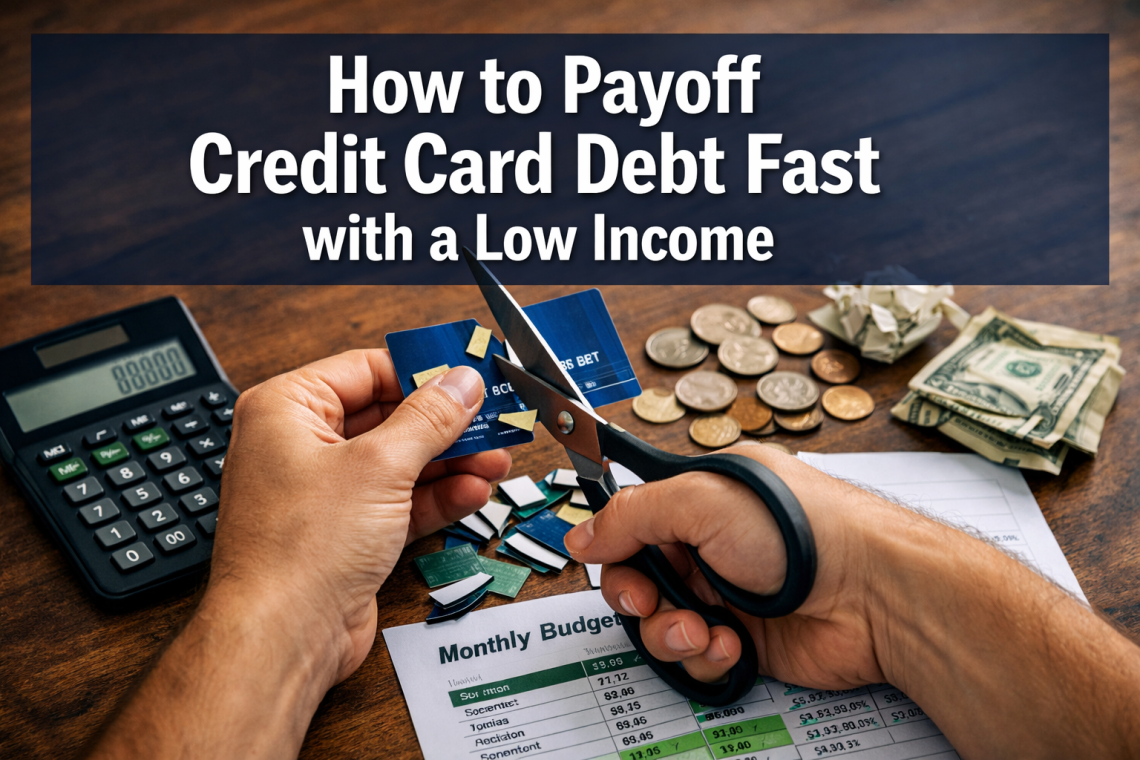
I’ll never forget the sinking feeling I had when I opened my credit card statement and saw a balance that felt impossible to tackle on my modest income. If you’re reading this, you probably know that feeling too. The good news? Learning how to payoff credit card debt fast isn’t just for people with six-figure salaries. Even with a low income, you can break free from the cycle of minimum payments and crushing interest charges.
The average American carries over $6,500 in credit card debt, and when you’re earning less, every dollar counts even more [1]. But here’s what most people don’t realize: paying off debt quickly has less to do with how much you earn and more to do with having the right strategy, mindset, and tools.
Key Takeaways
- The debt snowball and avalanche methods are proven strategies that work regardless of your income level, with each offering distinct psychological and financial benefits
- Negotiating with creditors can reduce your interest rates by 5-10 percentage points, potentially saving thousands in interest charges
- Increasing income through side hustles can accelerate debt payoff by 50-200%, making the “impossible” timeline suddenly achievable
- Addressing the psychological aspects of debt is just as important as the numbers—your mindset determines your success
- Technology and budgeting apps can automate tracking and keep you accountable without adding stress to your daily routine
Understanding Why Traditional Advice Fails Low-Income Earners

Most financial advice assumes you have wiggle room in your budget. “Just cut back on lattes!” they say. But when you’re already choosing between groceries and gas, there are no lattes to cut.
The reality is that credit card debt elimination for low-income earners requires a different approach. You need strategies that acknowledge your constraints while maximizing every opportunity to accelerate progress.
The Minimum Payment Trap
Here’s a sobering truth: if you have a $5,000 balance at 18% APR and only make minimum payments of $100, it’ll take you 7 years and cost $3,400 in interest to pay it off [2]. That’s money you can’t afford to waste.
The credit card companies designed minimum payments to keep you in debt longer. Breaking free means going beyond the minimum—even if it’s just $10 or $20 more each month.
How to Payoff Credit Card Debt Fast: Choosing Your Strategy
Credit Card Payoff Calculator
💳 Credit Card Payoff Calculator
Choose your strategy and see when you’ll be debt-free!
📋 Your First Month Payment Plan
There are two battle-tested methods for tackling multiple credit card debts: the debt snowball method and the debt avalanche technique. Both work, but they appeal to different personalities and situations.
The Debt Snowball Method
This approach focuses on psychological wins by targeting your smallest balance first, regardless of interest rate.
How it works:
- List all debts from smallest to largest balance
- Make minimum payments on everything except the smallest debt
- Throw every extra dollar at the smallest debt
- Once paid off, roll that payment into the next smallest debt
- Repeat until debt-free
Why it works for low-income earners: The quick wins keep you motivated. When you’re living paycheck to paycheck, seeing a credit card balance hit zero within a few months provides the emotional fuel to keep going.
I’ve seen people pay off their first card in 6-8 weeks using this method, and that victory creates momentum that spreadsheets can’t capture.
The Debt Avalanche Method
This strategy prioritizes mathematical efficiency by attacking the highest interest rate first.
How it works:
- List all debts from the highest to the lowest interest rate
- Make minimum payments on everything except the highest-rate debt
- Direct all extra money toward the highest-rate debt
- Once eliminated, move to the next highest rate
- Continue until all debts are paid
Why it saves more money: You minimize total interest paid. For someone with limited income, saving even $500 in interest over the payoff period can make a significant difference.
Which Method Should You Choose?
| Factor | Debt Snowball | Debt Avalanche |
|---|---|---|
| Total Interest Paid | Higher | Lower |
| Motivation | Quick wins | Requires discipline |
| Best For | Need encouragement | Mathematically minded |
| Time to First Payoff | Faster | Potentially slower |
| Money Saved | Less | More |
My recommendation: If you’ve struggled with debt before and need motivation, start with snowball. If you’re disciplined and want to save every possible dollar, choose avalanche. You can also check out these proven ways to pay down debt faster for additional strategies.
Creating a Realistic Budget That Actually Works
You can’t reduce credit card debt quickly without knowing exactly where your money goes. But budgeting on a low income isn’t about deprivation—it’s about intentionality.
The Zero-Based Budget Approach
Every dollar gets a job before the month begins:
- Income: $2,500/month (example)
- Housing: $900
- Utilities: $150
- Food: $300
- Transportation: $200
- Insurance: $150
- Minimum debt payments: $250
- Extra debt payment: $200
- Emergency fund: $50
- Personal/misc: $300
Notice that it adds up to exactly $2,500. Nothing is unaccounted for.
Finding Money You Didn’t Know You Had
When I first did this exercise, I discovered I was spending $180/month on subscriptions I barely used. Here’s where to look:
✅ Subscription audit: Cancel anything you haven’t used in 30 days
✅ Insurance review: Shop around annually (I saved $400/year on car insurance)
✅ Phone plan: Switch to budget carriers (savings: $30-50/month)
✅ Grocery optimization: Meal planning and store brands (savings: $100-200/month)
✅ Energy costs: Adjust thermostat, unplug devices (savings: $20-40/month)
These aren’t sexy tips, but they can free up $200-400 monthly for debt payoff. Learn more about budgeting mistakes to avoid to ensure your plan succeeds.
The 50/30/20 Budget Alternative
If zero-based budgeting feels overwhelming, try the simpler 50/30/20 rule:
- 50% needs (housing, food, utilities)
- 30% wants (entertainment, dining out)
- 20% savings and debt payoff
On a $2,500 income, that’s $500 toward debt elimination. Read about what I learned trying the 50/30/20 budget for real-world insights.
Negotiating with Creditors: The Overlooked Strategy
Here’s something most people don’t know: credit card companies would rather keep you as a customer at a lower rate than lose you to bankruptcy. This gives you negotiating power.
How to Negotiate a Lower Interest Rate
I’ve personally negotiated my rate from 22.99% to 15.99% with a single phone call. Here’s the script that works:
You: “Hi, I’ve been a customer for [X years], and I’ve always made on-time payments. I’m currently paying 22.99% APR, but I’ve received offers from other companies at much lower rates. Can you lower my rate to help me stay with you?”
Key points:
- Be polite but firm
- Mention your payment history
- Reference competitor offers (even if vague)
- Ask to speak to a supervisor if the first person says no
- Call back and try again if rejected
Success rate: About 60-70% of people who ask receive some reduction [3].
Hardship Programs
If you’re genuinely struggling, ask about hardship programs. These can:
- Reduce or waive fees
- Lower interest rates temporarily (sometimes to 0%)
- Reduce minimum payments
- Pause late fees
You’ll need to demonstrate financial hardship, but these programs exist because creditors want to help you succeed (and keep paying them).
Balance Transfer Strategy
If you have decent credit (650+), a balance transfer to a 0% APR card can save massive amounts in interest.
Example:
- Current balance: $5,000 at 19.99% APR
- Transfer to 0% APR for 18 months (3% transfer fee = $150)
- Pay $280/month = debt-free in 18 months
- Interest saved: $850+
Warning: Only do this if you’re disciplined. The 0% period is temporary, and if you keep using credit cards, you’ll dig a deeper hole.
Increasing Income: The Fastest Path to Debt Freedom

I know you clicked on this article about how to payoff credit card debt fast with a low income, but hear me out: temporarily increasing your income is often easier than cutting expenses to the bone.
Side Hustles That Actually Work in 2026
Based on current market data, these side hustles offer the best return on time invested:
1. Freelance Services ($20-100/hour)
- Writing, graphic design, virtual assistance
- Platforms: Upwork, Fiverr, Freelancer
- Time to first dollar: 1-2 weeks
2. Delivery/Rideshare ($15-25/hour)
- DoorDash, Uber Eats, Instacart
- Flexible hours, immediate pay
- Time to first dollar: 1 week
3. Online Tutoring ($20-60/hour)
- Tutor.com, VIPKid, Wyzant
- Use existing knowledge
- Time to first dollar: 2-3 weeks
4. Selling Items ($100-1,000 one-time)
- Facebook Marketplace, eBay, Poshmark
- Declutter and earn
- Time to first dollar: Days
5. Gig Work ($15-30/hour)
- TaskRabbit, Handy, Thumbtack
- Use practical skills
- Time to first dollar: 1-2 weeks
For more ideas, check out these realistic ideas for making money from home and passive income ideas that work in 2026.
The Power of Extra Income
Let’s say you earn an extra $500/month through side work:
Without extra income:
- $5,000 debt at 18% APR
- $200/month payment
- Payoff time: 31 months
- Interest paid: $1,107
With $500 extra monthly:
- Same debt and rate
- $700/month payment
- Payoff time: 8 months
- Interest paid: $308
- Time saved: 23 months
- Money saved: $799
That’s the power of increasing your debt payments by just $500/month.
Technology Tools for Debt Tracking and Motivation
Managing financial debt solutions is infinitely easier with the right technology. Here are the tools that actually make a difference:
Best Budgeting Apps for Debt Payoff
1. YNAB (You Need A Budget) – $14.99/month
- Zero-based budgeting
- Real-time tracking
- Debt payoff features
- Worth every penny if you’re serious
2. Mint – Free
- Automatic transaction tracking
- Budget creation
- Credit score monitoring
- Good for beginners
3. EveryDollar – Free (basic)
- Simple interface
- Manual or automatic tracking
- Debt snowball tracker
- Created by Dave Ramsey’s team
4. Debt Payoff Planner – Free
- Dedicated debt tracking
- Snowball and avalanche calculators
- Progress visualization
- Motivational milestones
Gamifying Your Debt Payoff
Turn debt elimination into a game:
📊 Visual trackers: Print a thermometer chart and color it in as you pay down debt
🎯 Milestone rewards: Celebrate every $1,000 paid off with a small, free reward
📱 Apps with achievements: Use apps that award badges for progress
👥 Accountability partners: Share goals with a friend doing the same thing
📸 Progress photos: Take monthly screenshots of declining balances
The psychological boost from these tactics is real. Our brains respond to visual progress and celebration.
The Psychological Side of Debt Elimination
Here’s what the financial gurus won’t tell you: debt is as much an emotional problem as it is a mathematical one.
Breaking the Shame Cycle
Debt shame keeps people stuck. You avoid looking at statements, ignore calls, and feel paralyzed. This is normal, but it’s also what keeps you trapped.
The mindset shift:
- Debt is a problem to solve, not a moral failing
- You’re not alone (78% of Americans live paycheck to paycheck) [4]
- Every small step forward matters
- Progress isn’t linear—setbacks happen
Managing Debt-Related Stress
The mental health impact of debt is significant. Studies show that people with high debt levels are 3x more likely to experience depression and anxiety [5].
Coping strategies:
- Set boundaries: Check balances once weekly, not obsessively
- Celebrate wins: Acknowledge every payment, no matter how small
- Practice self-compassion: Talk to yourself like you’d talk to a friend
- Seek support: Free financial counseling through NFCC (National Foundation for Credit Counseling)
- Focus on control: You can’t change the past, but you control today’s choices
The “Why” Behind Your Debt Freedom
Connect your goal to something deeper than numbers:
- “I’m paying off debt so my kids see financial responsibility”
- “I’m eliminating debt to reduce stress and improve my health”
- “I’m becoming debt-free to have choices in my career”
- “I’m clearing debt to eventually buy a home”
When the motivation is emotional, you’ll push through the hard moments.
Debt Consolidation and Professional Help
Sometimes, credit card debt relief requires bringing in reinforcements. Here’s when and how to get help.
Debt Consolidation Loans
A debt consolidation loan combines multiple credit card debts into one loan with a lower interest rate.
Pros:
✅ Single monthly payment
✅ Lower interest rate (typically 8-15% vs 18-25%)
✅ Fixed payoff timeline
✅ Simplifies budgeting
Cons:
❌ Requires decent credit (640+)
❌ May have origination fees
❌ Risk of accumulating new credit card debt
❌ Longer payoff period if you extend terms
Best for: People with $5,000+ in debt, credit scores above 640, and the discipline not to reuse credit cards.
Credit Counseling Services
Nonprofit credit counseling agencies (like NFCC members) offer:
- Free budget counseling
- Debt management plans (DMP)
- Negotiated lower interest rates
- Single monthly payment to the agency
How it works:
- Free consultation to review your situation
- Counselor creates a debt management plan
- They negotiate with creditors for lower rates
- You make one payment to the agency monthly
- They distribute payments to your creditors
Cost: Usually $25-50 setup fee and $20-75 monthly fee
Impact on credit: Minimal negative impact, and you’ll close credit accounts during the program
When to Consider Bankruptcy
I don’t recommend this lightly, but sometimes it’s the right choice. Consider bankruptcy if:
- Your debt exceeds your annual income
- You’re facing lawsuits or wage garnishment
- You’ve exhausted all other options
- Your health is seriously suffering from debt stress
Chapter 7 wipes out most unsecured debt but impacts credit for 10 years.
Chapter 13 creates a 3-5 year repayment plan and impacts credit for 7 years.
Consult with a bankruptcy attorney (many offer free consultations) before deciding.
Building Habits to Stay Debt-Free Forever

Paying off debt is only half the battle. The real victory is staying debt-free. Here’s how to make that permanent.
Emergency Fund Essentials
The #1 reason people go back into debt: Unexpected expenses with no savings to cover them.
Start with a starter emergency fund of $500-1,000 while paying off debt. Once debt-free, build it to 3-6 months of expenses.
How to build it:
- Automate $25-50 per paycheck to savings
- Direct all windfalls (tax refunds, bonuses) to the fund
- Keep it in a separate high-yield savings account
- Don’t touch it unless it’s a true emergency
Learn more about saving $1,000 in a month to jumpstart your emergency fund.
The Envelope System for Spending Control
This old-school method prevents overspending:
- Withdraw cash for variable expenses (groceries, gas, entertainment)
- Divide into labeled envelopes
- Spend only what’s in each envelope
- When it’s gone, it’s gone
Why it works: Cash creates psychological friction that swiping cards doesn’t. You physically see money leaving your hands.
Credit Card Use After Debt Freedom
Should you keep credit cards after paying them off? Yes, but with rules:
- Keep 1-2 cards for emergencies and credit building
- Pay the full balance every month (no exceptions)
- Use for planned purchases only
- Set up automatic payments to avoid late fees
- Check your accounts weekly
If you can’t follow these rules, cut up the cards and use debit only. Check out these simple habits that help you stay debt-free for life.
Improving Your Credit Score
As you pay down debt, your credit utilization ratio improves, which boosts your credit score. This ratio is your balance divided by your credit limit.
Ideal: Under 30% utilization
Excellent: Under 10% utilization
Example:
- Credit limit: $10,000
- Current balance: $5,000
- Utilization: 50% (hurts your score)
- After paying to $2,000: 20% (helps your score)
For more strategies, read about proven ways to raise your credit score fast and surprising things that hurt your credit score.
Real Success Stories: Proof It’s Possible
Maria’s Story:
Maria earned $32,000 annually as a retail worker with $8,500 in credit card debt. Using the debt snowball method and a weekend cleaning side hustle earning $300/month, she paid off all debt in 22 months. “The first card I paid off in 4 months gave me so much hope. I knew I could do it.”
James’s Story:
James had $12,000 in credit card debt on a $38,000 salary. He negotiated his interest rates down, used the avalanche method, and drove for DoorDash 10 hours weekly. He became debt-free in 18 months and saved over $2,000 in interest compared to minimum payments.
The Common Threads:
- Clear strategy (snowball or avalanche)
- Extra income source
- Unwavering commitment
- Celebrating small wins
- Support system
If they can do it, so can you. Consider following a step-by-step plan anyone can follow.
Your Debt-Free Action Plan: Next Steps
Knowing how to payoff credit card debt fast is worthless without action. Here’s your roadmap:
Week 1: Assessment
- List all debts (balance, interest rate, minimum payment)
- Calculate total debt and average interest rate
- Review last 3 months of spending
- Choose snowball or avalanche method
- Download a budgeting app
Week 2: Strategy
- Create zero-based budget
- Identify $100-300 to cut from expenses
- Call creditors to negotiate lower rates
- Research balance transfer options if applicable
- Set up automatic payments for minimums
Week 3: Income Boost
- Identify 2-3 potential side hustles
- Sign up for one platform
- Complete first gig/project
- Sell 10 items you don’t need
- Direct all extra income to debt
Week 4: Systems
- Set up debt tracking system
- Create visual progress tracker
- Schedule weekly money check-ins
- Join online debt-free community
- Celebrate first extra payment
Monthly Habits
- Review budget and adjust
- Track progress and celebrate milestones
- Increase payments when possible
- Reassess side hustle effectiveness
- Stay connected to your “why”
For additional support, explore these frugal living tips and life hacks and try a no-spend challenge to accelerate progress.
Common Mistakes to Avoid
🚫 Paying only minimums: You’ll stay in debt for years and pay thousands in interest
🚫 Ignoring high-interest debt: Every month you wait costs you money
🚫 Not having a written plan: “I’ll just pay extra when I can” never works
🚫 Continuing to use credit cards: You can’t dig out of a hole while still digging
🚫 Giving up after setbacks: Unexpected expenses happen; adjust and continue
🚫 Neglecting emergency savings: You need a buffer to avoid new debt
🚫 Comparing your journey to others: Your timeline is your timeline
🚫 Sacrificing all joy: Sustainable debt payoff includes small pleasures
Tax Implications of Debt Strategies

Most people don’t realize that forgiven debt can be taxable income. If you settle a debt for less than owed, the forgiven amount may be reported to the IRS on Form 1099-C.
Example:
- You owe $5,000
- Settle for $3,000
- Forgiven amount: $2,000
- You may owe taxes on that $2,000 as if it were income
Exceptions:
- Insolvency (your debts exceed your assets)
- Bankruptcy (debt discharged in bankruptcy isn’t taxable)
- Certain student loans
Consult a tax professional if you’re considering debt settlement to understand the implications.
Long-Term Financial Planning Beyond Debt
Once you’ve mastered how to payoff credit card debt fast, the next chapter is building wealth. Here’s what comes next:
Investing for the Future
After becoming debt-free and building a 3-6 month emergency fund, start investing:
1. Employer 401(k) match – Free money, always take it
2. Roth IRA – Tax-free growth for retirement
3. Index funds – Low-cost, diversified investing
4. Real estate – Long-term wealth building
Even $50/month invested at 8% annual return becomes $73,000 in 30 years. For beginners, check out investing in stocks for beginners with little money.
Setting Financial Goals
Short-term (1 year):
- Build $2,000 emergency fund
- Pay off one credit card
- Increase credit score by 50 points
Medium-term (1-5 years):
- Become completely debt-free
- Save $10,000 emergency fund
- Start investing 10% of income
Long-term (5+ years):
- Buy a home
- Retire comfortably
- Achieve complete financial independence
Learn more about achieving financial freedom in 5 simple steps.
Teaching Financial Literacy
Break the cycle by teaching your kids (or yourself) about:
- Budgeting basics
- The danger of credit card debt
- Compound interest (both good and bad)
- Living below your means
- The value of delayed gratification
Financial education isn’t taught in schools, so we must teach ourselves and our families.
Conclusion: Your Journey Starts Today
Learning how to payoff credit card debt fast with a low income isn’t easy, but it’s absolutely possible. I’ve shown you the strategies, tools, and mindset shifts that work. Now it’s your turn to take action.
Remember these key principles:
✅ Choose a method (snowball or avalanche) and stick with it
✅ Create a realistic budget that accounts for every dollar
✅ Negotiate with creditors to lower your interest rates
✅ Increase income through side hustles when possible
✅ Use technology to track progress and stay motivated
✅ Address the psychology of debt, not just the math
✅ Build emergency savings to avoid future debt
✅ Celebrate progress no matter how small
The debt didn’t accumulate overnight, and it won’t disappear overnight either. But with consistency, strategy, and determination, you can be debt-free faster than you think.
Your first step: Right now, list all your credit card debts with balances, interest rates, and minimum payments. That’s it. Just write them down. That simple act of facing the numbers is where transformation begins.
You’ve got this. Thousands of people with lower incomes than yours have done it, and you can too. The question isn’t whether you can become debt-free—it’s when you’ll decide to start.
Start today. Your future debt-free self will thank you.
For ongoing support and additional strategies, explore more resources at MS Budget and join a community of people on the same journey.