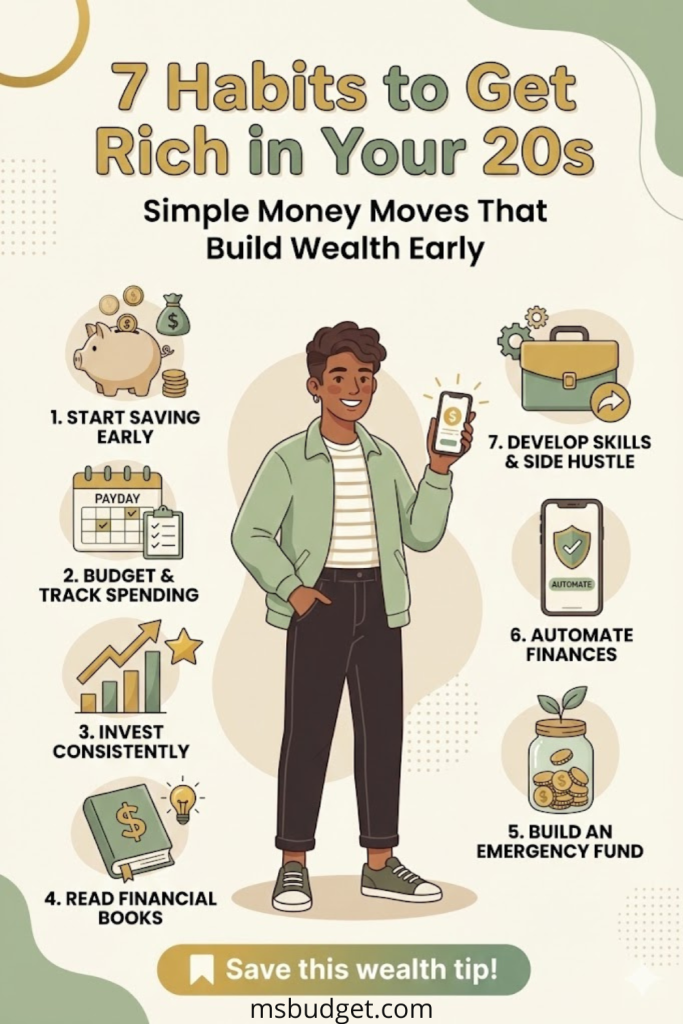


I’ll never forget the moment I realized most of my friends were living paycheck to paycheck while a few seemed to have it all figured out financially. What separated them? It wasn’t luck or a trust fund—it was their daily habits. The truth is, learning how to be rich in your 20s isn’t about making millions overnight. It’s about building the right financial foundation that compounds over time, turning small actions today into significant wealth tomorrow.
Your 20s are the most powerful decade for wealth creation, yet most young adults waste this golden opportunity. With compound interest on your side and decades ahead to grow your money, the habits you build now will determine your financial future. Let’s dive into the seven proven strategies that can transform your financial life.
Key Takeaways
- Start investing early with just $50-100 monthly to maximize compound growth over decades
- Build an emergency fund of $5,000-$10,000 as your #1 financial priority for security
- Invest 25% or more of your income for retirement to mirror millionaire wealth-building habits
- Create multiple income streams through side hustles to accelerate wealth accumulation
- Avoid common debt traps by adopting cautious borrowing habits and strategic repayment plans
Understanding How to Be Rich in Your 20s: The Foundation
Before we jump into specific strategies, let’s get real about what “rich” actually means in your 20s. It’s not about driving a Ferrari or living in a penthouse. Financial richness in your 20s means having options, security, and the freedom to make choices without money stress controlling your life.
Here’s the reality: only 44% of people aged 25-29 achieve complete financial independence, jumping to 67% by ages 30-34.[1] This shows that wealth-building is a gradual process, but those who start early have a massive advantage.
The wealth gap is real. Gen Z currently has average investments of $32,000 compared to Millennials at $173,000 and Gen X at $311,000.[2] But here’s the exciting part—you have time on your side. Every dollar you invest in your 20s has the potential to grow exponentially through the power of compound interest.
The Mindset Shift That Changes Everything
Building wealth in your 20s starts with a psychological transformation. You need to shift from a consumer mindset to an investor mindset. This means viewing money not as something to spend, but as a tool to create more money.
The psychological barriers to wealth building often include:
- Fear of missing out (FOMO) on experiences while friends spend freely
- Imposter syndrome around investing and financial planning
- Instant gratification bias that prioritizes today over tomorrow
- Scarcity mindset that prevents strategic risk-taking
Overcoming these mental blocks is just as important as the tactical strategies we’ll cover. Your relationship with money will determine your financial future more than your starting salary ever will.
Habit #1: Build Your Emergency Fund First
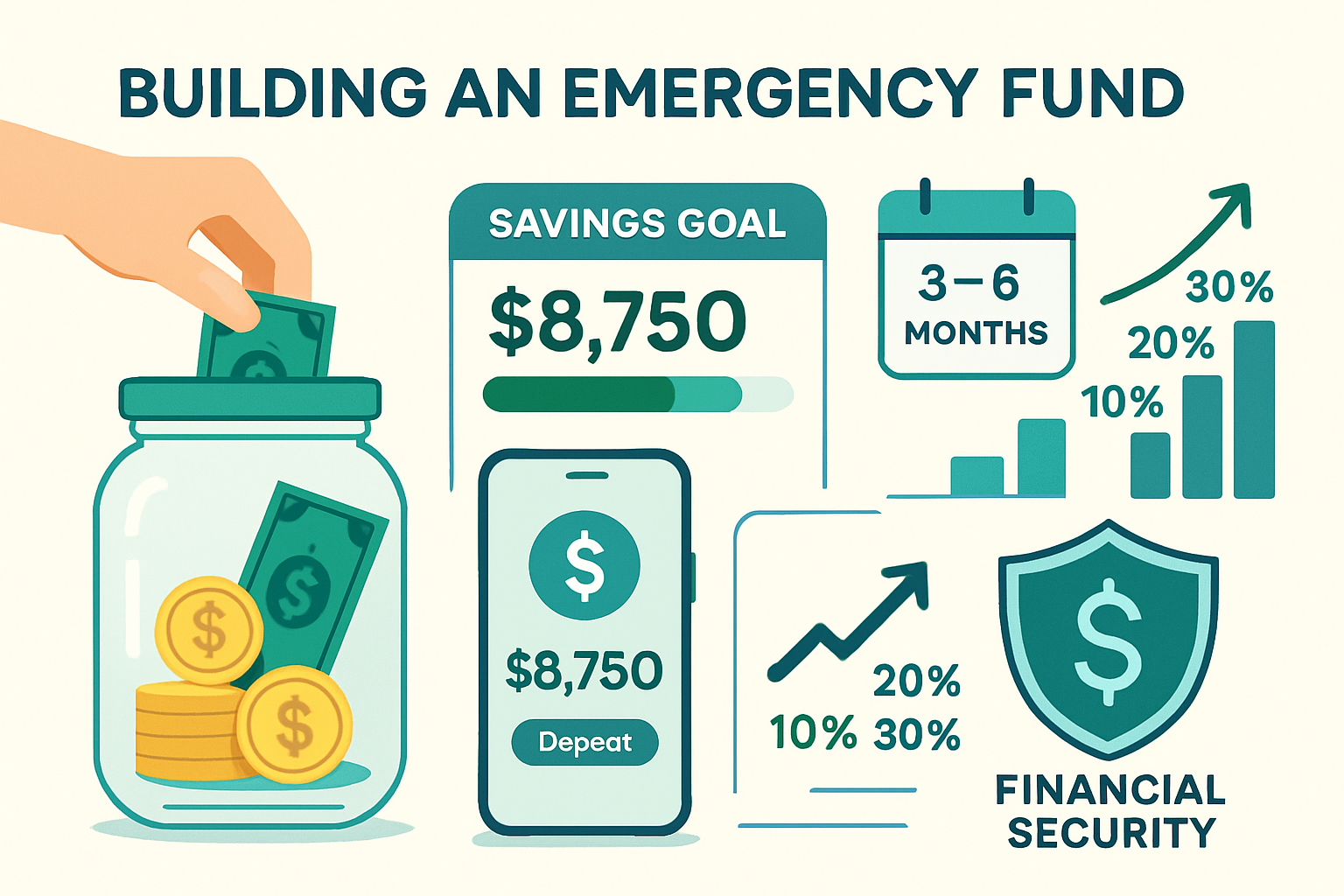
Let me be blunt: you cannot build real wealth without financial security. An emergency fund is your financial foundation, and it’s the #1 short-term financial priority for Gen Z, with 32% actively saving for one.[3]
Here’s why this matters: without an emergency fund, any unexpected expense—car repair, medical bill, or job loss—sends you spiraling into debt. That debt then sabotages your wealth-building efforts for years.
How Much Should You Save?
Target $5,000-$10,000 as your initial emergency fund goal. This typically covers 3-6 months of essential expenses for most young adults. If that sounds overwhelming, start with a mini-goal of $1,000, then build from there.
Quick-start emergency fund strategy:
- Calculate your monthly essentials: Rent, utilities, food, transportation, insurance
- Multiply by 3-6 months: This is your target number
- Automate weekly transfers: Set up automatic transfers of $50-100 per week
- Use a high-yield savings account: Keep it separate from your checking account
- Don’t touch it unless it’s a true emergency: No, a sale on sneakers doesn’t count
I recommend checking out this 30-day saving challenge to jumpstart your emergency fund with momentum and motivation.
Where to Keep Your Emergency Fund
Keep your emergency fund in a high-yield savings account that’s easily accessible but not too convenient. You want to earn interest (currently 4-5% APY at many online banks in 2025) while maintaining liquidity.
Mobile banking makes this easier than ever. With 66% of Gen Z using mobile apps as their primary banking method,[4] you can monitor and grow your emergency fund right from your smartphone.
Habit #2: Start Investing Immediately (Even with Small Amounts)
Here’s the secret wealthy people know: time in the market beats timing the market. Gen Z is already ahead of previous generations, with the average first investment happening at age 20.[5] But if you haven’t started yet, today is the day.
You don’t need thousands of dollars to begin. Starting with just $50-100 monthly can create substantial wealth over time thanks to compound interest—the eighth wonder of the world, as Einstein allegedly called it.
The Power of Compound Interest in Your 20s
Let me show you why starting in your 20s is so powerful:
| Starting Age | Monthly Investment | Total at Age 65 (7% return) |
|---|---|---|
| 25 | $100 | $264,012 |
| 30 | $100 | $180,105 |
| 35 | $100 | $121,997 |
| 40 | $100 | $81,007 |
Starting just five years earlier can mean an extra $84,000 in retirement savings with the same monthly contribution. That’s the power of compound growth working in your favor.
Where Should You Invest?
For beginners, I recommend a simple three-fund portfolio approach:
- 60% Total Stock Market Index Fund (like VTSAX or VTI)
- 30% International Stock Index Fund (like VTIAX or VXUS)
- 10% Bond Index Fund (like BND or VBTLX)
This provides diversification, low fees, and solid growth potential. As you learn more about investing in stocks for beginners with little money, you can adjust your asset allocation based on your risk tolerance.
Tax-Advantaged Accounts Are Your Best Friend
Maximize these accounts in order:
- 401(k) up to employer match: This is free money—never leave it on the table
- Roth IRA: Contribute up to $7,000 annually (2025 limit) with tax-free growth
- HSA (if eligible): Triple tax advantage for healthcare expenses
- Additional 401(k) contributions: Work toward that 25% savings rate millionaires use
Millionaires invest 25% or more of their income for retirement,[6] making this a core wealth-building habit regardless of income level. If you can’t hit 25% immediately, start with 10% and increase by 1% every six months.
Habit #3: Master the Art of Strategic Budgeting

Budgeting gets a bad rap because people think it’s about restriction. Wrong. Strategic budgeting is about intentional spending that aligns with your values and wealth-building goals.
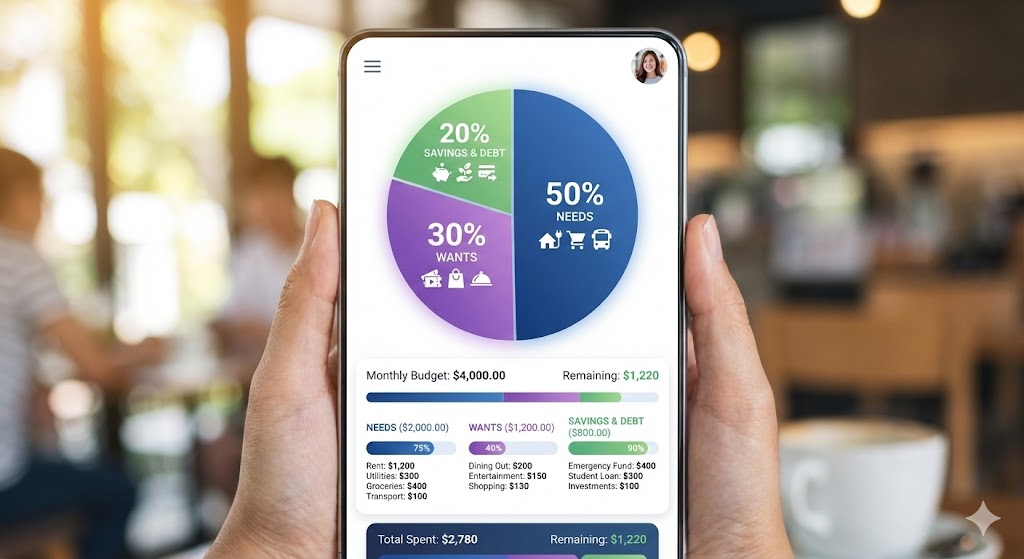
The most effective framework for young adults is the 50/30/20 rule: allocate 50% for needs, 30% for wants, and 20% for savings and debt repayment.[7] This provides structure while maintaining flexibility for your lifestyle.
Breaking Down the 50/30/20 Rule
50% Needs (Essential Expenses):
- Rent or mortgage
- Utilities and internet
- Groceries and basic food
- Transportation and car insurance
- Health insurance
- Minimum debt payments
30% Wants (Lifestyle Expenses):
- Dining out and entertainment
- Streaming services and subscriptions
- Hobbies and recreation
- Shopping and personal care
- Travel and vacations
20% Savings and Debt Payoff:
- Emergency fund contributions
- Retirement account investments
- Additional debt payments beyond minimums
- Short-term savings goals
I’ve written extensively about my experience with this approach in I Tried the 50/30/20 Budget Rule for 2 Months—Here’s What I Learned and Saved.
Technology Tools for Effortless Budgeting
In 2025, you have incredible technology at your fingertips. Here are the best budgeting apps for building wealth in your 20s:
- YNAB (You Need A Budget): Zero-based budgeting that gives every dollar a job
- Mint: Free automated tracking and categorization
- Personal Capital: Great for tracking investments alongside spending
- EveryDollar: Simple, user-friendly interface for beginners
- Simplifi by Quicken: Comprehensive financial planning with spending insights
The key is choosing one tool and sticking with it for at least three months. Consistency beats perfection when it comes to budgeting.
Common Budgeting Mistakes to Avoid
Even with the best intentions, young adults often make these budgeting errors:
❌ Setting unrealistic restrictions that lead to burnout
❌ Forgetting irregular expenses like car maintenance or annual subscriptions
❌ Not tracking small purchases that add up to hundreds monthly
❌ Failing to adjust the budget as income or circumstances change
❌ Treating the budget as punishment rather than a wealth-building tool
For a deeper dive into what to avoid, check out these 10 budgeting mistakes to avoid.
Habit #4: Eliminate and Avoid Toxic Debt
Here’s a hard truth: debt is the enemy of wealth building. While some debt (like a reasonable mortgage) can be strategic, most debt in your 20s is toxic—especially high-interest credit card debt and unnecessary student loans.
Gen Z is already showing wisdom here, with 49% using credit cards or loans only as a last resort and 21% wanting to avoid student loans entirely.[8] This cautious approach to borrowing is smart.
The Debt Payoff Hierarchy
Not all debt is created equal. Here’s how to prioritize your debt payoff:
- Payday loans and title loans (eliminate immediately—these are predatory)
- Credit card debt (typically 15-25% APR)
- Personal loans (usually 8-15% APR)
- Student loans (4-7% APR typically)
- Car loans (3-6% APR)
- Mortgage (lowest priority if rate is below 6%)
Use either the debt avalanche method (highest interest first) or debt snowball method (smallest balance first) to systematically eliminate debt. For detailed strategies, explore these 7 proven ways to pay down debt faster.
How to Stay Debt-Free for Life
Once you’ve eliminated debt, staying debt-free requires intentional habits:
- Live below your means: Spend less than you earn, always
- Use credit cards strategically: Pay off the full balance monthly to build credit without paying interest
- Build that emergency fund: This prevents debt during unexpected expenses
- Delay gratification: Save up for purchases instead of financing them
- Question every purchase: Ask “Do I need this, or do I want this?”
The habits you build now will serve you for decades. Learn more about 10 simple habits that help you stay debt-free for life.
Protecting Your Credit Score
Your credit score is a critical wealth-building tool that affects your ability to get favorable interest rates on mortgages, car loans, and even rental applications. Here’s how to build and protect it:
Key credit score factors:
- Payment history (35%): Never miss a payment—set up autopay
- Credit utilization (30%): Keep balances below 30% of your credit limit
- Length of credit history (15%): Keep old accounts open
- Credit mix (10%): Have a mix of credit types (cards, loans)
- New credit (10%): Avoid opening too many accounts quickly
Be aware of 7 surprising things that hurt your credit score and take action to raise your credit score fast if needed.
Habit #5: Create Multiple Income Streams
Here’s a statistic that should wake you up: 83% of Americans believe multiple income streams are essential for financial security.[9] The wealthy understand this instinctively—they don’t rely on a single paycheck.
Gen Z is already ahead of the curve, with 31% using side hustles that earn approximately $500 monthly.[10] That’s an extra $6,000 per year that can be invested, accelerating your wealth-building journey significantly.
Side Hustle Ideas for Your 20s
The best side hustles leverage your existing skills or interests:
Digital/Online Opportunities:
- Freelance writing, graphic design, or web development
- Social media management for small businesses
- Online tutoring or course creation
- Affiliate marketing and content creation
- Virtual assistant services
- E-commerce and dropshipping
In-Person Opportunities:
- Photography or videography services
- Personal training or fitness coaching
- Pet sitting or dog walking
- House cleaning or organization services
- Event planning or catering
For comprehensive ideas, check out 25 realistic ideas for making money from home.
Building Passive Income in Your 20s
While side hustles require active work, passive income generates money with minimal ongoing effort. Starting these in your 20s gives them time to compound:
Passive income strategies:
- Dividend-paying stocks: Invest in companies that pay regular dividends
- Real estate crowdfunding: Platforms like Fundrise or RealtyMogul require minimal capital
- Create digital products: E-books, templates, courses, or stock photography
- Peer-to-peer lending: Lend money through platforms for interest income
- Automated online businesses: Build once, earn repeatedly
Explore 15 passive income ideas that work in 2026 for more detailed strategies.
The Career Growth Factor
Don’t overlook your primary income source. Investing in your career growth—through skills development, networking, and strategic job moves—often provides the highest return on investment.
Career wealth-building strategies:
- Negotiate aggressively: Research market rates and ask for what you’re worth
- Switch jobs strategically: Job hoppers in their 20s earn 10-20% more than those who stay put
- Invest in skills: Certifications, courses, and degrees that increase earning potential
- Network intentionally: Build relationships that open doors to opportunities
- Document achievements: Track your wins to justify raises and promotions
Your earning potential in your 20s sets the trajectory for your entire career. A $10,000 salary increase now, invested properly, could mean hundreds of thousands in additional wealth by retirement.
Habit #6: Plan for Retirement (Yes, Already)
I know what you’re thinking: “Retirement? I’m in my 20s!” But here’s the reality—retirement planning in your 20s is the ultimate wealth-building hack. By age 30, the most prepared individuals have retirement savings equivalent to their annual salary, with median retirement savings for under-35s around $13,000.[11]
That might sound low, but remember—you’re not trying to be median. You’re trying to be exceptional.
The Retirement Savings Benchmark
Here’s what you should aim for by age:
| Age | Retirement Savings Goal |
|---|---|
| 25 | 0.5x annual salary |
| 30 | 1x annual salary |
| 35 | 2x annual salary |
| 40 | 3x annual salary |
If you’re earning $50,000 at age 25, you should target $25,000 in retirement savings. At age 30 earning $60,000, you should have $60,000 saved.
Retirement Account Strategy for Your 20s
Step 1: Max out employer 401(k) match
This is the easiest money you’ll ever make—typically a 50-100% instant return on your contribution.
Step 2: Max out Roth IRA
Contribute the full $7,000 annually (2025 limit). Roth IRAs grow tax-free, meaning you’ll never pay taxes on the gains—a massive advantage over decades.
Step 3: Return to 401(k)
After maxing your Roth IRA, increase 401(k) contributions toward that 25% total savings rate.
Step 4: Consider a taxable brokerage account
Once you’ve maxed tax-advantaged accounts, invest additional funds in a regular brokerage account for flexibility.
The Real Estate Factor
Real estate ownership is considered important for long-term wealth by 80% of Americans, with 45% of Gen Z planning to buy homes by 2028.[12] While homeownership isn’t right for everyone in their 20s, it’s worth considering as part of your long-term wealth strategy.
Home buying considerations:
- Location stability: Only buy if you plan to stay 5+ years
- 20% down payment: Avoid PMI and secure better rates
- Total housing costs under 28%: Don’t become house poor
- Emergency fund intact: Keep 6 months expenses after purchase
- Market conditions: Buy when it makes financial sense, not emotional sense
Real estate can build wealth through appreciation, equity building, and potential rental income, but it also comes with costs, risks, and reduced flexibility.
Habit #7: Invest in Financial Education and Mindset
The final habit that separates the wealthy from the struggling is continuous financial education. The financial landscape changes constantly—tax laws, investment vehicles, economic conditions—and staying informed gives you a competitive advantage.
Building Financial Literacy
Financial literacy isn’t taught in most schools, so you need to self-educate:
Essential financial knowledge areas:
- Personal finance fundamentals: Budgeting, saving, debt management
- Investment principles: Asset allocation, diversification, risk management
- Tax optimization: Legal strategies to minimize tax burden
- Insurance and risk management: Protecting your wealth
- Estate planning basics: Even in your 20s, understanding beneficiaries matters
Best resources for financial education:
- Books: “The Simple Path to Wealth” by JL Collins, “I Will Teach You to Be Rich” by Ramit Sethi
- Podcasts: “ChooseFI,” “The Money Guy Show,” “BiggerPockets Money”
- YouTube channels: Graham Stephan, Andrei Jikh, The Financial Diet
- Blogs and websites: MSBudget, Mr. Money Mustache, Financial Samurai
- Online courses: Coursera, Udemy, and Khan Academy offer free finance courses
The Psychology of Wealth Building
Understanding the psychological aspects of money is just as important as the technical knowledge:
Mental health and financial wellness connection:
- Money stress impacts mental health: Financial anxiety can lead to depression, relationship problems, and poor decision-making
- Mindfulness in spending: Being present and intentional with purchases reduces regret
- Delayed gratification practice: Building this skill improves all areas of life
- Abundance mindset: Believing there’s enough to go around opens opportunities
- Self-worth separation: Your net worth doesn’t define your self-worth
The relationship between mental health and financial wellness is bidirectional—improving one often improves the other. Prioritize both for holistic success.
Sustainable and Ethical Wealth Building
Modern wealth building increasingly considers environmental, social, and governance (ESG) factors:
Sustainable investing approaches:
- ESG funds: Invest in companies with strong environmental and social practices
- Impact investing: Direct capital toward businesses solving social problems
- Shareholder activism: Use your investor voice to influence corporate behavior
- Conscious consumption: Spend money with companies aligned with your values
- Community investment: Support local businesses and community development
You can build wealth while contributing to a better world—these goals aren’t mutually exclusive.
Common Mistakes That Derail Wealth Building in Your 20s
Even with the best intentions, young adults often make these critical errors:
Lifestyle Inflation
As your income increases, your spending shouldn’t increase proportionally. Lifestyle inflation is the silent wealth killer. When you get a raise, invest the difference instead of upgrading your lifestyle.
Comparing Yourself to Others
Social media creates a distorted view of others’ financial situations. Remember: people share their highlights, not their credit card statements. Focus on your own financial journey and goals.
Waiting for the “Perfect Time”
There’s never a perfect time to start investing or saving. The best time was yesterday; the second-best time is today. Imperfect action beats perfect inaction every time.
Ignoring Small Expenses
The $5 daily coffee seems insignificant, but it’s $1,825 annually—money that could be invested. Small leaks sink big ships. Track and question your recurring small expenses.
Not Automating
Relying on willpower to save and invest is a recipe for failure. Automate everything: savings transfers, investment contributions, bill payments. Make wealth-building the default, not the exception.
Neglecting Insurance
Health insurance, renters/homeowners insurance, and eventually life insurance protect your wealth from catastrophic loss. Don’t skip this critical risk management step.
Taking Action: Your 90-Day Wealth-Building Plan
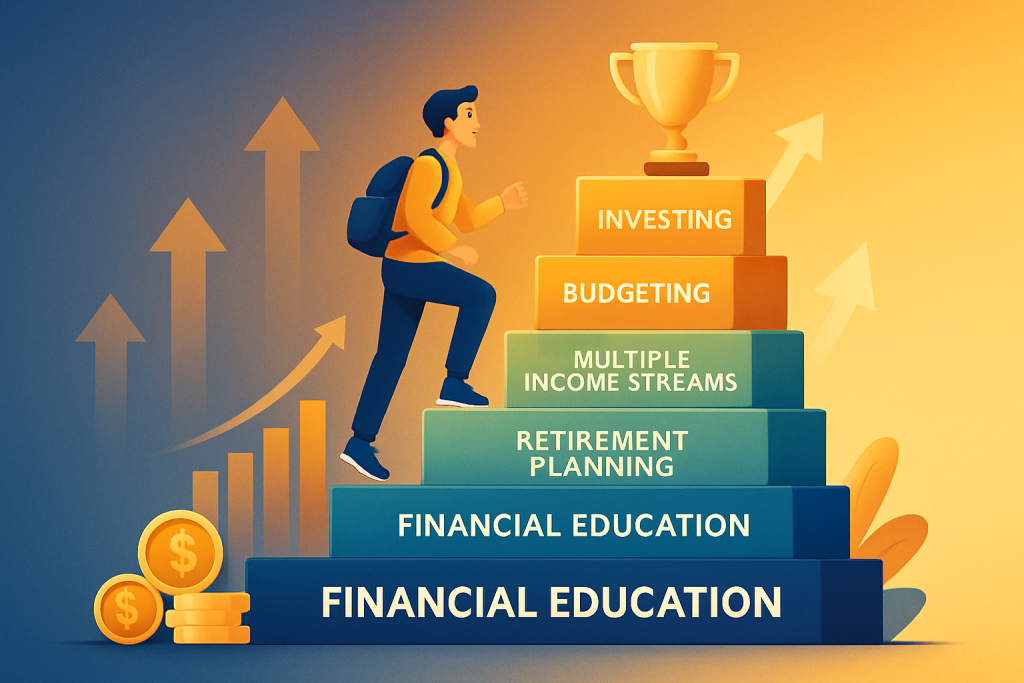
Knowledge without action is useless. Here’s your roadmap to implement these habits over the next 90 days:
Month 1: Foundation Building
- Week 1: Calculate net worth, track all expenses, identify financial goals
- Week 2: Open high-yield savings account, set up emergency fund automation
- Week 3: Review and optimize current spending, implement 50/30/20 budget
- Week 4: Research and open retirement accounts (Roth IRA, 401(k))
Month 2: Acceleration
- Week 5: Make first investment contribution, set up automatic investing
- Week 6: Create debt payoff plan if applicable, negotiate one bill or subscription
- Week 7: Research side hustle opportunities, identify skills to monetize
- Week 8: Launch first income stream or apply for higher-paying positions
Month 3: Optimization
- Week 9: Review and adjust budget based on two months of data
- Week 10: Increase investment contributions by 1-2%, automate raises to savings
- Week 11: Build financial education routine (one book, podcast, or course)
- Week 12: Review progress, celebrate wins, set next quarter goals
For additional motivation and structure, try these 7 genius savings strategy hacks that helped me save $3,000 in 90 days.
Conclusion: Your Wealthy Future Starts Today
Learning how to be rich in your 20s isn’t about quick schemes or lucky breaks—it’s about building powerful daily habits that compound over time. The seven habits we’ve covered—emergency fund building, early investing, strategic budgeting, debt elimination, multiple income streams, retirement planning, and continuous education—form the foundation of lasting wealth.
The gap between those who achieve financial independence and those who struggle isn’t talent, luck, or starting capital. It’s the consistent application of these proven principles over years and decades.
You have something priceless that older generations would pay millions for: time. Every day you delay implementing these habits is a day of compound growth lost forever. But every day you take action, you’re building a wealthier, more secure future.
Your next steps:
- Choose ONE habit to implement this week (I recommend starting with emergency fund automation)
- Set up one automated system today (savings transfer, investment contribution, or bill payment)
- Commit to tracking your spending for 30 days to build awareness
- Share your financial goals with an accountability partner
- Schedule a monthly “money date” with yourself to review progress
The wealthy life you envision isn’t built in a day, but it is built daily. Start now, stay consistent, and watch your financial future transform.
Remember: you don’t need to be perfect. You just need to start. Your 30-year-old self will thank you for the decisions you make today.