

Let me be honest with you: I was skeptical when I first heard people claiming they could make real money from home without spending a dime upfront. It sounded too good to be true, like one of those “get rich quick” schemes that flood your inbox. But after years of exploring the gig economy, talking to successful side hustlers, and testing various ideas to make money myself, I’ve discovered something incredible—there are genuinely legitimate ways to generate income from your living room without emptying your wallet first.
The landscape of work has transformed dramatically in 2025. Remote work options have exploded, digital platforms have democratized entrepreneurship, and the barrier to entry for starting a side hustle has never been lower. Whether you’re looking to supplement your current income, transition to full-time self-employment, or simply explore your entrepreneurial spirit, these ideas to make money from home require nothing more than your time, skills, and determination.
Key Takeaways
- Zero investment required: All 25 ideas can be started with resources you already have—a computer, internet connection, and your existing skills
- Flexible income potential: Earnings range from $100/month for casual side gigs to $5,000+ monthly for dedicated freelance businesses
- Skill monetization is key: Your current knowledge and abilities are more valuable than you think—the challenge is packaging and marketing them effectively
- Multiple income streams: The most successful home-based earners combine 2-3 complementary ideas rather than relying on a single source
- Time investment varies: Some opportunities offer quick wins within days, while others require 3-6 months to build sustainable income
Understanding the Modern Home-Based Income Landscape
Before we dive into specific ideas to make money, let’s talk about what’s changed in the work-from-home ecosystem. The gig economy has matured beyond simple task-based work into sophisticated marketplaces where professionals command premium rates. Digital nomad culture has normalized remote income generation, and companies have embraced flexible work arrangements like never before.
The 2025 reality: According to recent labor statistics, over 58 million Americans engaged in freelance work in 2024, contributing approximately $1.27 trillion to the economy[1]. This isn’t a fringe movement—it’s mainstream entrepreneurship.
What makes these opportunities truly accessible is that most require zero financial investment. You won’t need to:
- Purchase inventory
- Rent office space
- Buy expensive equipment
- Pay for certifications (initially)
- Invest in advertising
Your primary investment? Time and effort. And unlike financial capital, everyone starts with the same 24 hours each day.
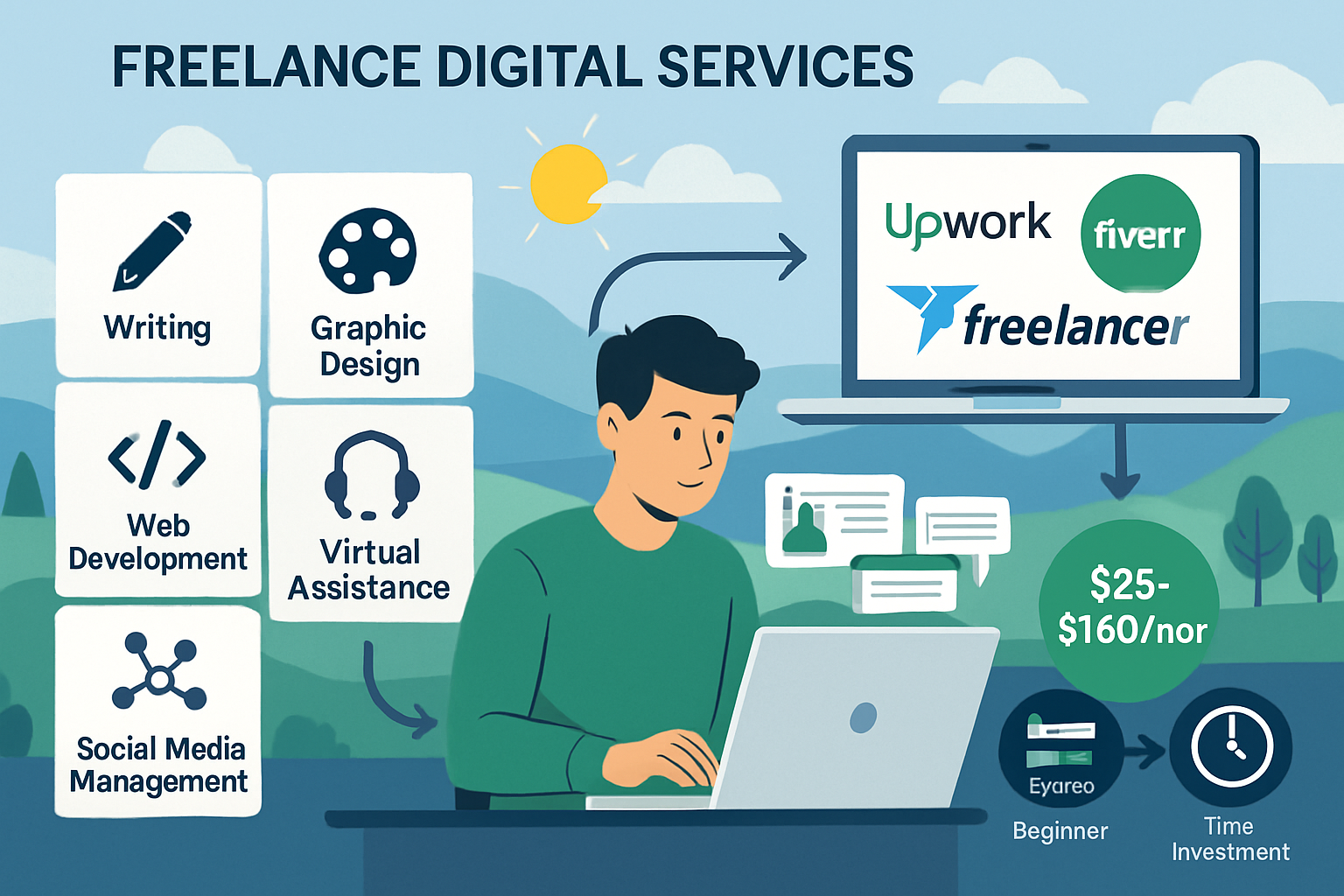
Category 1: Freelance Digital Services (Skills You Already Have)
1. Freelance Writing and Content Creation 📝
If you can write a coherent email, you can start freelance writing. Seriously. The content marketing industry is desperate for writers who can produce clear, engaging material.
What you’ll do: Create blog posts, articles, website copy, product descriptions, email newsletters, or social media content for businesses.
Getting started:
- Sign up for platforms like Upwork, Fiverr, or Contently (all free)
- Create a simple portfolio using Medium or a free WordPress site
- Start with lower rates ($0.03-0.05 per word) to build reviews
- Specialize in topics you know well (your day job industry, hobbies, etc.)
Earning potential: $25-150 per article initially, scaling to $200-500+ as you build expertise and client relationships. Full-time freelance writers often earn $3,000-6,000 monthly.
Time to first dollar: 1-2 weeks
Pro tip: Don’t claim to write about “anything.” Specialists in niches like SaaS, healthcare, or finance command 2-3x higher rates than generalists.
2. Virtual Assistant Services 💼
Virtual assistants handle administrative tasks remotely—email management, calendar scheduling, data entry, customer service, and basic research. It’s one of the most accessible ideas to make money because it requires skills you’ve likely developed in any office job.
What you’ll do: Support busy entrepreneurs, executives, or small businesses with routine tasks that free up their time for high-value work.
Getting started:
- List your services on Belay, Time Etc, or Fancy Hands
- Join Facebook groups like “Virtual Assistant Savvies” to find clients
- Offer a trial period (3-5 hours) at a discounted rate
- Focus on specific industries where you have experience
Earning potential: $15-40 per hour, depending on specialization. Executive assistants with specialized skills (CRM management, bookkeeping basics) can charge $50-75/hour.
Time to first dollar: 1-3 weeks
Reality check: You’ll start with basic tasks. As you prove reliability, clients will trust you with more complex (and better-paying) work.
3. Social Media Management 📱
Every business knows they need a social media presence. Few have the time or expertise to do it well. If you’re already scrolling Instagram and TikTok daily, you possess more platform knowledge than most business owners.
What you’ll do: Create content calendars, write posts, engage with followers, analyze metrics, and grow social media accounts for brands.
Getting started:
- Offer to manage social media for a local business for free (1 month) to build a case study
- Create your own business account to demonstrate your skills
- Use free tools like Canva for graphics and Buffer’s free plan for scheduling
- Target small local businesses that are underserving their social presence
Earning potential: $300-1,500 per client monthly for basic management (3-5 posts per week). Manage 3-5 clients and you’re looking at $1,500-5,000 monthly income.
Time to first dollar: 2-4 weeks
Skill stacking opportunity: Combine this with basic graphic design (learned free on YouTube) to increase your value proposition.
4. Graphic Design and Canva Templates 🎨
You don’t need to be a Photoshop wizard. With free tools like Canva, GIMP, and Figma, you can create professional designs that businesses will pay for.
What you’ll do: Design social media graphics, logos, presentations, infographics, or create templates that others can customize.
Getting started:
- Master Canva through their free tutorials (2-3 hours)
- Create 10-15 sample designs in your chosen niche
- List services on Fiverr or 99designs
- Sell templates on Creative Market or Etsy (digital products, no inventory)
Earning potential: $25-200 per design project. Template creators can earn passive income of $200-2,000 monthly once they build a library.
Time to first dollar: 1-2 weeks for services, 4-8 weeks for template passive income
Differentiation strategy: Specialize in one industry (real estate, fitness, coaches) rather than being a generalist.
5. Website Testing and User Experience Feedback 🖥️
Companies pay real people to test their websites and apps, providing feedback on usability, clarity, and user experience. It’s one of the easiest ideas to make money with literally zero barrier to entry.
What you’ll do: Navigate websites while speaking your thoughts aloud, complete specific tasks, and answer questions about your experience.
Getting started:
- Sign up for UserTesting, TryMyUI, Userlytics, and Validately (all free)
- Complete qualification tests to access more opportunities
- Ensure you have a working microphone
- Set aside specific times to check for available tests
Earning potential: $10-60 per test (most are $10 for 20 minutes). Active testers complete 5-15 tests monthly for $50-300 in extra income.
Time to first dollar: 1-7 days
Limitation: This won’t replace a full-time income, but it’s genuine money for minimal effort and requires zero specialized skills.
6. Transcription Services ⌨️
If you can type reasonably fast (40+ words per minute) and have good attention to detail, transcription offers steady work-from-home income.
What you’ll do: Listen to audio recordings and type out exactly what’s being said—for podcasts, videos, meetings, interviews, or legal proceedings.
Getting started:
- Sign up for Rev, TranscribeMe, or GoTranscript (free registration)
- Take their qualification tests (practice first!)
- Start with general transcription before specializing in medical or legal (which pay more but require training)
- Use free tools like Express Scribe to control audio playback
Earning potential: $15-25 per audio hour for general transcription (which takes 3-4 hours to transcribe). Experienced transcriptionists earn $1,000-2,000 monthly part-time.
Time to first dollar: 1-2 weeks
Efficiency tip: Your earning power directly correlates with typing speed. Free typing courses can increase your income by 30-50%.
7. Online Tutoring and Teaching 👨🏫
Your knowledge is valuable. Whether it’s academic subjects, professional skills, or even hobbies, people will pay to learn from you.
What you’ll do: Teach students via video call—anything from elementary math to college-level subjects, test prep, English as a second language, or professional skills like Excel or coding.
Getting started:
- For academic tutoring: Tutor.com, Chegg Tutors, or Wyzant (free to join)
- For English teaching: VIPKid, Cambly, or iTalki
- For professional skills: Create a profile on Skillshare or offer 1-on-1 coaching
- Set your own rates based on subject complexity and your credentials
Earning potential: $15-60 per hour depending on subject and credentials. ESL tutors average $14-22/hour, while specialized subjects (SAT prep, college admissions, coding) command $40-100/hour.
Time to first dollar: 1-3 weeks
Credential boost: You don’t always need formal teaching certification, but relevant degrees or professional experience significantly increase your rates. For those looking to build long-term income, consider how developing good financial habits can help you manage irregular tutoring income.
Category 2: Creative and Content-Based Income Streams
8. Start a YouTube Channel 📹
YouTube isn’t just for influencers. Niche channels with modest followings generate meaningful income through ads, sponsorships, and affiliate marketing.
What you’ll do: Create videos about topics you’re knowledgeable or passionate about—tutorials, reviews, commentary, education, or entertainment.
Getting started:
- Use your smartphone camera (quality is sufficient for most niches)
- Edit with free software like DaVinci Resolve or iMovie
- Focus on searchable topics (how-to content, product reviews, tutorials)
- Post consistently (weekly minimum) for 3-6 months before expecting significant growth
Earning potential: $0 initially, then $100-500 monthly once you hit monetization requirements (1,000 subscribers, 4,000 watch hours). Successful niche channels earn $1,000-10,000+ monthly.
Time to first dollar: 3-6 months (this is a longer-term play)
Strategic approach: Don’t compete with entertainment channels. Focus on educational or problem-solving content in underserved niches where viewers actively search for solutions.
9. Podcast Production and Editing 🎙️
Podcasting has exploded, but most podcasters hate editing. If you can learn basic audio editing (2-3 hours of YouTube tutorials), you’ve got a marketable skill.
What you’ll do: Edit raw podcast recordings—removing mistakes, adding intro/outro music, balancing audio levels, and exporting final files.
Getting started:
- Learn Audacity (free) or GarageBand basics
- Offer free editing for one podcast episode to build a portfolio
- List services on Fiverr, Upwork, or podcast-specific job boards
- Join podcasting Facebook groups where hosts seek editors
Earning potential: $25-100 per episode depending on length and complexity. Edit 10-20 episodes monthly for $500-1,500 income.
Time to first dollar: 2-3 weeks
Efficiency multiplier: As you get faster, your effective hourly rate increases dramatically. Experienced editors complete a 1-hour episode in 2-3 hours.
10. Stock Photography and Video 📸
If you have a smartphone with a decent camera, you can sell stock photos and videos. No professional equipment required.
What you’ll do: Upload photos and videos to stock platforms where businesses, marketers, and creators purchase licenses to use them.
Getting started:
- Sign up for Shutterstock, Adobe Stock, Pexels, or Unsplash (contributor programs are free)
- Study what’s selling (business concepts, diverse people, technology, lifestyle)
- Focus on quality over quantity—10 great images beat 100 mediocre ones
- Include detailed, searchable keywords with each upload
Earning potential: $0.25-10 per download. Passive income builds slowly—expect $50-200 monthly after uploading 200-500 quality images over 6-12 months.
Time to first dollar: 2-8 weeks
Long-term strategy: This is passive income that compounds. Your library works for you 24/7 once uploaded.
11. Blogging with Affiliate Marketing 💻
Blogging isn’t dead—it’s evolved. Strategic blogs that solve specific problems can generate substantial affiliate income without selling your own products.
What you’ll do: Create a blog focused on a specific niche, write helpful content, and recommend products through affiliate links (you earn commissions when readers purchase).
Getting started:
- Start a free WordPress.com or Medium blog
- Choose a focused niche you know well (not “lifestyle”—too broad)
- Write comprehensive, helpful content targeting specific questions
- Join affiliate programs like Amazon Associates, ShareASale, or CJ Affiliate (all free)
- Focus on product reviews, comparisons, and tutorials
Earning potential: $0 for 3-6 months, then $100-500 monthly as traffic builds. Successful niche blogs earn $1,000-10,000+ monthly.
Time to first dollar: 3-6 months (requires patience)
SEO reality: Success requires learning basic SEO (free resources abundant). Target low-competition keywords and create genuinely helpful content.
12. Digital Product Creation 📦
Create once, sell forever. Digital products require upfront work but generate passive income indefinitely.
What you’ll do: Create and sell templates, worksheets, planners, guides, checklists, or educational resources.
Getting started:
- Identify a problem you’ve solved in your life or work
- Create a simple solution (Excel template, PDF guide, Notion template)
- Sell on Etsy, Gumroad, or your own simple website
- Use Canva for professional-looking design (free)
Earning potential: $0-50 monthly per product initially. Creators with 10-20 products earning $5-50 each monthly generate $500-2,000 in passive income.
Time to first dollar: 2-6 weeks
Validation tip: Before creating, search Etsy or Google to confirm people are already buying similar products. Don’t create in a vacuum.
Category 3: Service-Based Ideas to Make Money
13. Pet Sitting and Dog Walking 🐕
Love animals? Turn that affection into income. Pet owners need reliable care, especially during work hours and vacations.
What you’ll do: Watch pets in their homes or yours, take dogs for walks, administer medications, or provide overnight care.
Getting started:
- Create free profiles on Rover, Wag, or Care.com
- Start with lower rates to build reviews (critical for trust)
- Get friends/family to write testimonials
- Consider pet first aid certification (often free online)
Earning potential: $15-40 per walk, $25-75 per day for sitting. Active sitters earn $500-2,000 monthly part-time.
Time to first dollar: 1-2 weeks
Trust factor: This business runs on reviews. Provide exceptional service to your first 5-10 clients to build a reputation that attracts premium clients.
14. House Sitting and Property Management 🏠
Homeowners traveling for extended periods need someone to maintain their property, collect mail, water plants, and provide security.
What you’ll do: Stay in someone’s home while they’re away, maintaining the property and sometimes caring for pets.
Getting started:
- Join TrustedHousesitters or MindMyHouse (some charge small fees, but many gigs are free to apply)
- Create a detailed profile highlighting responsibility and reliability
- Start locally, then expand to destination house-sitting (free accommodation while traveling!)
- Ask for references from employers, landlords, or colleagues
Earning potential: $25-75 daily, or free luxury accommodation in exchange for services. Some sitters save $1,000-2,000 monthly on rent.
Time to first dollar: 2-4 weeks
Lifestyle benefit: Beyond income, this offers free housing and the ability to live in different locations.
15. Personal Shopping and Errand Services 🛒
Busy professionals, elderly individuals, and people with mobility challenges need help with shopping and errands.
What you’ll do: Grocery shopping, prescription pickup, dry cleaning, post office runs, or general errand completion.
Getting started:
- Sign up for Instacart, Shipt, or TaskRabbit (free registration)
- Offer services to neighbors and local community groups
- Create a simple flyer for local bulletin boards
- Focus on reliability and communication
Earning potential: $15-30 per hour plus tips. Active shoppers earn $500-1,500 monthly part-time.
Time to first dollar: Less than 1 week
Efficiency tip: Batch errands in the same area to maximize your hourly rate. Learn store layouts to shop faster.
16. House Cleaning Services 🧹
Cleaning is always in demand, requires no special skills, and has low startup costs (most clients provide supplies).
What you’ll do: Clean homes on a regular or one-time basis—vacuuming, dusting, bathroom and kitchen cleaning, organization.
Getting started:
- Offer services to friends, family, and neighbors at a discount initially
- Create a simple pricing structure (per hour or per job)
- List on Care.com, Handy, or local Facebook groups
- Bring basic supplies (many clients provide theirs)
Earning potential: $25-50 per hour. Clean 3-4 homes weekly for $1,200-2,400 monthly.
Time to first dollar: 1 week
Business growth: Start solo, then hire helpers as you gain more clients than you can handle personally, transitioning from service provider to business owner.
17. Lawn Care and Yard Work 🌱
If you have access to basic tools (or can borrow them), lawn care offers immediate income, especially in suburban areas.
What you’ll do: Mowing, edging, weeding, leaf removal, basic landscaping, or seasonal cleanup.
Getting started:
- Offer services in your neighborhood (door-to-door or flyers)
- Post on Nextdoor and local Facebook groups
- Price competitively initially to build a client base
- Focus on reliability—show up when you say you will
Earning potential: $30-60 per lawn. Service 10-15 lawns weekly for $1,200-3,600 monthly during growing season.
Time to first dollar: Less than 1 week
Seasonal consideration: In most climates, this is seasonal work (spring through fall). Pair with snow removal in winter for year-round income.
18. Handyman Services 🔧
Basic repair skills are incredibly valuable. You don’t need to be a licensed contractor—simple fixes like furniture assembly, picture hanging, or minor repairs are in high demand.
What you’ll do: Furniture assembly, TV mounting, shelf installation, basic repairs, or general odd jobs.
Getting started:
- List services on TaskRabbit, Handy, or Thumbtack
- Start with tasks you’re confident completing
- Watch YouTube tutorials to expand your skill set
- Bring basic tools (screwdriver set, drill, level, tape measure)
Earning potential: $30-75 per hour depending on task complexity. Complete 10-15 jobs monthly for $1,200-3,000.
Time to first dollar: 1-2 weeks
Liability note: Stick to simple tasks initially. Complex electrical or plumbing work may require licensing in your area.
19. Personal Fitness Training and Coaching 💪
If you’re passionate about fitness, you can coach others without expensive certifications (though they help). Start with basic accountability coaching and nutritional guidance.
What you’ll do: Create workout plans, provide accountability, offer nutritional guidance, or conduct virtual training sessions.
Getting started:
- Offer free coaching to 2-3 people to develop your system and get testimonials
- Use free video platforms (Zoom, Google Meet) for virtual sessions
- Share transformation stories (with permission) on social media
- Join fitness coaching communities to learn best practices
Earning potential: $30-100 per client monthly for accountability coaching, $50-150 per session for personal training. 10-15 clients generates $500-2,000 monthly.
Time to first dollar: 2-4 weeks
Credential path: Start without certification, then invest in NASM or ACE certification once you’re earning (costs $400-700 but significantly increases credibility and rates).
20. Language Tutoring and Conversation Practice 🗣️
If you speak multiple languages, you can teach your native language to learners worldwide via video chat.
What you’ll do: Conduct conversation practice, teach grammar and vocabulary, or help students prepare for language exams.
Getting started:
- Create a profile on italki, Preply, or Verbling (free)
- Set competitive introductory rates ($8-15/hour)
- Offer a discounted trial lesson to attract first students
- Focus on conversation practice (less prep needed than structured lessons)
Earning potential: $10-40 per hour depending on language and your teaching approach. Teach 10-20 hours weekly for $400-3,200 monthly.
Time to first dollar: 1-3 weeks
Language advantage: Native English speakers have highest demand, but any language has learners seeking practice.
Category 4: Online Opportunities and Digital Entrepreneurship
21. Affiliate Marketing Without a Blog 🔗
You don’t need a blog to succeed with affiliate marketing. Social media, YouTube, email, and online communities offer alternative platforms.
What you’ll do: Recommend products you genuinely use and earn commissions when people purchase through your unique affiliate links.
Getting started:
- Join affiliate programs (Amazon Associates, ShareASale, ClickBank—all free)
- Share recommendations on Pinterest, Instagram, TikTok, or YouTube
- Create helpful content (reviews, tutorials, comparisons) rather than pushy sales
- Disclose affiliate relationships (legally required and builds trust)
Earning potential: $0-100 monthly initially, scaling to $500-5,000+ as your audience grows over 6-12 months.
Time to first dollar: 1-3 months
Platform strategy: Pinterest and YouTube work best for affiliate marketing without a blog because content has longer lifespan than Instagram or TikTok posts. Understanding strategic savings approaches can help you reinvest early affiliate earnings into growing your platform.
22. Online Surveys and Market Research 📊
Not a primary income source, but legitimate sites pay for your opinions. Perfect for earning while watching TV or during downtime.
What you’ll do: Complete surveys, participate in focus groups, test products, or provide feedback on advertisements.
Getting started:
- Sign up for multiple legitimate sites: Swagbucks, Survey Junkie, Prolific, UserInterviews
- Complete profile surveys thoroughly (unlocks higher-paying opportunities)
- Check daily for available surveys
- Focus on sites with good payout-to-time ratios
Earning potential: $50-300 monthly with consistent participation across multiple platforms.
Time to first dollar: 1-3 days
Reality check: This won’t replace income, but it’s genuinely free money for minimal mental effort. Treat it as bonus income, not a business.
23. Sell Your Expertise Through Digital Coaching 🎯
Package your professional or life experience into coaching services. People pay for guidance, accountability, and expertise in areas where they’re struggling.
What you’ll do: Offer one-on-one or group coaching in your area of expertise—career development, life coaching, business strategy, parenting, organization, etc.
Getting started:
- Identify a specific problem you’ve solved that others struggle with
- Offer 3-5 free coaching sessions to develop your methodology and get testimonials
- Use free scheduling tools (Calendly) and video platforms (Zoom)
- Share valuable content on social media to demonstrate expertise
Earning potential: $50-300 per session, or $200-1,000 monthly for group coaching programs. 5-10 clients generates $1,000-3,000 monthly.
Time to first dollar: 3-6 weeks
Positioning tip: “Life coach” is oversaturated. Niche down: “career transition coach for teachers,” “productivity coach for creative entrepreneurs,” or “financial coach for young families.”
24. Voiceover Work 🎤
If you have a clear speaking voice and decent microphone (even smartphone quality works initially), voiceover work offers flexible income.
What you’ll do: Record voiceovers for videos, audiobooks, commercials, e-learning courses, or phone systems.
Getting started:
- Create profiles on Voices.com, Voice123, or ACX (audiobook platform)
- Record samples in different styles (commercial, narration, character)
- Use a quiet room with soft furnishings (reduces echo)
- Practice reading scripts smoothly and with appropriate emotion
Earning potential: $50-300 per project for short commercial work, $100-3,000 for audiobook narration (depending on length). Active voice actors earn $500-2,000 monthly part-time.
Time to first dollar: 2-4 weeks
Equipment evolution: Start with what you have. Invest in better equipment ($100-200 microphone) once you’re earning consistently.
25. Remote Customer Service Representative 📞
Many companies hire remote customer service reps with no experience required—just a quiet workspace and reliable internet.
What you’ll do: Answer customer questions via phone, chat, or email for various companies.
Getting started:
- Apply directly to companies hiring remote reps: Amazon, Apple, Concentrix, LiveOps
- Check FlexJobs or Remote.co for legitimate postings
- Ensure you have a quiet workspace and reliable internet
- Some positions require specific hours, others are flexible
Earning potential: $12-20 per hour. Work 20-40 hours weekly for $1,000-3,200 monthly.
Time to first dollar: 2-4 weeks (includes application and training period)
Advancement opportunity: Many companies promote from within. Start in customer service, advance to team lead or specialized roles with higher pay.
Maximizing Your Success: Strategic Implementation

The Skill Stacking Approach
The most successful home-based earners don’t rely on a single income stream. They combine complementary skills to create unique value propositions.
Example combinations:
- Writing + SEO + Social Media = Full-service content marketing
- Graphic Design + Virtual Assistant = Creative VA commanding premium rates
- Fitness Knowledge + Digital Coaching + Content Creation = Online fitness business
- Language Skills + Tutoring + Content Creation = Educational content creator
Why this works: You’re not competing on price alone. Your unique combination of skills makes you irreplaceable rather than interchangeable.
Time Management for Side Hustlers
Let’s be realistic—most people starting these ideas to make money have full-time jobs, families, and existing commitments. Time management isn’t optional; it’s essential.
Strategies that actually work:
- The 5-Hour Rule: Dedicate 5 focused hours weekly to your side hustle. That’s 45 minutes daily or 2.5 hours on weekend days. Consistency beats intensity.
- Time blocking: Schedule your side hustle like any other appointment. “Someday when I have time” never comes.
- Energy matching: Do creative work (content creation, design) when your energy is high. Save administrative tasks (responding to emails, invoicing) for low-energy periods.
- Batch similar tasks: Write multiple articles in one session, edit several podcast episodes consecutively, or schedule a week’s worth of social media posts at once.
- Eliminate decision fatigue: Create systems and templates so you’re not reinventing the wheel each time.
For those juggling multiple financial goals, learning to manage debt while building income can accelerate your path to financial freedom.
Tax Implications You Can’t Ignore
I’m not a tax professional, but I’ve learned these lessons the hard way. When you start earning money from home, you’re running a business in the eyes of the IRS—even if it feels like a casual side hustle.
Critical tax considerations:
- Self-employment tax: Unlike traditional employment, you’ll pay both employer and employee portions of Social Security and Medicare taxes (15.3% on top of income tax)
- Quarterly estimated taxes: If you’ll owe more than $1,000 in taxes, you should pay quarterly to avoid penalties
- Deductions: Track everything—home office space, internet, phone, supplies, software subscriptions, mileage, education
- Business structure: Most start as sole proprietors, but LLCs or S-Corps may save money as income grows
Action step: Set aside 25-30% of your side hustle income for taxes. Open a separate savings account and transfer this percentage with each payment received.
When to get professional help: Once you’re earning $500+ monthly consistently, a $200-300 consultation with a CPA will likely save you more than it costs.
Legal Considerations by Business Type
Different side hustles have different legal requirements. Here’s what you need to know:
| Business Type | Legal Considerations | Action Required |
|---|---|---|
| Freelance Services | Business license (varies by location), contracts | Check local requirements, use contract templates |
| Pet Sitting/House Sitting | Liability insurance, bonding | Consider $1M liability policy ($300-500 annually) |
| Food-related | Health permits, kitchen certification | Required in most jurisdictions—check local laws |
| Coaching/Consulting | Professional liability insurance, clear disclaimers | Especially important for health/financial advice |
| Childcare | Background checks, licensing, safety requirements | Heavily regulated—research thoroughly |
General rule: Start small and add legal protections as your income grows. Don’t let legal concerns paralyze you from starting, but don’t ignore them entirely.
Mental Health and Burnout Prevention
Here’s what nobody talks about: side hustles can be exhausting. The excitement of extra income can quickly turn into resentment if you’re working 60-80 hour weeks indefinitely.
Warning signs of side hustle burnout:
- Dreading work on your side business
- Neglecting relationships and self-care
- Quality of work declining
- Physical symptoms (headaches, insomnia, anxiety)
- Inability to enjoy your success
Prevention strategies:
- Set boundaries: Decide your maximum weekly hours and stick to them
- Schedule rest: Block out time for activities that recharge you
- Celebrate milestones: Acknowledge your first client, first $100, first $1,000
- Outsource when possible: As income grows, buy back your time
- Remember your why: Regularly reconnect with your motivation for starting
The sustainable approach: Build your side hustle to replace your income over 1-2 years, not 3 months. Marathon, not sprint.
Networking Strategies for Side Hustlers
Your network directly impacts your income. The most successful side hustlers I know didn’t just work harder—they connected better.
Where to network (all free):
- LinkedIn: Share your journey, engage with others in your field, join relevant groups
- Facebook Groups: Industry-specific groups are goldmines for clients and collaboration
- Local meetups: Meetup.com has groups for freelancers, entrepreneurs, and specific industries
- Online communities: Reddit, Discord servers, Slack groups for your niche
- Virtual conferences: Many offer free attendance options
Networking that actually works:
- Give before you ask: Help others, share resources, make introductions
- Be specific: “I’m looking for clients” is vague. “I’m seeking SaaS companies needing blog content” is actionable
- Follow up: Most networking fails here. Send a brief message within 48 hours
- Provide value: Share an article, introduce two people who should know each other, offer genuine compliments
The 5-5-5 rule: Spend 5 minutes daily engaging on LinkedIn, 5 minutes in a Facebook group, and 5 minutes sending personal messages. That’s 15 minutes daily building relationships that lead to opportunities.
Technology Tools and Platforms (All Free Options)
Success with these ideas to make money often depends on using the right tools. Here’s what actually matters:
Essential Free Tools
Communication and scheduling:
- Zoom (free for 40-minute meetings)
- Google Meet (free, unlimited time)
- Calendly (free basic plan for scheduling)
Project management:
- Trello (free visual task management)
- Asana (free for basic project tracking)
- Notion (free all-in-one workspace)
Design and content creation:
- Canva (free version is robust)
- GIMP (free Photoshop alternative)
- DaVinci Resolve (free professional video editing)
Financial tracking:
- Wave (free accounting software)
- Google Sheets (free spreadsheets)
- PayPal/Venmo (free for receiving payments)
Marketing and social media:
- Buffer (free for 3 social accounts)
- Mailchimp (free up to 500 subscribers)
- Linktree (free link-in-bio tool)
Don’t fall into the tool trap: You don’t need the perfect tech stack to start. Use what’s free until you’re earning enough that paid tools will increase your income more than they cost.
Scaling Your Home-Based Income
Once you’ve established one or two income streams, strategic scaling can multiply your earnings without proportionally increasing your time investment.
From Side Hustle to Main Income
The transition roadmap:
Phase 1: Validation (Months 1-3)
- Start one idea, prove you can earn consistently
- Target: $200-500 monthly
- Keep your day job
Phase 2: Growth (Months 4-9)
- Increase rates, add clients, improve efficiency
- Add a complementary second income stream
- Target: $1,000-2,000 monthly
- Still keep your day job
Phase 3: Scaling (Months 10-18)
- Systematize your processes
- Consider hiring help for lower-value tasks
- Build passive income streams
- Target: $3,000-5,000 monthly
- Build 6-month emergency fund before quitting day job
Phase 4: Transition (Months 18-24)
- Match or exceed day job income for 3+ consecutive months
- Have health insurance plan in place
- Understand tax implications
- Make the leap
Reality check: This timeline assumes consistent effort and some luck. It might take longer. That’s okay. Sustainable growth beats rushed transitions that fail.
Passive Income Evolution
The holy grail of home-based income is passive revenue—money earned while you sleep. Here’s how to transition from active to passive income:
Active income (trading time for money):
- Freelance services
- Coaching sessions
- Virtual assistant work
Semi-passive income (upfront work, ongoing maintenance):
- Affiliate marketing
- YouTube channel
- Blog with ads
Passive income (create once, earn indefinitely):
- Digital products
- Stock photography
- Online courses
The progression: Start with active income (fastest to first dollar), use those earnings to build semi-passive streams, then invest time in creating truly passive products.
Example path: Freelance writer → Build blog while freelancing → Create writing course → Earn from freelancing + blog ads + course sales
Common Mistakes to Avoid
I’ve made most of these mistakes myself. Learn from my expensive lessons:
Mistake #1: Waiting for Perfect Conditions
The trap: “I’ll start when I have more time/better equipment/more knowledge/perfect website.”
The reality: Perfect conditions never arrive. Start with what you have, improve as you go.
The fix: Set a deadline to launch (2 weeks maximum) and commit to starting imperfectly.
Mistake #2: Underpricing Your Services
The trap: Charging extremely low rates to attract clients, then feeling resentful and burned out.
The reality: Competing on price alone attracts the worst clients and devalues your work.
The fix: Research market rates. Price in the middle range initially, then raise rates every 3-6 months as you gain experience and testimonials.
Mistake #3: Saying Yes to Everything
The trap: Accepting every opportunity, even those outside your expertise or interest, fearing you’ll miss out.
The reality: Generalists earn less than specialists. Unfocused effort produces mediocre results everywhere.
The fix: Define your niche and ideal client. Politely decline work that doesn’t fit, even when starting out.
Mistake #4: Neglecting Marketing
The trap: Believing great work automatically attracts clients.
The reality: Nobody knows you exist unless you tell them. Marketing isn’t optional.
The fix: Spend 20-30% of your time on marketing activities—networking, content creation, social media engagement, email outreach.
Mistake #5: Failing to Track Finances
The trap: Mixing personal and business money, not tracking expenses, ignoring taxes until April.
The reality: Financial chaos creates stress and costs you money in missed deductions and tax penalties.
The fix: Open separate bank account, use free accounting software (Wave), set aside tax money immediately, review finances monthly.
Mistake #6: Isolating Yourself
The trap: Working alone without community, support, or accountability.
The reality: Isolation leads to stagnation, missed opportunities, and burnout.
The fix: Join online communities, find an accountability partner, attend virtual meetups, share your journey.
Real Success Stories: Proof These Ideas Work
Sarah, Virtual Assistant → $3,200/month
Started offering basic VA services on Upwork while working full-time as a receptionist. Within 8 months, specialized in CRM management for real estate agents. Now works 25 hours weekly earning more than her previous full-time job.
Marcus, Freelance Writer → $4,500/month
Began writing $25 blog posts on Fiverr while in college. Niched down to SaaS product descriptions and case studies. Two years later, works with 5 retainer clients at $900-1,200 monthly each.
Jennifer, Online Tutor → $2,800/month
Former teacher who started tutoring elementary students via Zoom for $20/hour. Built reputation through referrals, raised rates to $45/hour, now tutors 15-20 hours weekly around her kids’ schedules.
David, Handyman Services → $3,600/month
Lost his construction job during economic downturn. Started offering furniture assembly and basic repairs on TaskRabbit. Built local client base through excellent service, now fully booked with recurring clients.
Lisa, Digital Products → $1,900/month passive
Created budget planning spreadsheets for her own use, decided to sell them on Etsy. Now has 15 different financial templates generating consistent passive income with minimal ongoing work.
Common threads: All started small, specialized as they grew, prioritized customer satisfaction, reinvested early earnings into improving their skills or marketing, and maintained consistency over 6-12 months.
Your Action Plan: Getting Started This Week
Feeling overwhelmed by options? Here’s your simple action plan:
Day 1-2: Self-Assessment
- List your skills (professional and personal)
- Identify problems you’ve solved
- Note what people already ask for your help with
- Consider what you’d do even without payment
- Review the 25 ideas and shortlist 3 that match your skills and interest
Day 3-4: Market Research
- Search your chosen ideas on freelance platforms
- Study competitors’ profiles and pricing
- Read reviews to understand what clients value
- Join relevant Facebook groups or subreddits
- Confirm there’s actual demand
Day 5-6: Setup
- Create profiles on relevant platforms (free)
- Write a compelling bio highlighting your unique value
- Gather or create 2-3 portfolio samples
- Set up basic tracking system (spreadsheet is fine)
- Prepare your workspace
Day 7: Launch
- Apply for your first 5-10 opportunities
- Post in relevant groups offering your services
- Tell friends and family what you’re doing
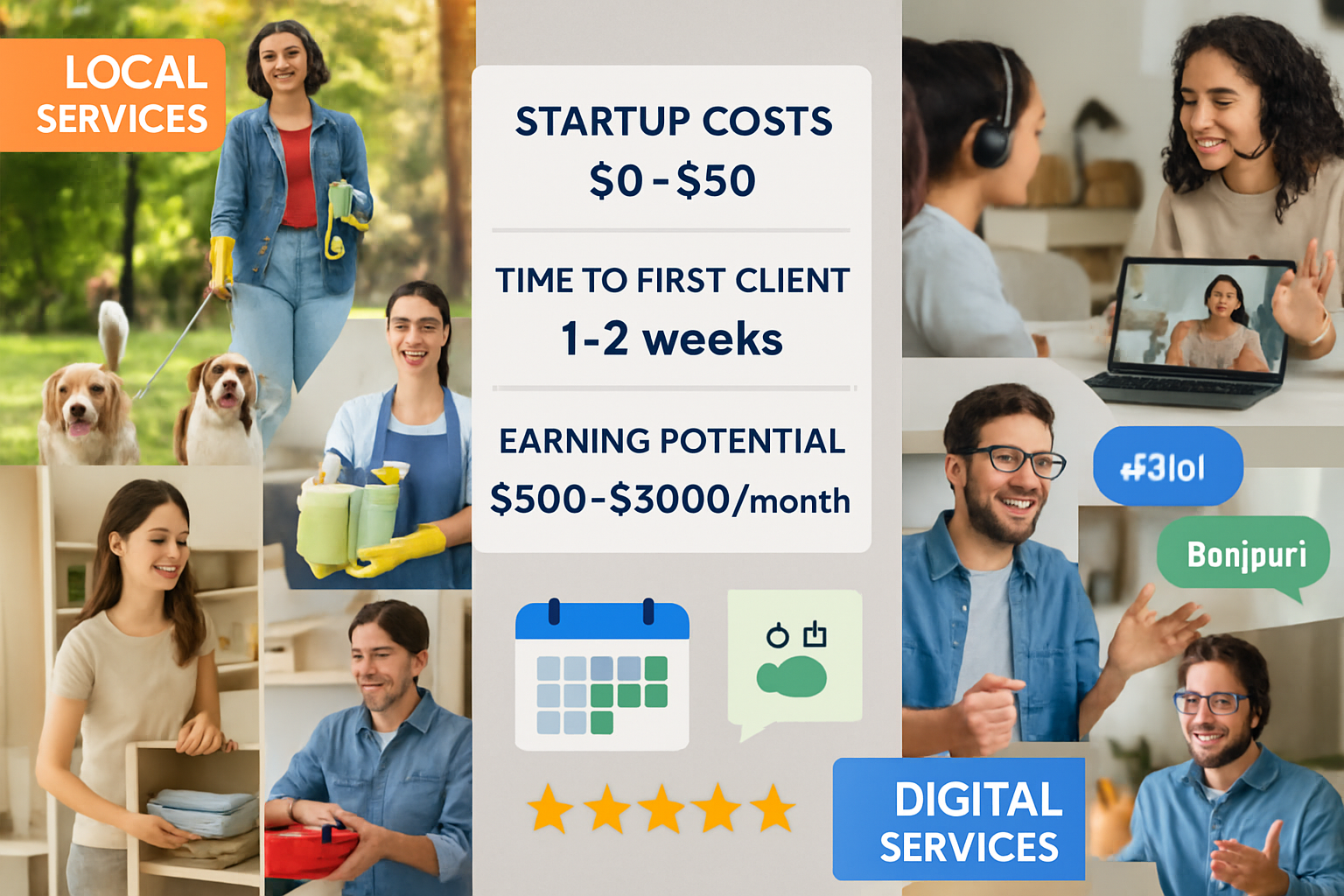
- Set a goal for your first paying client (2-4 weeks is realistic)
- Schedule daily time blocks for your new venture
The most important step: Actually start. Imperfect action beats perfect planning every single time.
Frequently Asked Questions
Q: How much can I realistically earn in my first month?
A: Most people earn $0-200 in month one. You’re building foundation, not yet harvesting. By month three with consistent effort, $300-800 is realistic for most ideas. By month six, $1,000-2,000 is achievable.
Q: Do I need to register a business or get a license?
A: Initially, most can operate as sole proprietors without formal registration. Once you’re earning $500+ monthly consistently, research your local requirements. Business licenses, if required, typically cost $50-200 annually.
Q: What if I don’t have any marketable skills?
A: You do—you just haven’t identified them yet. Can you communicate clearly? (Writing, customer service, tutoring). Are you organized? (Virtual assistant, organizing services). Do you have life experience? (Coaching, consulting). Skills are more common than you think.
Q: How do I handle difficult clients?
A: Set clear expectations upfront with contracts or agreements. Communicate professionally but firmly. If a client is truly problematic, it’s okay to end the relationship. Your mental health and business reputation matter more than one difficult client.
Q: Should I quit my job to focus on my side hustle?
A: Not until your side income consistently exceeds your job income for at least 3-6 months AND you have a 6-month emergency fund. The financial pressure of needing your side hustle to work immediately often sabotages it.
Q: What if my idea doesn’t work?
A: Then you try another one. Most successful entrepreneurs failed at 2-3 ventures before finding their winner. Each “failure” teaches valuable lessons. The only real failure is never trying.
Conclusion: Your Path to Financial Freedom Starts Today
We’ve covered 25 realistic ideas to make money from home without spending a dime upfront. From freelance digital services to creative content streams, from local service businesses to online entrepreneurship—the opportunities are genuinely abundant in 2025.
But here’s the truth: reading this article won’t change your financial situation. Only action will.
The difference between people who successfully generate home-based income and those who don’t isn’t talent, luck, or special advantages. It’s simply this: they started, and they persisted.
Your next steps are clear:
- Choose one idea from this list that aligns with your skills and interests
- Commit to 30 days of focused effort—just one month to see what’s possible
- Take the first action today—create a profile, reach out to a potential client, produce your first piece of content
- Track your progress and adjust your approach based on what you learn
- Connect with others on the same journey for support and accountability
Remember, you don’t need to replace your income overnight. Even an extra $500 monthly changes your financial picture—that’s $6,000 annually for vacations, debt payoff, emergency fund building, or investment. At $1,000 monthly, you’ve added $12,000 to your annual income. That’s life-changing money for most families.
The gig economy, remote work revolution, and digital entrepreneurship have created unprecedented opportunities for ordinary people to build extraordinary income streams from home. You don’t need special credentials, expensive equipment, or business degrees. You need commitment, consistency, and the courage to start.
Your future self—the one with more financial security, flexibility, and freedom—is waiting for you to take the first step.
What will you start today?
References
[1] “Freelancing in America 2024,” Upwork Economic Research, accessed January 2025, https://www.upwork.com/research/freelancing-in-america