
Saving $3,000 in 90 days might sound wild, but honestly, it’s doable with a mix of strategy, discipline, and some clever financial tools. Most folks struggle to save because they don’t have a system—they’re just hoping willpower will carry them, which rarely works.
By blending automated savings, cutting back on expenses, boosting income, and using a smart budget, you can save real money fast—without feeling totally deprived.

People who actually succeed at saving usually have a few specific money-saving hacks up their sleeves. It’s not about cutting out every joy or living on bread and water. It’s more about tweaking your spending, finding ways to earn a bit more, and setting up systems that quietly build up your savings.
This article dives into seven strategies that helped me sock away $3,000 in three months. Each hack is practical and pretty easy to start, and they work best when you combine them. Whether you’re building an emergency fund, tackling debt, or saving for something big, these ideas can help you get there faster.
Key Takeaways
- Automating savings transfers and using high-yield accounts means you don’t have to rely on willpower and your money grows in the background.
- Cutting subscriptions and unnecessary expenses can free up a surprising amount of cash every month—without making life boring.
- If you combine cutting costs with finding ways to earn more, you’ll reach your savings goals way faster than just doing one or the other.
Foundational Goal Setting and Smart Budgeting

Getting to $3,000 in 90 days takes a clear target and a plan. Start by deciding what the money’s for, break it into smaller weekly chunks, and build a budget that fits real life.
Define Your Savings Goal With Precision
Vague goals like “save more money” just don’t cut it. Pick a specific number and a real reason. Instead of “I want to save,” try “I’m saving $3,000 for an emergency fund by March 15.”
SMART goals help turn fuzzy ideas into actual plans. Make your goal Specific (pick a dollar amount), Measurable (track it weekly), Achievable (something you can really do), Relevant (it actually matters to you), and Time-bound (set a deadline).
Write your goal down. Seriously. People who do this save a lot more. Stick it somewhere you’ll see it every day—phone wallpaper, bathroom mirror, fridge, whatever works.
Break Down $3,000 Into Manageable Milestones
$3,000 in one shot feels huge. Split it up: over 90 days, that’s $1,000 a month, $250 a week, or about $33 a day.
Small targets feel way more doable. Treat each week like its own mini-goal, not just a long slog toward one big number. Many savers treat these weekly chunks like bills—they just have to be paid.
Check your progress every week or two. Hitting the first $750 feels good and keeps you going. Even a simple chart helps you see how close you’re getting. Those little wins matter more than you’d think.
Craft a Realistic and Flexible Budget
Knowing where your money goes each month is half the battle. A good budget covers fixed stuff (rent, utilities), variable costs (groceries, gas), and fun money (eating out, shows).
Track your spending for a couple weeks. Most people get surprised by what they find—subscription fees, daily coffees, quick impulse buys. It adds up.
Try splitting your budget into three buckets:
- Essentials you can’t avoid
- Flexible spending you can trim
- Savings—treat this as a must-do, not “if there’s anything left”
Leave a little wiggle room for surprises. Budgets that are too rigid usually crash and burn. The idea is to make steady progress, not be perfect.
Automate and Supercharge Your Savings

Automation takes the thinking out of saving money. Once you set it up, you just watch your balance grow—no effort required.
Set Up Automatic Transfers
Treat savings like a bill you have to pay. Set up an automatic transfer from checking to savings right after payday, so the money moves before you even notice it’s there.
Most banks let you schedule these for free online. Even $50 per paycheck gets things rolling. When you’re comfortable, bump it up.
Timing is everything. Do it as soon as your paycheck lands, so you’re not tempted to spend it. Out of sight, out of mind, right?
Leverage Dedicated and Online Savings Accounts
Mixing savings with spending money is just asking for trouble. Open a separate savings account, ideally at a different bank. It adds a small hurdle before you can dip in.
Online savings accounts are awesome because:
- You get 4-5% interest (way better than traditional banks)
- No monthly fees or minimums
- Easy to check progress on your phone
- Your money grows faster
With $3,000 in a high-yield account at 4.5%, you’ll get about $135 in interest a year. In a regular account, you’d get almost nothing.
Use Savings Apps and Digital Tools
Apps make saving painless. Tools like Qapital and Acorns round up your purchases and stash the spare change.
Buy a $3.75 coffee? The app rounds it to $4.00 and drops 25 cents into savings. You barely notice, but it adds up fast.
Lots of apps let you set goals, track spending, or trigger savings when certain things happen—like payday or skipping a purchase. These digital tools make saving so easy you almost forget you’re doing it.
Cut Expenses and Eliminate Unnecessary Spending
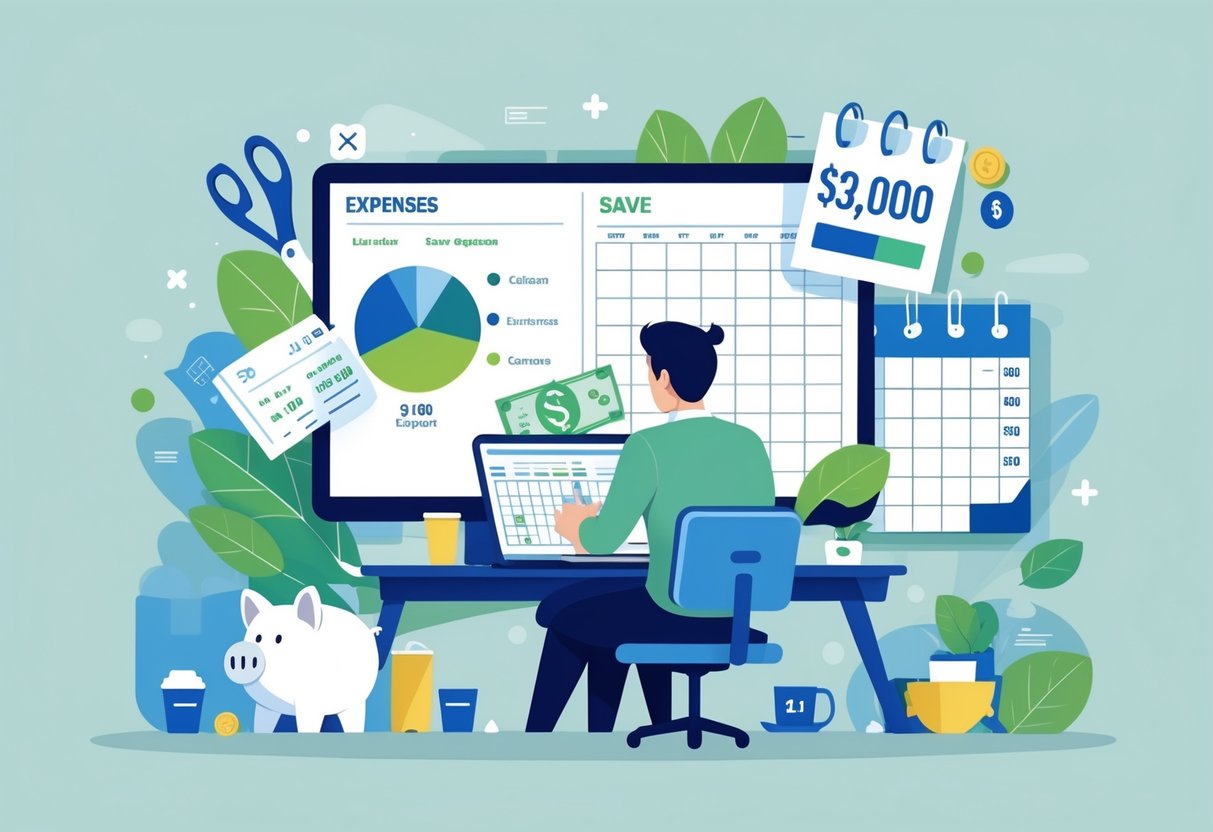
If you want to save more, you’ve got to know where your money’s leaking out. Most people find hundreds in savings just by spotting waste, trimming unused services, and challenging themselves to do better.
Identify Hidden Money Leaks
Track your spending to see where your cash disappears. Little things—like daily coffee, impulse buys, or forgotten subscriptions—add up way more than you’d guess.
Look at the last three months of bank statements. Highlight every transaction under $20. You’ll probably find a bunch of small, regular expenses that total $200 to $400 a month.
Some common money leaks:
- Daily coffee shop stops ($5-7 a day adds up fast)
- Snacks and drinks from convenience stores
- Unused apps or digital stuff
- ATM fees from other banks
- Late fees on bills
- Monthly bank account charges
Try sorting expenses into “needs” and “wants.” Rent, groceries, and utilities are needs. Restaurant meals, new clothes you don’t need, and extra streaming services? Wants. Those are the first things to cut.
Slash Subscription Services
Most people pay for a bunch of subscriptions—streaming, apps, memberships—they barely use. These keep charging you because you forget they’re even there.
List every subscription you have. That means everything: streaming, gym, meal kits, software, magazines, whatever. Most folks use only a couple of these regularly.
Canceling unused subscriptions can save $50 to $150 a month. Just dropping a few streaming services could cut $40 to $50 from your bills. Add in gym memberships or unused apps, and the savings grow.
Quick subscription audit:
| Category | Action | Potential Savings |
|---|---|---|
| Streaming services | Keep 1-2, cancel the rest | $30-50/month |
| Gym memberships | Cancel if unused for 3+ months | $30-80/month |
| App subscriptions | Delete unused apps | $10-30/month |
| Food delivery services | Pause or cancel | $20-40/month |
Don’t forget your phone plan. Switching to a cheaper carrier or prepaid plan can save $30 to $50 a month with barely any difference in service.
Implement No-Spend and Savings Challenges
No-spend challenges help you focus on buying only what you truly need. Most last a week to a month and cut out extras like restaurants, entertainment, and non-essentials.
Try a 30-day no-spend challenge to push all leftover cash toward your savings. During these weeks, you’ll use what you already have, cook at home, and hunt down free entertainment. It’s not unusual to save $300 to $600 in just one month.
Popular saving challenges:
- 52-week challenge: Start with $1 the first week, $2 the next, and keep going up to $52 by year’s end (total: $1,378).
- Monthly no-spend challenge: Skip all non-essential buys for 30 days.
- $5 bill challenge: Save every $5 bill you get for a year.
- Pantry challenge: Eat through what’s in your kitchen before buying more groceries.
These savings challenges work because they set clear rules and time limits. When you know it’s temporary, it feels way less daunting.
Track and Celebrate Your Savings Progress
Visuals make a difference. A savings thermometer lets you see your progress toward that $3,000 goal. Draw a big thermometer on paper or use a digital tracker—either way, it makes your savings tangible.
Every time you hit another $100, mark it off. Those small wins keep you moving forward. Watching the thermometer fill up becomes a daily nudge to stick with it.
Breaking the $3,000 goal into weekly chunks—like $230 a week—makes it feel doable. Hitting each target is worth a little celebration, whether it’s a checkmark or a small, planned treat.
Apps and spreadsheets help you see exactly how much you’re saving. Record that $40 from canceled subscriptions, $200 from eating out less, or $60 from switching phone plans. It’s satisfying to see those numbers add up and know that cutting expenses actually works.
Share your progress with someone else or an online group. Weekly updates and celebrating milestones with others make the tough days feel lighter and keep you motivated.
Boost Income and Build Accountability
Cutting costs helps, but sometimes it’s just not enough. Earning extra on the side and having support can speed up your savings more than you’d think.
Start a Side Hustle or Part-Time Job
Picking up a side hustle or part-time job brings in more cash you can stash away. Freelance writing, graphic design, virtual assistant gigs, or tutoring are all popular choices if you’ve got the skills.
Gig apps are flexible. Rideshare driving, food delivery, or task apps let you work evenings and weekends. That’s perfect if your main job keeps you busy during the day.
Service-based hustles pay surprisingly well and don’t need much to get started. Pet sitting through apps can bring in $25 to $50 a day. Dog walking goes for $15 to $30 a pop. House sitting sometimes combines several gigs in one go.
Find something that fits your schedule and talents. Even earning $333 a month on the side means you’ll hit $1,000 saved in three months—without touching your regular paycheck.
Sell Unused Items for Extra Cash
Most of us have a bunch of stuff at home we never use. Selling it puts cash in your pocket and clears out your space at the same time.
Facebook Marketplace is great for local sales. Electronics, furniture, clothes, and home goods sell fast if you price them right and take good photos. Poshmark and Mercari are solid for clothes and accessories.
Don’t overlook high-value stuff. Old phones, tablets, game consoles, and laptops are worth more than you might expect. Collectibles, unused gift cards, and specialty gear can surprise you, too.
Set a weekly goal to list and sell items. Even $100 a week adds up to $1,200 in three months.
Find an Accountability Partner for Motivation
An accountability partner turns saving money into a team effort. They’ll check in, cheer you on, and help you through the rough patches.
Pick someone with similar goals or a strong sense of discipline. Weekly check-ins to talk about wins, challenges, and spending keep everyone on track. Some team up with a personal finance expert or join online savings groups.
When you share your numbers and targets, it’s harder to slack off. If someone else knows you’re aiming for $3,000 in 90 days, you’ll feel that extra push to follow through. Plus, accountability partners often swap money-saving tips you wouldn’t find on your own.
Frequently Asked Questions
People ask a lot about how to save fast, if it’s possible on a tight income, and what gets in the way. Here’s a rundown of what actually works and what to watch for.
What practical money-saving strategies can someone implement to save a significant sum in a short period?
Automation is a lifesaver for fast savings. Set up automatic transfers from checking to savings right after payday so you don’t even see the money—out of sight, out of mind. Many folks swear by automating finances to build savings without thinking about it every day.
Cutting subscriptions frees up cash right away. The average household wastes $400 to $800 a year on stuff they don’t use. Cancel those streaming services, gym memberships, or apps you forgot about and you’ll likely save $50 to $100 a month.
Move your savings to a high-yield account for better returns. Regular banks pay next to nothing, but high-yield accounts can give you 10 to 20 times more interest. That passive boost adds up over time.
Big expenses are where you’ll find the biggest savings. Refinance loans, negotiate rent, or even downsize temporarily to save hundreds each month. Shop around for cheaper insurance or try public transit to cut transportation costs.
Can you achieve substantial savings without a high income, and what steps should you take?
It’s less about how much you make and more about how you manage it. Someone earning $40,000 can save $3,000 in three months by trimming $1,000 a month off their spending. That’s about 25 to 30 percent, which is doable with some effort.
The 50/30/20 rule is a good starting point for any income. Spend 50 percent on needs, 30 percent on wants, and put 20 percent into savings. For a short-term push, swap the wants and savings percentages. That can give you an extra $1,000 a month to save.
Focus on your biggest expenses for the most impact. Housing, transportation, and food usually eat up 60 to 70 percent of the budget. Cut those by 15 percent and you’ll save more than if you just skip coffee or movie nights.
Set specific, measurable goals no matter your income. A target like “$3,000 by March 15” keeps you motivated in a way that vague wishes just can’t. That sense of urgency helps you stick with it.
What are common financial pitfalls to avoid when trying to save aggressively over a few months?
Unrealistic goals are a fast track to giving up. If you try to cut spending by half overnight, you’ll probably burn out in two weeks. Start by cutting 20 to 30 percent and adjust as you go.
Don’t forget about irregular expenses. Car repairs, medical bills, or yearly insurance can pop up and wreck your plan. Keep a $200 to $300 buffer so you’re not forced to dip into your main savings.
Lifestyle creep sneaks up on you. A little more eating out or online shopping here and there can quietly drain your account. Track every expense with an app or spreadsheet so you can see where money leaks out.
Watch out for your own spending triggers. Shopping when you’re stressed, browsing online stores out of boredom, or saving payment info for quick checkouts makes it way too easy to spend. Delete saved cards and avoid temptation to help yourself out.
Remember to celebrate milestones. Hitting $500, $1,500, or $2,500 saved is a big deal. Mark those moments with something low-cost or free to keep your energy up without undoing your hard work.
How can I adapt the 7-11-4 money rule to maximize my savings potential?
The 7-11-4 rule means keeping seven days of expenses in checking, 11 in savings, and four in investments. It’s designed to keep your cash flowing without too much sitting idle in low-interest accounts.
If you’re saving hard, tweak the rule for now. Drop your checking buffer to five days and bump up savings to 15 days. For someone spending $3,000 a month, that’s an extra $200 to $400 moved into savings each month.
Keep your investment contributions steady, even when saving aggressively. Don’t stop building long-term wealth—automate $50 to $100 a month if you can. That keeps your momentum going.
Check these ratios weekly while you’re in savings mode. If you see extra cash piling up in checking at the end of the month, increase your automatic savings. Adjust as you go to squeeze out the best results.
What tips do savings experts have for individuals under 45 to boost their savings quickly?
If you’re younger, knock out high-interest debt before you go all-in on saving. Credit card debt at 20 percent interest eats up more than you’ll ever earn in a savings account. Pay it off first and your monthly budget will thank you.
Take full advantage of employer retirement matching. Put in enough to get the company match—it’s basically free money and gives you a 50 to 100 percent return instantly. Nothing else comes close.
Use tech and AI-powered budgeting tools to spot spending habits you might miss. These apps sort your purchases and flag problem areas like too much takeout or impulse buys. The data helps you cut smarter, not just harder.
Extra income goes a long way. Freelance gigs, gig apps, or selling stuff you don’t use can add $300 to $800 a month. That’s real money straight toward your savings goal without touching your main budget.
When you get a raise or a bonus, don’t let your spending rise to match it. Route 50 to 75 percent of any new income straight to savings. That’s how you keep your savings growing as your paycheck grows.
Are there any unconventional yet effective savings hacks that have proven results?
The “pay yourself first” method treats savings like a must-pay bill. Move money to savings the same day you get paid—make it automatic and you barely notice it’s gone.