
I’ll never forget the sinking feeling I had when my car broke down, and I realized I didn’t have $500 for the repair. That moment changed everything. I knew I needed to build better money habits, but traditional savings advice felt overwhelming and slow. That’s when I discovered the 30-day savings challenge—a simple, powerful approach that transformed my relationship with money in just one month.
If you’ve struggled to save consistently, felt defeated by financial goals that seem too distant, or simply want to jumpstart your savings journey, a 30-day savings challenge might be exactly what you need. This isn’t just another budgeting tip—it’s a behavioral finance tool that rewires how you think about money, one day at a time.
Key Takeaways
- A 30 day savings challenge creates immediate momentum through short-term, achievable goals that build lasting financial discipline
- Multiple challenge variations exist to match different income levels and savings capacities, from penny challenges to no-spend months
- Behavioral psychology makes these challenges effective by providing quick wins, visual progress tracking, and habit formation in just 30 days
- Automation and tracking tools dramatically increase success rates by removing decision fatigue and creating accountability
- The habits formed during one month often extend into long-term financial wellness, creating a foundation for emergency funds and larger goals
What Is a 30-Day Savings Challenge? 💰
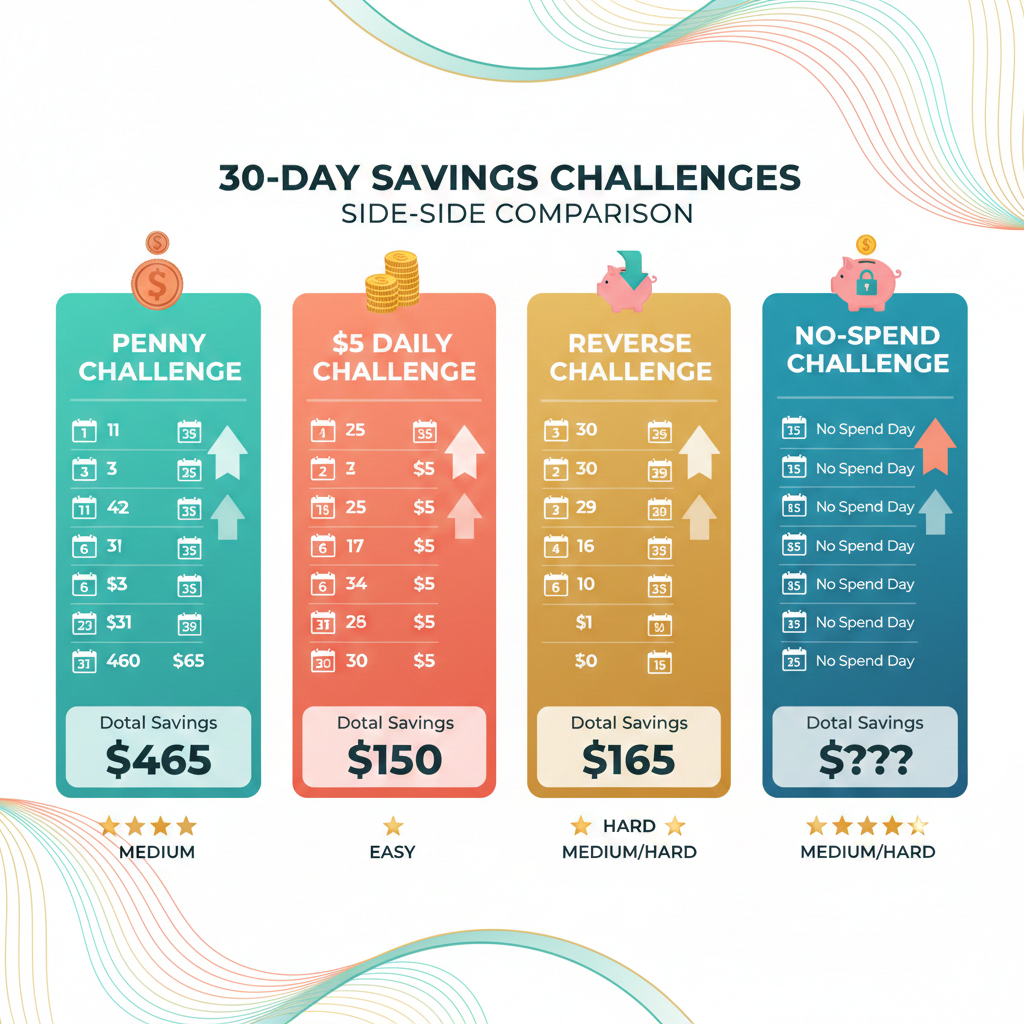
A 30-day savings challenge is a short-term, intensive saving effort designed to help you build consistent saving habits and achieve quick financial wins over one month. Unlike vague goals like “save more money,” these challenges provide specific daily or weekly targets that make saving feel manageable and measurable[1].
The beauty of this approach lies in its simplicity and time-bound nature. Thirty days is long enough to form a habit but short enough to maintain motivation without burning out. Research in behavioral finance shows that people are more likely to stick with financial goals when they can see immediate progress and celebrate small victories along the way[2].
Why 30 Days Is the Magic Number
The 30-day framework isn’t arbitrary. Studies suggest it takes approximately 21 to 66 days to form a new habit, with 30 days falling right in the sweet spot for financial behavior change[3]. This timeframe provides:
- Immediate gratification compared to longer-term savings goals
- Quick wins that boost confidence and motivation
- Manageable commitment that doesn’t feel overwhelming
- Clear endpoint that makes the challenge feel achievable
- Momentum building that often extends beyond the initial month
When you complete a money saving challenge successfully, you prove to yourself that you can save—and that psychological shift is invaluable for long-term financial wellness.
Popular 30 Day Savings Challenge Variations
One of the best aspects of the 30-day savings framework is its flexibility. You can customize the challenge based on your budget, financial capacity, and personal goals. Here are the most effective variations I’ve seen transform people’s finances:
The Classic Penny Challenge (Incremental Savings)
This popular version involves saving a specific amount daily that increases incrementally. The most common approach starts with $1 on day one, $2 on day two, $3 on day three, and so on. By the end of 30 days, you’ll have saved $465[1].
Daily breakdown:
- Days 1-10: Save $1-$10 daily (Total: $55)
- Days 11-20: Save $11-$20 daily (Total: $155)
- Days 21-30: Save $21-$30 daily (Total: $255)
- Grand total: $465
This challenge works brilliantly because it starts easy and builds gradually. The first week feels effortless, giving you momentum before the amounts increase.
The Reverse Challenge (Start Strong)
Prefer to tackle the hardest part first? The reverse challenge flips the script—you save $30 on day one, $29 on day two, and decrease by $1 each day until you’re saving just $1 on day thirty. You’ll still save $465 total, but this approach works better if you:
- Just received a paycheck and have more available cash
- Prefer front-loading difficult tasks
- Want easier days as the month progresses
- Worry about motivation fading over time
The $5 Daily Challenge
For a simpler approach, commit to saving exactly $5 every single day for 30 days. This straightforward method yields $150 in savings and eliminates the mental math of increasing amounts[4].
This challenge is perfect for:
- Beginners who want consistency over complexity
- People with a steady daily income
- Those who prefer predictable savings amounts
- Anyone building their first emergency fund
The Weekly Savings Strategy
If daily deposits feel too frequent, try a weekly savings strategy instead. Divide your monthly goal into four weekly targets:
| Week | Savings Goal | Running Total |
|---|---|---|
| Week 1 | $125 | $125 |
| Week 2 | $125 | $250 |
| Week 3 | $125 | $375 |
| Week 4 | $125 | $500 |
This approach aligns perfectly with typical pay schedules and makes the goal of saving $500 in 30 days feel achievable[1]. I’ve found this particularly effective when combined with budgeting strategies that avoid common mistakes.
The No-Spend Challenge
This behavioral variant focuses on eliminating discretionary spending rather than depositing specific amounts. For 30 days, you commit to spending money only on essentials like rent, utilities, groceries, and transportation.
Every time you resist a non-essential purchase, immediately transfer that amount to savings. For example:
- Skip the $6 latte → Transfer $6 to savings
- Resist the $40 online shopping cart → Transfer $40 to savings
- Cook at home instead of $25 takeout → Transfer $25 to savings
The no-dining-out challenge variant alone can yield $200+ in monthly savings if you typically spend $10 daily on work lunches and coffee[1]. This approach powerfully demonstrates how small daily expenses accumulate into significant amounts.
The Spare Change Challenge
This micro-saving strategy involves rounding up every purchase to the nearest dollar and saving the difference. Many banking apps now automate this process, making it effortless:
- $3.47 coffee → Round to $4.00, save $0.53
- $27.82 gas → Round to $28.00, save $0.18
- $64.15 groceries → Round to $65.00, save $0.85
While individual amounts seem tiny, these passive savings techniques can accumulate $50-100 monthly without conscious effort—perfect for supplementing other challenges.
The 30-Day Impulse Purchase Rule
This powerful variant addresses the psychological root of overspending. The rule is simple: before making any non-essential purchase, wait 30 days. During that waiting period, deposit the intended purchase amount into savings[1].
Here’s what typically happens:
- 60-70% of impulse purchases are forgotten or no longer desired after 30 days
- You keep the money you saved instead of spending it
- You develop mindful spending habits that last beyond the challenge
- You learn to distinguish between wants and needs
This approach is particularly effective for online shopping habits and can be combined with other savings challenges for maximum impact.
How to Start Your 30 Day Savings Challenge: Step-by-Step Guide
Ready to transform your money habits? Here’s exactly how to set yourself up for success:
Step 1: Choose Your Challenge Type
Select a challenge variation that matches your current financial situation. Be honest about what you can realistically commit to—starting with an overly ambitious challenge sets you up for failure and discouragement.
Consider these factors:
- Your current income and expenses
- How much you can comfortably save without creating financial stress
- Your personality (do you prefer daily or weekly tasks?)
- Your primary savings motivation (emergency fund, specific purchase, debt payoff)
If you’re unsure, start with the $5 daily challenge or weekly $125 deposits. You can always increase the difficulty in future months.
Step 2: Set Your Specific Savings Goal
Transform your vague intention into a concrete target. Instead of “save more money,” commit to “save $465 through the incremental penny challenge” or “save $200 by eliminating dining out for 30 days.”
Write down:
- Exact dollar amount you’ll save
- Specific challenge type you’re following
- Start and end dates (e.g., “March 1-30, 2025”)
- What you’ll do with the savings (emergency fund, debt payment, specific purchase)
Having a clear purpose for your savings dramatically increases motivation. Research shows that goal-specific savings accounts have 73% higher success rates than general savings[2].
Step 3: Review and Adjust Your Budget
Before starting, examine your current spending to identify where you’ll find the money to save. Download a printable budget tracker or use a budgeting app to categorize your expenses.
Look for temporary reductions in:
- Subscription services you can pause for 30 days
- Entertainment and dining out expenses
- Impulse purchases and non-essentials
- Grocery spending through meal planning
- Utility costs through conscious conservation
Even small adjustments across multiple categories can free up significant savings capacity. For comprehensive guidance, check out these genius savings strategy hacks.
Step 4: Set Up Your Savings System
Automation is the secret weapon that separates successful savers from those who give up halfway through. Manual transfers require willpower and memory—both of which are unreliable over 30 days.
Create your automated system:
- Open a dedicated savings account separate from your checking account (preferably at a different bank to reduce temptation)
- Set up automatic transfers matching your challenge schedule (daily, weekly, or bi-weekly)
- Time transfers strategically right after payday when funds are available
- Name your account with your specific goal (e.g., “Emergency Fund Challenge”)
Most banks allow scheduled transfers through their mobile apps. If yours doesn’t, consider high-yield savings apps like Ally, Marcus, or CIT Bank that make automation effortless.
Step 5: Choose Your Tracking Method
Visual progress tracking is crucial for maintaining motivation throughout the month. Seeing your progress creates a psychological reward that reinforces the saving behavior.
Effective tracking options:
📊 Printable trackers: Download or create a 30-day grid where you color in each day’s savings. Printable templates are available for $0.85-$2.99 online, or create your own in Excel[1].
📱 Mobile apps: Apps like Qapital, Digit, or YNAB (You Need A Budget) automatically track savings and provide visual progress bars and achievement badges.
📝 Spreadsheet tracking: Create a simple Google Sheet or Excel file with columns for date, amount saved, running total, and notes about what you sacrificed to save.
🏺 Physical jar method: For cash-based challenges, use a clear jar where you can literally see your savings grow. This tangible approach is surprisingly motivating.
Choose the method that you’ll actually use consistently. The best tracking system is the one you’ll engage with daily.
Step 6: Build Accountability
You’re 3x more likely to complete a financial challenge when you have accountability[3]. Share your goal with someone who will check in on your progress.
Accountability options:
- Savings buddy: Find a friend doing the same challenge and check in daily or weekly
- Social media: Post updates to your Instagram stories or Facebook (public commitment increases follow-through)
- Partner or spouse: Make it a team effort if you share finances
- Online communities: Join personal finance forums or Facebook groups focused on savings challenges
The key is choosing accountability that feels supportive rather than judgmental. You want encouragement, not pressure that creates stress.
Step 7: Plan for Obstacles
Every challenge encounters roadblocks. Planning for common obstacles before they occur dramatically increases your completion rate.
Common challenges and solutions:
Unexpected expenses: Build a small buffer into your budget or have a backup plan for pausing the challenge for 2-3 days if necessary.
Motivation dips: Prepare motivational reminders (photos of your goal, inspiring quotes, or calculations showing what your savings will become) for the inevitable mid-month slump.
Social pressure: Plan responses for friends who invite you to expensive activities: “I’m doing a savings challenge this month, but I’d love to do [free alternative] instead!”
Income fluctuations: If you have irregular income, choose the weekly strategy over daily deposits, or adjust amounts based on actual earnings.
The Psychology Behind Why 30 Day Savings Challenges Work 🧠
Understanding why these challenges are so effective helps you leverage their power more intentionally. The success isn’t just about the money—it’s about the psychological transformation that occurs.
Behavioral Finance Principles at Play
1. Small wins create momentum
Behavioral economists have identified the “progress principle”—making progress on meaningful goals creates positive emotions that fuel continued effort[2]. Each day you successfully save, your brain releases dopamine, reinforcing the behavior and making you want to continue.
The incremental penny challenge brilliantly exploits this by making the first week incredibly easy. Those early wins build confidence before amounts increase.
2. Loss aversion motivates completion
Once you’ve invested effort into a challenge, the psychological pain of “losing” that progress becomes a powerful motivator. After saving for 15 days, the thought of quitting and losing your streak feels worse than continuing—even when it gets harder.
This is why tracking is so important. Seeing your progress makes the potential loss more tangible and emotionally significant.
3. Time-bound goals reduce procrastination
Open-ended goals like “save more money” suffer from infinite procrastination. There’s always tomorrow to start. A 30-day challenge creates urgency through a clear deadline, triggering action today rather than someday[3].
4. Identity shift creates lasting change
After 30 days of consistent saving, something profound happens: you begin to see yourself as “a person who saves money.” This identity shift is more powerful than willpower for creating lasting behavioral change.
When saving becomes part of your identity rather than something you’re forcing yourself to do, it transitions from a temporary challenge to a permanent habit.
The Connection Between Financial Discipline and Mental Health
The relationship between money and mental wellness runs deeper than most people realize. Financial stress is one of the leading causes of anxiety and depression, while financial security significantly improves overall life satisfaction[4].
Completing a 30 day savings challenge provides:
✨ Sense of control: Financial chaos creates helplessness; successful saving restores agency over your circumstances
✨ Reduced anxiety: Even a small emergency fund dramatically decreases stress about unexpected expenses
✨ Improved self-efficacy: Proving you can achieve a financial goal builds confidence that extends to other life areas
✨ Future optimism: Visible progress toward goals creates hope and positive expectations about your financial future
I’ve personally experienced how the mental health benefits of financial discipline extend far beyond the bank account. The confidence gained from completing one challenge often motivates people to tackle other areas where they’ve felt stuck.
Breaking Through Psychological Barriers to Saving
Many people struggle to save not because of income limitations, but due to psychological barriers that sabotage their efforts:
Barrier 1: “I don’t make enough to save”
This scarcity mindset becomes a self-fulfilling prophecy. The 30-day challenge proves that even small amounts accumulate significantly. Saving $5 daily might seem insignificant, but $150 monthly becomes $1,800 annually—enough for a solid emergency fund start.
Solution: Start with the spare change challenge or $1 daily challenge to prove saving is possible at any income level.
Barrier 2: “Saving means deprivation”
When saving feels like punishment, it’s unsustainable. Reframing is essential.
Solution: Focus on what you’re saving for rather than what you’re giving up. The no-spend challenge becomes easier when you’re excited about your emergency fund rather than resentful about skipped lattes.
Barrier 3: “I’ll save what’s left over”
Waiting to save until after spending guarantees nothing will be left. This approach fails 95% of the time[2].
Solution: Automate savings first, then spend what remains. This “pay yourself first” principle is the foundation of all successful savings strategies.
Barrier 4: “I’m not good with money”
This limiting belief becomes your financial reality. Challenging it requires evidence to the contrary.
Solution: A completed 30-day challenge provides concrete proof that you are capable of managing money effectively, breaking the negative self-concept.
Maximizing Your Success: Advanced Tips and Strategies

Once you’ve mastered the basics, these advanced strategies will amplify your results and extend your success beyond the initial 30 days.
Technology Tools for Automated Savings
In 2025, leveraging technology is the single most effective way to ensure challenge completion. The right tools remove decision fatigue and create effortless consistency.
Top savings automation apps:
Qapital: Creates rules-based savings (round-ups, goal-based transfers, “if this, then that” triggers). Particularly effective for behavioral challenges like the impulse purchase rule.
Digit: Uses AI to analyze your spending patterns and automatically save amounts you won’t miss. Perfect for people who want savings to happen in the background.
Chime: Offers automatic savings when you get paid, spend money, or receive direct deposits. The “Save When You Get Paid” feature transfers 10% of every paycheck automatically.
YNAB (You Need A Budget): While primarily a budgeting app, YNAB’s goal-tracking features make it excellent for monitoring 30-day challenges and seeing exactly how your savings align with spending.
Acorns: Rounds up purchases and invests the spare change, combining savings with long-term wealth building. Great for people who want their challenge savings to grow beyond the initial month.
The key is choosing tools that match your specific challenge type and automating as much as possible. Every manual decision point is an opportunity for willpower to fail.
Gamification Strategies That Boost Motivation
Turning your savings challenge into a game makes it more engaging and fun, dramatically increasing completion rates.
Gamification techniques:
🎯 Achievement badges: Create or download badges for milestones (first week completed, halfway point, $100 saved, etc.) and display them where you’ll see them daily.
🏆 Leaderboards: If doing the challenge with friends or family, create a shared spreadsheet showing everyone’s progress. Friendly competition is incredibly motivating.
🎲 Randomized challenges: On certain days, roll a die to determine bonus savings amounts or use a “challenge spinner” app to add variety and excitement.
⭐ Reward tiers: Set mini-rewards at specific milestones (not cash rewards that defeat the purpose, but free treats like a home spa day, movie night, or sleeping in).
📊 Visual progress bars: Create a large poster with a thermometer-style progress bar that you color in daily. The visual representation of progress is surprisingly powerful.
The more you can make saving feel like an engaging game rather than a sacrifice, the easier it becomes to maintain consistency.
Customizing Challenges for Different Income Levels
One size definitely doesn’t fit all when it comes to savings challenges. The beauty of the 30-day framework is its adaptability to any financial situation.
For tight budgets (under $30K annually):
- Start with the spare change challenge or $1 daily challenge
- Focus on no-spend variations that reduce expenses rather than requiring deposits
- Target $50-100 total savings to build confidence without financial strain
- Emphasize habit formation over dollar amounts
For moderate incomes ($30K-$75K annually):
- The classic $5 daily or weekly $125 challenge works well
- Combine spending reduction with active saving
- Target $150-500 monthly savings
- Use this as a foundation for building a 3-month emergency fund
For higher incomes ($75K+ annually):
- Try the reverse challenge or create custom higher-amount variations
- Challenge yourself with 10% of take-home pay as your monthly target
- Focus on percentage-based goals rather than fixed amounts
- Use the challenge to accelerate debt payoff or investment contributions
The important principle is challenging yourself appropriately—difficult enough to require intentionality, but achievable enough to maintain motivation.
Extending Success Beyond 30 Days
The real magic happens when your 30-day challenge becomes the foundation for lasting financial transformation.
Strategies for long-term habit formation:
1. Chain challenges together: Immediately start a new 30-day challenge when you complete one. Many people do three consecutive challenges (90 days total) to solidify habits.
2. Increase difficulty gradually: If you saved $5 daily the first month, try $7 daily the second month. Progressive challenge prevents plateaus.
3. Maintain the savings account: Don’t touch the money you saved. Let it become your emergency fund foundation and continue adding to it.
4. Automate permanently: Keep the automatic transfers you set up for the challenge running indefinitely. What started as a temporary challenge becomes your permanent savings system.
5. Apply principles to other financial goals: Use the same 30-day challenge framework for debt payoff, spending reduction in specific categories, or building new income streams.
Research shows that habits formed during intensive 30-day periods often persist for 6+ months afterward, especially when reinforced with continued tracking and accountability[3].
For those ready to tackle larger financial goals, consider applying these same principles to becoming debt-free or building sustainable habits.
Real Success Stories: How the 30 Day Savings Challenge Changed Lives
Nothing inspires like real examples of people who transformed their finances through these challenges.
Sarah’s Story: From $0 to $465 in One Month
Sarah, a 28-year-old teacher, had never successfully saved money despite wanting to build an emergency fund for years. She started the incremental penny challenge in January 2025.
“The first week was almost too easy—saving $1, $2, $3 felt like nothing,” Sarah shared. “By week three, when I was saving $20+ daily, it got harder, but I’d built so much momentum I didn’t want to break my streak.”
Sarah made it work by:
- Bringing lunch from home instead of buying it (saved $10 daily)
- Skipping her usual Friday happy hours (saved $30 weekly)
- Selling unused items on Facebook Marketplace (generated $120 extra)
She completed the full challenge and had $465 saved—her first emergency fund ever. Six months later, she’s maintained the savings habit and has over $2,000 in her emergency account.
Key takeaway: Starting small builds the momentum needed to accomplish bigger goals.
Marcus and Jennifer’s Joint Challenge
This couple had been arguing about money for years. Marcus was a spender; Jennifer was a saver. They decided to try the weekly $125 challenge together as a team effort.
“Making it a team challenge completely changed the dynamic,” Marcus explained. “Instead of Jennifer nagging me about spending, we were both working toward the same goal. It became fun to find creative ways to hit our weekly target.”
They used:
- A shared Google Sheet to track progress
- Weekly “money dates” to review their numbers and celebrate wins
- A joint savings account they both contributed to equally
After completing the 30-day challenge with $500 saved, they continued for another two months and built a $1,500 emergency fund. More importantly, they developed a framework for discussing money without conflict.
Key takeaway: Shared financial challenges can strengthen relationships and create teamwork around money.
David’s No-Spend Month Transformation
David, a 35-year-old software developer with a six-figure income, was shocked to realize he had less than $1,000 in savings despite his high earnings. His problem wasn’t income—it was unconscious spending.
He committed to a 30-day no-spend challenge, allowing only essential expenses. Every time he resisted a purchase, he transferred that amount to savings.
“I was horrified to discover I was spending $400+ monthly on food delivery alone,” David said. “Seeing those transfer notifications pile up as I cooked at home instead was eye-opening.”
His 30-day results:
- $420 saved from eliminated food delivery
- $180 saved from skipped impulse Amazon purchases
- $95 saved from canceled unused subscriptions
- Total: $695 saved + new awareness of spending patterns
David now uses the 30-day impulse purchase rule permanently and has built a six-month emergency fund.
Key takeaway: High earners often benefit most from spending awareness rather than income increases.
Common Mistakes to Avoid During Your Challenge
Learning from others’ mistakes saves you from repeating them. Here are the most common pitfalls and how to avoid them:
Mistake 1: Setting Unrealistic Goals
The problem: Choosing a challenge that’s too aggressive for your current financial situation creates stress and leads to abandonment.
The solution: Start with a challenge that feels 80% achievable. You can always increase difficulty next month. Building the habit is more important than the dollar amount in your first challenge.
Mistake 2: Not Automating Transfers
The problem: Relying on memory and willpower to manually transfer money daily or weekly leads to forgotten days and broken streaks.
The solution: Set up automatic transfers before the challenge starts. Automation removes the decision-making burden and ensures consistency even on busy or stressful days.
Mistake 3: Touching the Savings Mid-Challenge
The problem: Dipping into your challenge savings for non-emergencies undermines your progress and demotivates future efforts.
The solution: Keep your challenge savings in a separate account that’s not linked to your debit card. Create a clear definition of what constitutes an actual emergency before starting. For more guidance on avoiding financial pitfalls, review these budgeting mistakes to avoid.
Mistake 4: No Tracking or Accountability
The problem: Challenges without visible tracking lose momentum quickly. You forget what day you’re on or lose sight of your progress.
The solution: Choose a tracking method before day one and commit to updating it daily. Share your goal with at least one person who will check in on your progress.
Mistake 5: All-or-Nothing Thinking
The problem: Missing one day leads to “I’ve already failed, so why continue?” thinking, causing complete abandonment.
The solution: Build flexibility into your challenge. If you miss a day, simply make it up the next day or adjust your target slightly. Completing 28 out of 30 days is still a massive success worth celebrating.
Mistake 6: Ignoring the “Why”
The problem: Saving for the sake of saving lacks emotional motivation, making it easy to quit when it gets difficult.
The solution: Connect your challenge to a meaningful purpose. Whether it’s peace of mind, a specific purchase, or breaking a family cycle of financial instability, keep your “why” visible and front-of-mind.
Combining Your Savings Challenge with Other Financial Strategies
A 30 day savings challenge works even better when integrated with complementary financial practices.
Pairing with Debt Reduction
If you’re carrying debt, you might wonder whether to focus on saving or debt payoff. The answer is often both, strategically.
The hybrid approach:
- Start with a modest savings challenge ($5 daily or $100 monthly total)
- Build a starter emergency fund of $500-1,000
- Then shift focus to aggressive debt payoff while maintaining smaller ongoing savings
Having even a small emergency fund prevents you from adding new debt when unexpected expenses arise. Once you have that buffer, you can attack debt more aggressively without derailing progress.
For comprehensive debt strategies, explore this step-by-step debt-free plan.
Integrating with the 50/30/20 Budget Rule
The popular 50/30/20 budgeting framework allocates:
- 50% of income to needs
- 30% to wants
- 20% to savings and debt repayment
A 30-day savings challenge helps you reach that 20% savings target more consistently. If you’re currently saving less than 20%, use the challenge to bridge the gap.
I personally tested the 50/30/20 rule and documented my experience in detail—you can read about what I learned and saved.
Building Toward Larger Financial Goals
Your 30-day challenge savings can become the foundation for bigger objectives:
Emergency fund: Financial experts recommend 3-6 months of expenses. A $500 monthly challenge gets you to $6,000 in a year—a solid emergency fund for many households.
Investment starting point: Once you’ve built your emergency fund, redirect challenge savings toward investment accounts. Even small monthly investments compound significantly over time. Learn more about investing in stocks with little money.
Income diversification: Use savings to fund side business startup costs or education that increases your earning potential. Explore realistic ideas for making money from home or smart passive income ideas.
Major purchases: Saving for purchases instead of financing them saves enormous amounts in interest and builds delayed gratification muscles.
The habits you develop during a 30-day challenge create ripple effects throughout your entire financial life.
Frequently Asked Questions About 30 Day Savings Challenges

How much money can you realistically save in 30 days?
The amount varies based on your income and the challenge type you choose. Common ranges include:
- $50-100: Spare change or $1-2 daily challenges (great for beginners or tight budgets)
- $150-200: $5 daily challenge or no-dining-out challenge
- $465: Classic incremental penny challenge
- $500+: Weekly $125 challenge or customized high-income variations
The “right” amount is whatever challenges you without creating financial stress. Success is measured by consistency and habit formation, not just the dollar amount.
What if I miss a day during the challenge?
Missing a day doesn’t mean failure. You have several options:
- Make it up the next day by doubling that day’s amount
- Add the missed day to the end (extend to day 31)
- Adjust your final total slightly and keep going
- Forgive yourself and continue from where you are
The goal is building a savings habit, not perfection. Completing 28 out of 30 days still represents tremendous progress and habit development.
Can I do multiple challenges simultaneously?
Yes, but be strategic about it. Combining challenges can accelerate results but may also create overwhelm. Effective combinations include:
- Spare change challenge + $5 daily challenge (automated + active saving)
- No-spend challenge + penny challenge (spending reduction + active deposits)
- Weekly deposits + 30-day impulse rule (scheduled saving + behavioral change)
Avoid combining multiple high-effort challenges that might lead to burnout and abandonment.
Should I save in cash or a savings account?
Both methods have advantages:
Cash (physical jar method):
- Provides tangible, visual progress
- Eliminates temptation to transfer money digitally
- Creates psychological satisfaction from seeing bills accumulate
- Best for: People motivated by physical representations
Savings account:
- Earns interest (high-yield accounts offer 4-5% APY in 2025)
- Easier to automate
- More secure than cash at home
- Provides digital tracking
- Best for: People who want optimization and automation
Consider using cash for the first week to build excitement, then transferring to a high-yield savings account to earn interest while maintaining momentum.
What should I do with the money after completing the challenge?
Your options depend on your financial situation and goals:
If you have no emergency fund: Keep the money in your savings account and continue adding to it until you have 3-6 months of expenses saved.
If you have high-interest debt: After building a $500-1,000 starter emergency fund, redirect savings toward debt payoff to save on interest.
If you’re financially stable: Consider investing the money for long-term growth, funding a specific goal, or starting a new challenge with a larger target.
Whatever you do, don’t spend it on non-essentials. The money represents more than its dollar value—it’s proof of your capability and the foundation of better financial habits.
Your 30-Day Challenge Starts Now
You’ve learned everything you need to know about 30 day savings challenges—the psychology behind why they work, multiple variations to match your situation, step-by-step implementation strategies, and advanced tips for maximizing success.
Now comes the most important part: actually starting.
Here’s your action plan for the next 24 hours:
✅ Choose your challenge type based on your current financial situation and goals
✅ Set your specific target (exact dollar amount and dates)
✅ Open or designate a savings account separate from your regular checking
✅ Set up automatic transfers matching your challenge schedule
✅ Download or create your tracking tool (printable tracker, app, or spreadsheet)
✅ Tell at least one person about your challenge for accountability
✅ Make your first deposit today—don’t wait for Monday or the first of the month
Remember, the perfect time to start doesn’t exist. Your circumstances will never be ideal, your budget will never feel spacious enough, and you’ll never feel completely ready. Start anyway.
The transformation that occurs during 30 days of consistent saving extends far beyond your bank account balance. You’ll develop financial confidence, prove your capability, build lasting habits, and create momentum that carries into every area of your financial life.
Thirty days from now, you’ll either have a stronger financial foundation and proof of your discipline, or you’ll wish you had started today. The choice is entirely yours.
What challenge will you start today? I’d love to hear about your experience—the wins, the struggles, and the habits you develop along the way. Your financial transformation begins with a single decision to start.
Now go make that first deposit. Your future self will thank you. 💪