Let me guess—you’re tired of checking your bank account and feeling that pit in your stomach when you see the balance. You’re working hard, but somehow your money disappears before the next paycheck arrives. I’ve been there, and I know how exhausting it feels to constantly stress about money. The good news? Budgeting for Dummies doesn’t have to be complicated or restrictive. In fact, the simplest strategies are often the most effective when it comes to breaking free from the paycheck-to-paycheck cycle.
In this guide, I’m sharing 15 super simple tricks that anyone can use—no finance degree required. These are the exact strategies that helped me transform my financial life in 2026, and they can work for you too.
Key Takeaways
- Start with tracking your spending for just one week to understand where your money actually goes
- Automate your savings so you pay yourself first before spending on anything else
- Use the 50/30/20 rule as a simple framework to divide your income into needs, wants, and savings
- Build a small emergency fund of $500-$1,000 to break the debt cycle when unexpected expenses hit
- Focus on one financial goal at a time instead of overwhelming yourself with too many changes
Understanding Budgeting for Dummies: Why Simple Works Best

Here’s what nobody tells you about budgeting: the more complicated your system, the less likely you are to stick with it. I tried fancy spreadsheets, multiple apps, and complex tracking methods before I realized that simple beats perfect every single time.
When you’re living paycheck to paycheck, you don’t need a 47-category budget breakdown. You need clarity on three things: how much money comes in, where it goes, and how to keep more of it. That’s the essence of budgeting for dummies—stripping away the complexity and focusing on what actually works.
The paycheck-to-paycheck cycle affects nearly 64% of Americans as of 2026[1], which means you’re definitely not alone. But here’s the empowering part: most people in this situation aren’t there because they don’t earn enough. They’re there because they haven’t implemented basic money management systems yet.
The Foundation: 5 Budgeting for Dummies Basics You Need First
1. Track Every Dollar for One Week 📊
Before you create any budget, you need to know your actual spending patterns. For just seven days, write down every single purchase—yes, even that $2 coffee.
Why this works: Most people underestimate their spending by 20-30%. Tracking reveals the truth without judgment. Use your phone’s notes app, a small notebook, or one of the best money-making apps that includes tracking features.
2. Calculate Your True Monthly Income
Add up what actually hits your bank account each month after taxes and deductions. If you have irregular income, use your lowest month from the past six months as your baseline.
Pro tip: If you get paid biweekly, learn how to budget biweekly paychecks effectively since you’ll have two “three-paycheck months” each year.
3. List Your Non-Negotiable Expenses
These are the bills you absolutely must pay:
- Housing (rent/mortgage)
- Utilities
- Minimum debt payments
- Insurance
- Transportation
- Groceries
Add these up. If they exceed 50% of your income, you’ll need to either increase income or reduce these costs long-term.
4. Identify Your Money Leaks 💸
Money leaks are those small, recurring expenses that drain your account without providing real value. Common culprits include:
- Unused subscriptions
- Daily convenience store stops
- Impulse online shopping
- Excessive food delivery fees
- ATM fees from out-of-network withdrawals
Action step: Cancel at least three subscriptions you don’t actively use this week.
5. Set Up a Separate Savings Account
Even if you can only put $10 in it initially, having a separate savings account creates a psychological barrier between your spending money and your safety net. Many online banks offer high-yield savings accounts with no minimums.
The Simple Budgeting for Dummies Method: 50/30/20 Rule
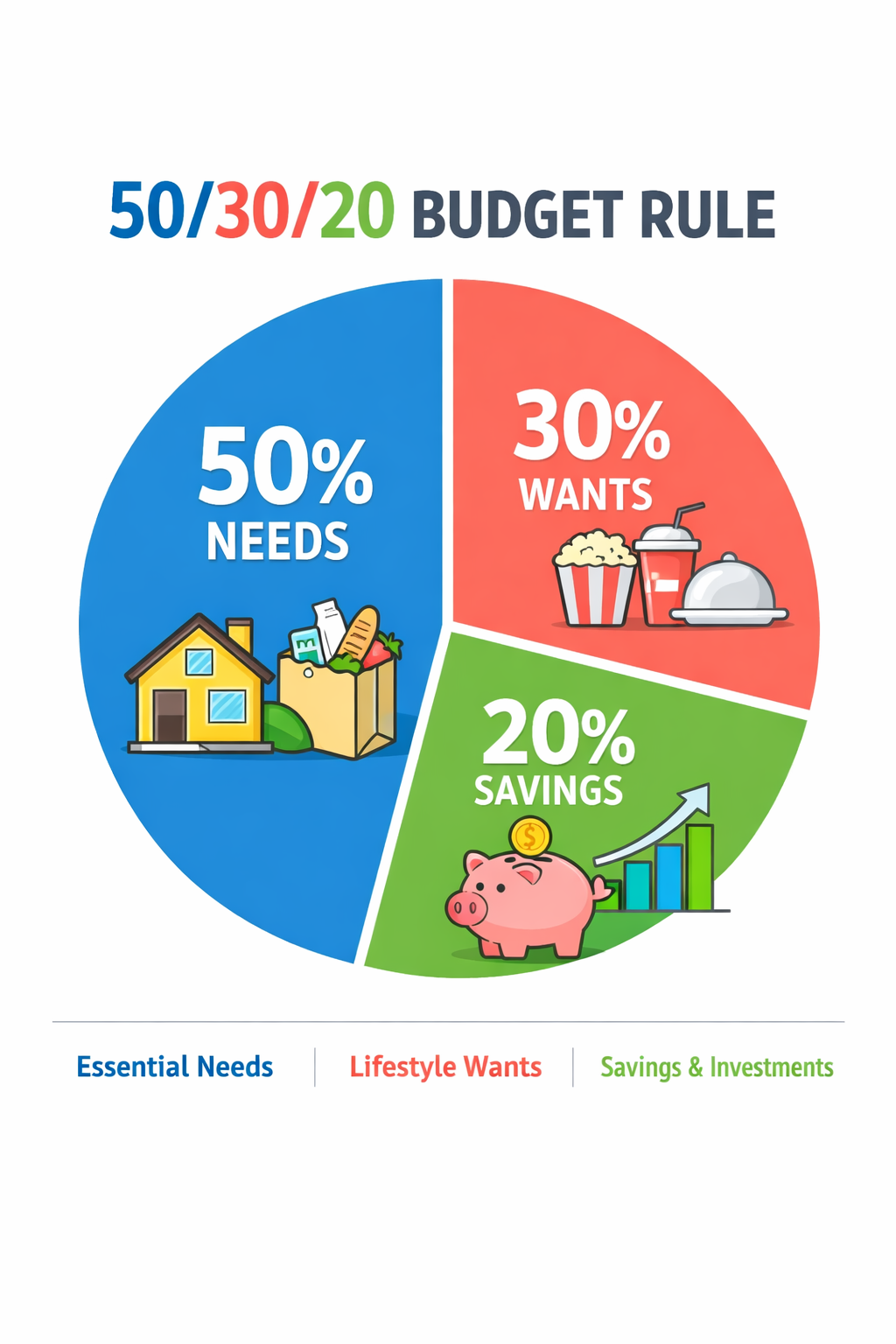
Let me introduce you to the easiest budgeting framework that exists: the 50/30/20 rule. I personally tried the 50/30/20 budget rule for 2 months and it completely changed my relationship with money.
Here’s how it breaks down:
| Category | Percentage | What It Includes |
|---|---|---|
| Needs | 50% | Housing, utilities, groceries, insurance, minimum debt payments, transportation |
| Wants | 30% | Dining out, entertainment, hobbies, shopping, subscriptions, non-essential purchases |
| Savings | 20% | Emergency fund, retirement, debt payoff beyond minimums, financial goals |
6. Apply the 50/30/20 to Your Income
Let’s say you bring home $3,000 per month:
- $1,500 for needs
- $900 for wants
- $600 for savings and debt payoff
If your numbers don’t fit perfectly yet, don’t stress. Use this as your target and work toward it gradually. You might also explore the 70/20/10 budget rule as an alternative if your situation requires more flexibility.
7. Use the Cash Envelope System for Variable Expenses
For categories where you tend to overspend (dining out, entertainment, personal care), withdraw cash and put it in labeled envelopes. When the envelope is empty, you’re done spending in that category for the month.
Why this works: Handing over physical cash creates a psychological pain point that swiping a card doesn’t. Studies show people spend 12-18% less when using cash instead of cards[2].
Building Your Financial Safety Net
8. Start with a Mini Emergency Fund 🚨
Forget the advice about saving 3-6 months of expenses right now. That’s overwhelming when you’re living paycheck to paycheck. Instead, focus on $500-$1,000 first.
This small buffer is enough to handle most common emergencies:
- Car repair
- Urgent medical co-pay
- Broken appliance
- Unexpected bill
Quick win: Try a 30-day saving challenge to jumpstart your emergency fund. Even saving $10-20 per week adds up to $520-$1,040 in a year.
9. Automate Your Savings
Set up an automatic transfer from your checking to savings account on payday—before you have a chance to spend it. Start with just $25 per paycheck if that’s all you can manage.
“Paying yourself first isn’t selfish—it’s essential. You can’t pour from an empty cup, and you can’t build wealth without saving consistently.”
The good financial habits you build now will compound over time. I’ve seen people use these genius savings strategy hacks to save $3,000 in just 90 days.
10. Use the “Round-Up” Method
Every time you make a purchase, round up to the nearest dollar and transfer the difference to savings. Spent $3.47 on coffee? Transfer $0.53 to savings. These micro-savings add up faster than you’d think—usually $50-100 per month without feeling the pinch.
Cutting Costs Without Feeling Deprived

11. Implement “No-Spend” Days
Choose 2-3 days per week where you spend absolutely nothing except pre-planned expenses. No coffee runs, no online shopping, no “just browsing” that turns into buying.
Challenge yourself: Try these no-spend challenge tips to make it fun rather than restrictive. Many people save $200-400 monthly just by implementing strategic no-spend days.
12. Master the 24-Hour Rule
Before making any non-essential purchase over $25, wait 24 hours. Add it to a wishlist and revisit it the next day. You’ll be surprised how often the urge passes.
Bonus benefit: This simple pause prevents impulse purchases, which account for 40-80% of all purchases depending on the category[3].
13. Embrace Strategic Frugality 💰
Being frugal doesn’t mean being cheap—it means being intentional. Focus on cutting costs in areas that don’t impact your happiness while spending freely on what truly matters to you.
Check out these frugal living tips and life hacks that helped me save hundreds monthly without feeling restricted. The key is finding the balance between saving and living.
Increasing Your Income (Because You Can’t Cut Your Way to Wealth)
14. Start a Side Hustle with Zero Investment
While cutting expenses helps, increasing income accelerates your progress dramatically. Consider these home businesses you can start with no money:
- Freelance writing or editing
- Virtual assistant services
- Online tutoring
- Social media management
- Pet sitting or dog walking
Even an extra $200-500 monthly can transform your financial situation. Explore these realistic ideas for making money from home that fit around your current schedule.
15. Build Passive Income Streams
Once you’ve stabilized your budget, start thinking about passive income ideas that work in 2026. These include:
- Dividend-paying investments (start with micro-investing if you’re new)
- Digital products or courses
- Affiliate marketing
- Rental income (including renting out storage space or parking)
Passive income won’t happen overnight, but starting now means you’ll be earning while you sleep in the future.
Avoiding Common Budgeting Pitfalls

Even with the best intentions, certain mistakes can derail your progress. Here are the most common budgeting mistakes to avoid:
❌ Being too restrictive: Budgets that allow zero fun money always fail. Build in 5-10% for guilt-free spending.
❌ Ignoring irregular expenses: Annual costs like insurance, gifts, and car registration need to be divided by 12 and saved monthly.
❌ Not adjusting your budget: Your budget should evolve with your life. Review and adjust it monthly.
❌ Forgetting to celebrate wins: When you hit a savings milestone or pay off a debt, acknowledge it! Positive reinforcement keeps you motivated.
❌ Comparing yourself to others: Your financial journey is unique. Focus on progress, not perfection.
Taking Action: Your Next Steps
Breaking free from the paycheck-to-paycheck cycle isn’t about making huge, dramatic changes overnight. It’s about implementing these simple systems consistently until they become automatic.
Here’s your action plan for this week:
- Today: Track every purchase for the next seven days
- Day 3: Calculate your 50/30/20 numbers based on your actual income
- Day 5: Set up automatic savings transfer of at least $25 per paycheck
- Day 7: Review your spending tracker and identify your top three money leaks
- Week 2: Cancel unused subscriptions and redirect that money to savings
Remember, these simple habits that help you stay debt-free for life start with small, consistent actions. You don’t need to be perfect—you just need to be persistent.
Conclusion
Budgeting for dummies isn’t about complicated spreadsheets or restrictive penny-pinching. It’s about gaining control of your money through simple, sustainable systems that actually work in real life. The 15 tricks I’ve shared aren’t theoretical—they’re the exact strategies that helped me and thousands of others stop living paycheck to paycheck.
Start with just one or two tricks from this list. Maybe it’s tracking your spending for a week or setting up automatic savings. Once those become habits, add another trick. Small changes compound into massive results over time.
The path from paycheck-to-paycheck to financial stability isn’t as long as you think. With these simple budgeting strategies, you can stop living paycheck to paycheck in just 90 days. Your future self will thank you for starting today.
What’s the one trick you’re going to implement this week? Pick one, commit to it, and watch your financial confidence grow. You’ve got this! 💪