
Picture this: You’re sitting on the couch at 2 PM, finally getting that precious moment of silence as your little one drifts off to sleep. Instead of scrolling mindlessly through social media or folding the never-ending pile of laundry, what if you could use that time to build something that’s entirely yours? Something that brings in extra income, reignites your passion, and fits perfectly into the chaos of motherhood?
You’re not alone in dreaming about this. More than 60% of mothers are interested in supplementing their income through entrepreneurship, and women now account for 49% of new business owners as of 2020[1][2]. The rise of stay at home mom entrepreneurs isn’t just a trend—it’s a movement reshaping how we think about work, family, and financial independence in 2026.
I’ve been there myself, wondering if I could actually build a business while managing diaper changes, toddler tantrums, and the mental load that comes with motherhood. The good news? You absolutely can. And you don’t need a fancy business degree, thousands of dollars in startup capital, or even a full workday to make it happen.
Key Takeaways
- 60% of moms are exploring entrepreneurship as a way to create flexible income while staying home with their children, with approximately 5 million mom-owned businesses currently operating in the U.S.[1][2]
- Nap time businesses are realistic and profitable—most successful stay at home mom entrepreneurs start with just 1-3 hours per day during children’s sleep times
- Low-barrier business ideas like virtual assistance, freelance writing, handmade products, online courses, and social media management require minimal startup costs and can be launched quickly
- Nearly 75% of mompreneurs serve as primary childcare providers while building their businesses, proving you don’t have to choose between being present for your kids and pursuing financial goals[4]
- Strategic time management and realistic expectations are crucial—starting small and scaling gradually leads to sustainable success without burnout
Why Stay at Home Mom Entrepreneurs Are Thriving in 2026
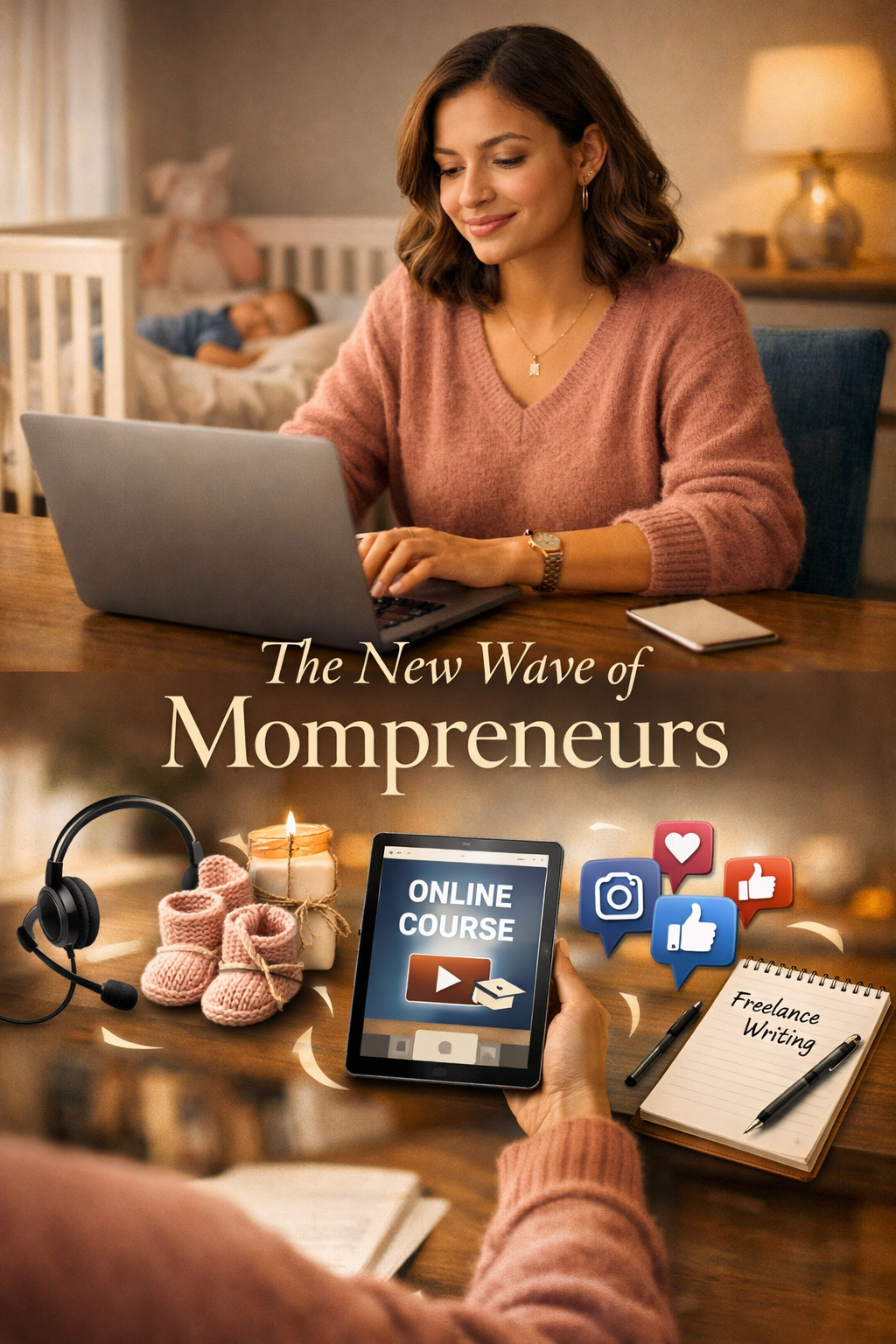
The landscape for stay-at-home mom entrepreneurs has never been more promising. Between 2007 and 2021, women-owned businesses increased nationally by 27%, and women now own 44.1% of small businesses in the U.S.—that’s more than 15 million businesses generating approximately $1.8 trillion in annual revenue[2][3].
But what’s driving this massive shift?
The Perfect Storm of Opportunity 🌟
Several factors have converged to create an ideal environment for moms to launch businesses from home:
Technology has leveled the playing field. You no longer need a storefront, expensive equipment, or even an office. A laptop, internet connection, and determination are often enough to get started.
Flexible work is the new normal. The pandemic permanently changed how we view work-life integration. Companies and clients are more accepting of flexible schedules and remote collaboration than ever before.
The side hustle economy is booming. Platforms like Shopify, Etsy, Teachable, and Upwork have made it incredibly easy to monetize your skills and reach customers globally.
Childcare costs are astronomical. With the average cost of childcare rivaling mortgage payments in many areas, staying home while earning income makes financial sense for many families.
The Reality of Mom Entrepreneurship
Let’s be honest—it’s not all Instagram-worthy laptop-on-the-beach moments. The data shows that 57% of surveyed mompreneurs are 40 years old or older, 79% are married, and 95% have a partner who brings in income[4]. This tells us that most mom entrepreneurs aren’t trying to replace a full-time income overnight—they’re strategically building businesses that complement their family’s financial picture.
Here’s what really resonates with me: 88% of mompreneurs spend less than 3-4 hours per week on hobbies[4]. We’re not looking for another time-consuming obligation. We need business ideas that fit into the fragments of time we actually have—like nap time.
If you’re interested in exploring home businesses you can start with no money, you’re already thinking in the right direction.
Understanding Your Unique Advantages as a Stay-at-Home Mom
Before we dive into specific business ideas, let’s talk about why you’re actually in a better position than you might think.
Skills You’ve Already Mastered
Being a stay-at-home mom has taught you invaluable business skills:
- Project management: Coordinating doctor appointments, meal planning, activities, and household management requires serious organizational skills
- Multitasking under pressure: You can handle a conference call while preventing a toddler meltdown—that’s executive-level crisis management
- Negotiation: If you can convince a three-year-old to eat vegetables, you can close a business deal
- Time optimization: You’ve learned to accomplish tasks in whatever time windows appear
- Emotional intelligence: Understanding needs, building relationships, and communicating effectively are core business competencies
- Budget management: Stretching household budgets translates directly to managing business finances
The Nap Time Advantage ⏰
Most traditional businesses require large blocks of uninterrupted time. But as stay at home mom entrepreneurs, we’ve learned to work differently. Nap time—whether it’s 45 minutes or two glorious hours—becomes sacred productive time.
The businesses I’m sharing today are specifically chosen because they:
✅ Can be started during short time windows
✅ Don’t require you to be “on” at specific times
✅ Allow you to pause and resume without losing momentum
✅ Scale gradually as your children grow and your available time increases
✅ Require minimal startup investment
Business Idea #1: Virtual Assistant Services
Virtual assistance is hands-down one of the most accessible entry points for stay at home mom entrepreneurs. The virtual assistant industry is projected to continue growing exponentially, with businesses of all sizes seeking remote support.
What Does a Virtual Assistant Actually Do?
Virtual assistants provide administrative, technical, or creative support to clients remotely. The beauty of this business model is its flexibility—you can specialize in areas that match your existing skills.
Common VA services include:
- Email management and inbox organization
- Calendar scheduling and appointment coordination
- Social media posting and engagement
- Data entry and spreadsheet management
- Customer service and client communication
- Travel planning and research
- Basic bookkeeping and invoicing
- Content formatting and blog post uploading
Why This Works for Nap Time
VA work is typically task-based rather than time-based. You can batch similar tasks together and complete them during nap time, early mornings, or evenings. Most clients care about quality and deadlines, not when you’re actually working.
Getting Started
Step 1: Identify Your Service Offering
Start with 2-3 services you’re confident providing. Don’t try to be everything to everyone initially.
Step 2: Set Your Rates
Beginning VAs typically charge $15-25 per hour, while experienced VAs with specialized skills can earn $50-75+ per hour. Consider starting with project-based pricing to avoid hourly time tracking stress.
Step 3: Find Your First Clients
- Reach out to small business owners in your network
- Join Facebook groups for entrepreneurs seeking VAs
- Create profiles on Upwork, Fiverr, or Belay
- Offer a discounted trial period to build testimonials
Step 4: Deliver Exceptional Service
Your first few clients are your portfolio. Overdeliver, ask for testimonials, and request referrals.
Real Income Potential 💰
If you work just 10 hours per week at $25/hour, that’s $1,000 per month. As you gain experience and raise rates, 15 hours per week at $40/hour equals $2,400 monthly—all during nap times and after bedtime.
For more ideas on building income streams, check out these realistic ideas for making money from home.
Business Idea #2: Handmade Products and Crafts
If you’re creative and enjoy making things with your hands, turning your hobby into a business could be your perfect nap time venture. The handmade market continues to thrive, with consumers increasingly valuing unique, artisan-created items over mass-produced alternatives.
Popular Handmade Business Ideas
For the crafty mom:
- Jewelry (earrings, bracelets, necklaces)
- Candles and home fragrances
- Soap and bath products
- Knitted or crocheted items
- Personalized gifts and decor
- Baby accessories and clothing
- Printable art and planners
- Resin crafts and accessories
The Business Model That Works
The key to success with handmade products is batch production. Instead of making one item at a time, you create multiple products during focused work sessions.
Here’s a realistic schedule:
| Time Block | Activity |
|---|---|
| Monday nap time | Design new products, order supplies |
| Tuesday nap time | Batch create 10-15 items |
| Wednesday nap time | Photography and listing creation |
| Thursday nap time | Social media content creation |
| Friday nap time | Order fulfillment and customer service |
Platforms to Sell Your Products
Etsy remains the go-to marketplace for handmade goods, with built-in traffic and buyer trust. You’ll pay listing fees and transaction fees, but you gain access to millions of potential customers.
Instagram and Facebook Shops allow you to sell directly to your followers without marketplace fees.
Local markets and craft fairs provide face-to-face selling opportunities on weekends when your partner can watch the kids.
Startup Costs and Profit Margins
Most handmade businesses can start with $100-300 in supplies. The key is to price for profit, not just to cover materials.
Pricing formula:
(Materials + Labor + Overhead) × 2 = Wholesale Price
Wholesale Price × 2 = Retail Price
If earrings cost $3 in materials and take 15 minutes to make (valued at $20/hour = $5), your cost is $8. Add overhead ($2), multiply by 2 for wholesale ($20), then by 2 for retail ($40).
Success Tips for Handmade Businesses
🎯 Niche down: Instead of “jewelry,” become “minimalist geometric earrings for professional women”
🎯 Invest in photography: Your product photos are your storefront
🎯 Build an email list: Own your customer relationships
🎯 Create seasonal collections: Give customers reasons to return
🎯 Automate where possible: Use scheduling tools for social media
Business Idea #3: Freelance Writing and Content Creation
If you enjoy writing, freelance content creation offers unlimited income potential with ultimate flexibility. Businesses desperately need quality content for blogs, websites, email campaigns, and social media—and they’re willing to pay well for it.
Types of Freelance Writing
Blog posts and articles: The most common entry point, with rates ranging from $50-500+ per post depending on length and expertise.
Website copy: Product descriptions, About pages, and landing pages command premium rates ($100-1,000+ per project).
Email marketing: Businesses need engaging email sequences and newsletters ($75-300 per email).
Social media content: Captions, posts, and content calendars ($200-1,000+ per month per client).
Case studies and white papers: B2B companies pay top dollar for these ($500-3,000+ each).
Why This Is Perfect for Stay at Home Mom Entrepreneurs
Writing is the ultimate nap time business because:
✍️ You control your schedule completely
✍️ Work can be done in small chunks and saved
✍️ No video calls required (though some clients may want them)
✍️ Income scales with skill, not just time
✍️ Minimal startup costs (just a computer and internet)
Getting Your First Clients
Start with your network: Let friends and family know you’re available for writing projects.
Pitch directly to businesses: Find small businesses with outdated blogs or minimal web content and send personalized pitches explaining how you can help.
Use freelance platforms: Upwork, Fiverr, and Contently connect writers with clients, though they take a percentage of your earnings.
Guest post strategically: Write for established blogs in your niche to build credibility and attract clients.
Create samples: If you don’t have client work yet, write 2-3 strong samples in your target niche and publish them on Medium or your own simple website.
Building Your Rates
Don’t undersell yourself. Here’s a realistic progression:
- Beginner (0-6 months): $50-100 per 1,000-word blog post
- Intermediate (6-18 months): $150-300 per post
- Experienced (18+ months): $300-600+ per post
- Expert/Specialized: $1,000+ per post in technical or specialized niches
Many successful freelance writers earn $3,000-6,000+ per month working 15-20 hours per week—all during nap times and after kids’ bedtime.
Developing high income skills to learn at home like copywriting can significantly boost your earning potential.
Business Idea #4: Online Courses and Digital Products
Creating and selling online courses or digital products is the ultimate passive income strategy for stay at home mom entrepreneurs. You create the product once, then sell it repeatedly without trading hours for dollars.
What Can You Teach?
You don’t need to be a world-renowned expert to create a valuable course. You just need to know more than your target audience and be able to teach it clearly.
Popular course topics for moms:
- Parenting strategies and child development
- Organization and productivity systems
- Budget management and financial planning
- Healthy meal planning and prep
- Crafts and DIY projects
- Fitness and postpartum recovery
- Career transition and resume writing
- Social media marketing basics
- Photography for beginners
Types of Digital Products
Online courses: Comprehensive video or text-based lessons ($27-497+)
Ebooks and guides: Written resources solving specific problems ($7-47)
Templates and printables: Ready-to-use resources like planners, checklists, or worksheets ($5-27)
Membership communities: Ongoing access to resources and support ($9-97/month)
The Creation Process During Nap Time
Creating digital products requires upfront time investment, but it’s perfectly suited to nap time work:
Week 1-2: Outline your content and create your curriculum
Week 3-4: Record video lessons or write content (in small chunks)
Week 5: Edit and organize materials
Week 6: Set up your sales page and payment system
Week 7+: Launch and market your product
Platforms to Host Your Products
Teachable, Thinkific, or Kajabi: All-in-one course platforms with built-in payment processing ($39-199/month)
Gumroad or SendOwl: Simple digital product delivery (free or low monthly fees)
Your own website with WordPress: Maximum control, requires more technical knowledge
Real Income Potential 📈
Let’s say you create a $47 course on meal planning for busy moms. If you sell just 20 courses per month, that’s $940 in mostly passive income. As you build your audience and create additional products, this scales significantly.
One mom I know created a simple $19 printable planner pack and sells 50-100 per month through Etsy and Instagram—that’s $950-1,900 monthly from a product she created once.
Exploring smart passive income ideas can help you understand how to build income that works while you sleep.
Business Idea #5: Social Media Management

Businesses know they need to be on social media, but most small business owners don’t have time to post consistently or engage with their audience. That’s where you come in as a social media manager.
What Social Media Managers Do
Your role is to maintain and grow a business’s social media presence by:
- Creating content calendars and planning posts
- Designing graphics using tools like Canva
- Writing engaging captions and hashtags
- Scheduling posts in advance using tools like Later or Buffer
- Responding to comments and messages
- Analyzing performance metrics
- Running basic ad campaigns
- Staying current with platform trends
Why This Works for Nap Time Entrepreneurs
Social media management is batch-work friendly. You can create an entire month’s worth of content during a few focused nap time sessions, then schedule everything to post automatically.
Typical workflow:
- Week 1: Client consultation and content planning
- Week 2: Content creation (graphics, captions, hashtags)
- Week 3: Scheduling posts for the month
- Week 4: Engagement, analytics, and adjustments
Daily engagement might require 15-30 minutes, which you can do from your phone while your toddler plays independently.
Getting Started Without Experience
Take a free course: Platforms like HubSpot Academy offer free social media certifications.
Practice on your own accounts: Build your own following to demonstrate your skills.
Offer free or discounted trial months: Get 2-3 businesses to let you manage their accounts for a month at a reduced rate in exchange for testimonials.
Specialize in one platform first: Become an Instagram expert or TikTok specialist rather than trying to master everything.
Pricing Your Services 💵
Social media management packages typically include:
Basic Package ($300-500/month):
- 3-4 posts per week on one platform
- Caption writing and hashtag research
- Basic engagement (30 min/day)
Standard Package ($600-1,000/month):
- Daily posting on 2 platforms
- Custom graphics
- Community management
- Monthly analytics report
Premium Package ($1,200-2,000/month):
- Multi-platform management
- Content creation (photos/videos)
- Ad campaign management
- Strategy development
With just 3-4 clients on standard packages, you’re earning $2,400-4,000 per month—life-changing money for many families.
Time Management Strategies for Stay at Home Mom Entrepreneurs
Having a great business idea means nothing if you can’t find time to execute it. Here’s how successful stay at home mom entrepreneurs actually make it work.
The Nap Time Power Hour ⚡
Not all nap time work is created equal. Use this framework to maximize productivity:
First 10 minutes: Quick admin tasks (check emails, respond to messages, review to-do list)
Next 40-50 minutes: Deep work on your most important task (creating content, client work, product development)
Final 10 minutes: Prep for tomorrow (set up your workspace, outline next session’s work)
Batch Everything
Batching similar tasks together dramatically increases efficiency:
- Content creation day: Create all social posts, blog content, or products for the week
- Admin day: Invoicing, bookkeeping, email management
- Client communication day: Calls, check-ins, project updates
- Marketing day: Social media engagement, networking, pitching
Use the “Minimum Viable Progress” Approach
On tough days when nap time is only 30 minutes (or nonexistent), what’s the minimum you can do to move forward?
- Write 100 words instead of a full blog post
- Create one social post instead of a week’s worth
- Respond to one client email instead of clearing your inbox
- List one product instead of ten
Small progress compounds over time and prevents the all-or-nothing thinking that leads to burnout.
Strategic Use of After-Hours Time
Many successful mom entrepreneurs work a split schedule:
- Nap time (1-2 hours): Deep work requiring focus
- Evening (1-2 hours after kids’ bedtime): Admin, planning, lighter tasks
- Early morning (optional, 30-60 minutes): Personal development, learning
This gives you 2.5-5 hours of work time daily without sacrificing family time or sleep.
Protecting Your Time and Energy
Set clear boundaries:
🚫 Don’t: Check work emails during playtime
✅ Do: Set specific “work windows” and be fully present otherwise
🚫 Don’t: Say yes to every client or project
✅ Do: Choose clients and work that align with your schedule and values
🚫 Don’t: Compare your progress to full-time entrepreneurs
✅ Do: Celebrate your unique wins and pace
For more strategies on managing money while building your business, explore these budgeting hacks for beginners.
Setting Realistic Financial Goals
Let’s talk numbers. What can you realistically expect to earn as a stay at home mom entrepreneur, and how should you think about your business finances?
First Year Income Expectations
Months 1-3: $0-500/month
You’re learning, building systems, and getting your first clients. Focus on skills over income.
Months 4-6: $500-1,500/month
You have a few clients or consistent sales. You’re refining your offerings.
Months 7-12: $1,500-3,000/month
You’ve found your rhythm, have testimonials, and are growing steadily.
Year 2+: $3,000-6,000+/month
With established systems and reputation, income accelerates.
These are conservative estimates. Some moms exceed these numbers quickly, while others take longer—both are perfectly fine.
Reinvesting vs. Taking Profit
In your first year, consider this split:
- 50% to yourself (you deserve to be paid!)
- 30% reinvested in business growth (tools, education, marketing)
- 20% saved for taxes and emergencies
As your business stabilizes, shift to taking 70-80% as profit.
The Tax Reality
Remember that self-employment income is taxed differently than W-2 income. Set aside 25-30% of your earnings for taxes, or make quarterly estimated tax payments to avoid a surprise bill.
Tracking Your Business Finances
Keep business and personal finances separate from day one:
✅ Open a separate checking account for business income and expenses
✅ Use accounting software like Wave (free) or QuickBooks
✅ Save all receipts and track deductible expenses
✅ Consider working with a tax professional once you’re earning consistently
Understanding the 7 streams of income can help you diversify your revenue sources over time.
Overcoming Common Obstacles

Every stay at home mom entrepreneur faces challenges. Here’s how to navigate the most common ones.
“I Don’t Have Enough Time”
Reality check: You probably have more time than you think—it’s just fragmented.
Solution: Track your time for one week. You’ll likely find pockets of time currently spent on low-value activities (scrolling social media, watching TV) that could be redirected to business building.
Mindset shift: You’re not looking for large blocks of time. You’re looking for 15-30 minute pockets that add up to meaningful progress.
“I Feel Guilty Working While My Kids Are Home”
Reality check: You’re modeling entrepreneurship, work ethic, and financial independence for your children.
Solution: Reframe “work time” as “teaching time.” Your kids are learning that moms can be nurturing caregivers AND ambitious businesswomen.
Practical tip: Involve age-appropriate kids in your business. Let them help package products, choose colors, or be your “assistant.”
“My Partner Doesn’t Take My Business Seriously”
Reality check: This is unfortunately common, especially in the early stages when income is minimal.
Solution: Have a clear conversation about your goals, timeline, and what support you need. Share statistics about mom entrepreneurs and your business plan.
Boundary setting: Establish that nap time is your work time, just as sacred as if you were at an office job.
“I’m Afraid I’ll Fail”
Reality check: Most businesses don’t fail—they’re just abandoned before they have a chance to succeed.
Solution: Redefine failure. The only true failure is not trying. Everything else is learning.
Action step: Set a minimum commitment period (6-12 months) where you promise yourself you won’t quit, no matter what.
“I Don’t Know Where to Start”
Reality check: Analysis paralysis keeps more moms from starting than any actual obstacle.
Solution: Choose ONE business idea from this article. Spend this week researching it. Next week, take one concrete action (create a social media account, buy a domain, reach out to a potential client).
Remember: Done is better than perfect. Start messy and refine as you go.
Building Your Support System
You don’t have to do this alone. In fact, you shouldn’t.
Find Your Tribe
Connect with other stay at home mom entrepreneurs:
- Join Facebook groups specifically for mom entrepreneurs
- Participate in local mom business networking groups
- Follow and engage with mompreneurs on Instagram
- Attend virtual summits and webinars for women in business
Invest in Education
The most successful mom entrepreneurs are continuous learners:
- Take affordable online courses in your business area
- Listen to business podcasts during household tasks
- Read books about entrepreneurship and marketing
- Watch YouTube tutorials for specific skills
Consider a Mentor or Coach
Once you’re earning consistently, investing in a business coach or mentor can accelerate your growth exponentially. Look for someone who understands the unique challenges of mom entrepreneurship.
Get Family Buy-In
Your business will thrive when your family supports it:
- Share your wins and challenges with your partner
- Explain to your kids (in age-appropriate ways) what you’re building
- Ask for specific help when you need it
- Celebrate milestones together as a family
Your Next Steps: Creating Your Action Plan
You’ve read about five viable business ideas for stay at home mom entrepreneurs. Now it’s time to take action.
This Week
Day 1-2: Choose ONE business idea that excites you most and aligns with your skills.
Day 3-4: Research that business model thoroughly. Read success stories, join relevant groups, understand the market.
Day 5-6: Create a simple one-page business plan outlining:
- Your service/product
- Your target customer
- Your pricing
- Your first 3 months’ goals
Day 7: Take your first concrete action (register a business name, create a social media account, reach out to a potential client).
This Month
- Set up basic business infrastructure (email, social media, payment system)
- Create your first offer or product
- Reach out to 10 potential customers or clients
- Make your first sale or sign your first client
This Quarter
- Refine your offering based on initial feedback
- Establish consistent work routines during nap time
- Build a small portfolio or customer base
- Aim for $500-1,000 in revenue
This Year
- Scale to $2,000-3,000 monthly income
- Develop systems and processes that create efficiency
- Consider expanding your offerings or raising rates
- Celebrate your wins and learn from challenges
For additional ways to boost your income, check out these passive income ideas that earn money while you sleep.
Conclusion: Your Entrepreneurial Journey Starts Now
The statistics don’t lie: 60% of moms are interested in entrepreneurship, and millions are already building successful businesses from home[1]. You’re not alone in wanting more—more income, more fulfillment, more flexibility, and more control over your financial future.
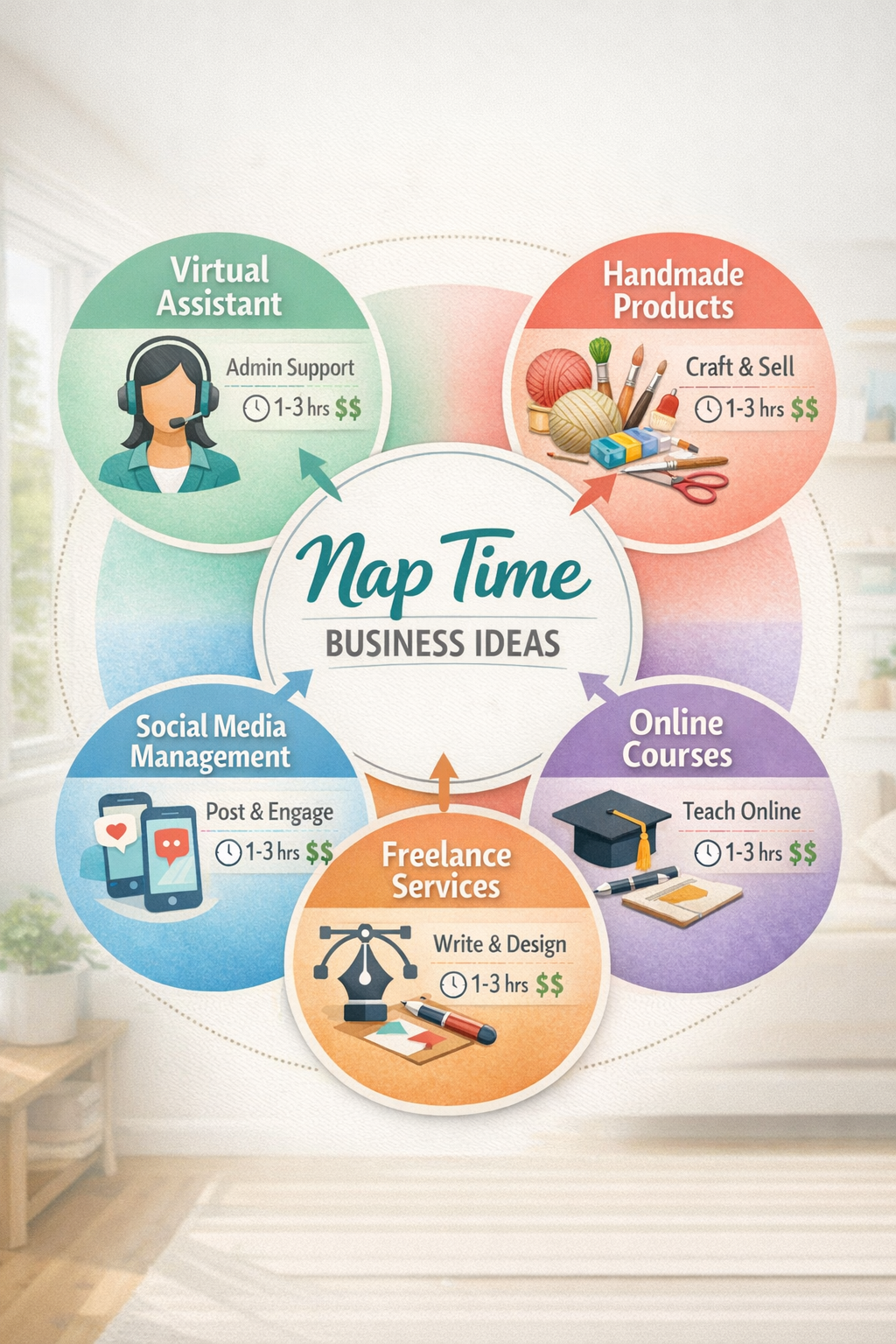
The five business ideas I’ve shared—virtual assistance, handmade products, freelance writing, online courses, and social media management—are all proven paths that stay at home mom entrepreneurs are using right now to build meaningful income during nap time.
You don’t need to choose between being present for your children and pursuing your ambitions. You don’t need to wait until your kids are in school or until you have more time. You don’t need permission, a business degree, or thousands in startup capital.
What you need is:
✨ A decision to start
✨ A willingness to learn as you go
✨ Consistency during those precious nap time hours
✨ Grace for yourself when things don’t go perfectly
✨ Belief that you’re capable of more than you imagine
Your journey as a mom entrepreneur won’t look like anyone else’s, and that’s exactly as it should be. Some days you’ll make incredible progress. Other days, survival mode will win, and that’s okay too.
The moms who succeed aren’t the ones with the most time, the best circumstances, or the fewest obstacles. They’re the ones who start anyway, who keep showing up during nap time, who believe their dreams matter just as much as their children’s needs.
So here’s my challenge to you: Don’t let this be another article you read and forget. Choose one business idea. Take one action this week. Start building something that’s entirely yours.
Your future self—the one running a thriving business while still being the mom you want to be—is waiting for you to begin.
The nap time is yours. What will you build with it? 💪