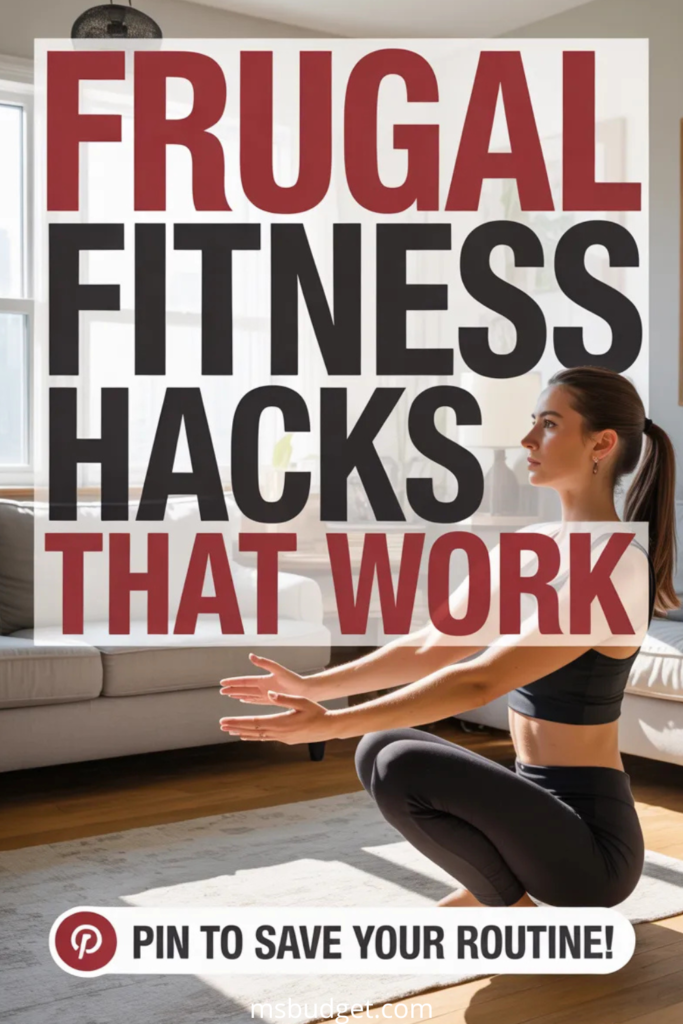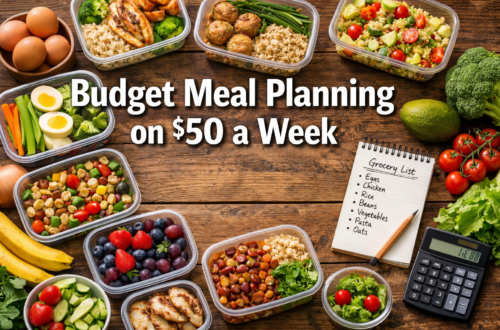
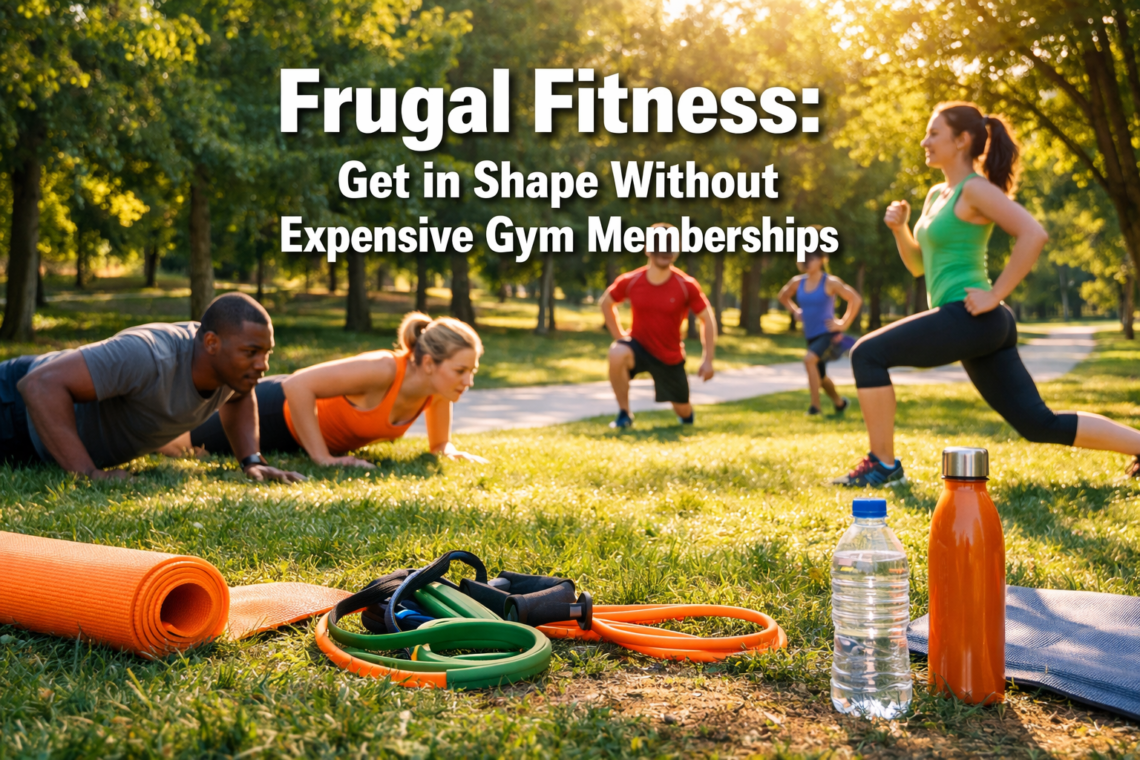
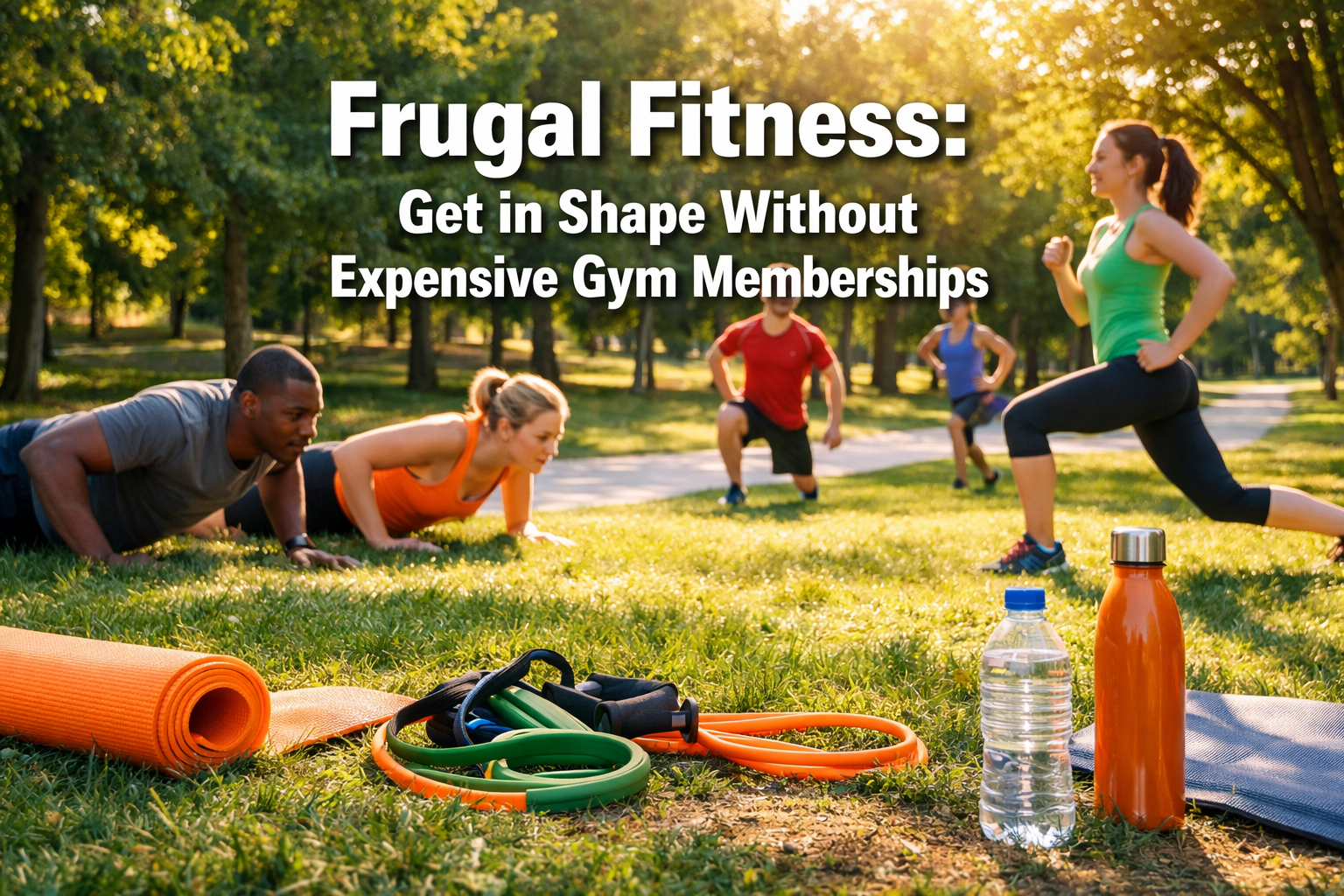
Let me tell you something that might surprise you: I haven’t paid for a gym membership in over three years, yet I’m in the best shape of my life. While my friends complain about $60+ monthly gym fees they rarely use, I’ve discovered that frugal fitness isn’t just possible—it’s actually more sustainable and enjoyable than traditional gym culture. In 2026, with 83% of Americans prioritizing saving money more than ever before[2], getting fit without breaking the bank isn’t just smart—it’s essential.
The fitness industry wants you to believe you need expensive equipment, premium memberships, and fancy workout gear to achieve your health goals. But here’s the truth: your body doesn’t care whether you’re lifting $500 dumbbells or doing bodyweight exercises in your living room. What matters is consistency, proper form, and progressive challenge—all of which cost absolutely nothing.
Key Takeaways
✅ Bodyweight exercises provide complete workouts requiring zero equipment investment and can be done anywhere, anytime
✅ Free outdoor spaces and public facilities offer gym-quality workout opportunities without membership fees
✅ Budget home gym setups under $100 can deliver the same results as expensive commercial gym equipment
✅ Free digital resources including apps, YouTube channels, and online communities provide professional guidance at no cost
✅ Strategic frugal fitness approaches can save $600-$1,200 annually while improving health outcomes
Why Frugal Fitness Makes Financial (and Physical) Sense
The average gym membership in 2026 costs between $50-$80 per month, totaling $600-$960 annually. Premium fitness studios charge even more—often $150-$200 monthly. But here’s the kicker: studies consistently show that most people who purchase gym memberships use them fewer than twice per week, and many stop going entirely within three months.
When you embrace frugal fitness strategies, you’re not just saving money—you’re actually setting yourself up for better long-term success. Without the financial pressure of “getting your money’s worth” from an expensive membership, you can focus on building sustainable habits that fit your lifestyle.
The Hidden Costs of Traditional Gym Memberships
Beyond the monthly fee, traditional gym memberships come with sneaky additional expenses:
- Initiation fees: $50-$200 upfront
- Annual maintenance fees: $30-$75 yearly
- Parking costs: $3-$10 per visit in urban areas
- Specialized class fees: $15-$30 per session
- Locker rentals: $5-$15 monthly
- Workout gear and accessories: $100+ annually
- Protein shakes and supplements: Often marked up 200-300%
When you add everything together, that “affordable” $50 monthly membership can easily cost $1,000+ per year. That’s money that could go toward paying down debt faster or building your emergency fund.
The Frugal Fitness Advantage
Freedom and flexibility top the list of frugal fitness benefits. You’re not tied to gym hours, commute times, or crowded equipment. You can work out at 5 AM or 11 PM—whatever fits your schedule. Plus, you avoid the intimidation factor that keeps many people from starting their fitness journey.
The home gym market experienced massive growth during the pandemic, but predictions indicate a decline in 2026 as consumers who already invested reduce new purchases[1]. This creates an opportunity: the budget equipment market remains strong with excellent deals available on Amazon and Facebook Marketplace[1].
Zero-Equipment Bodyweight Workouts That Actually Work
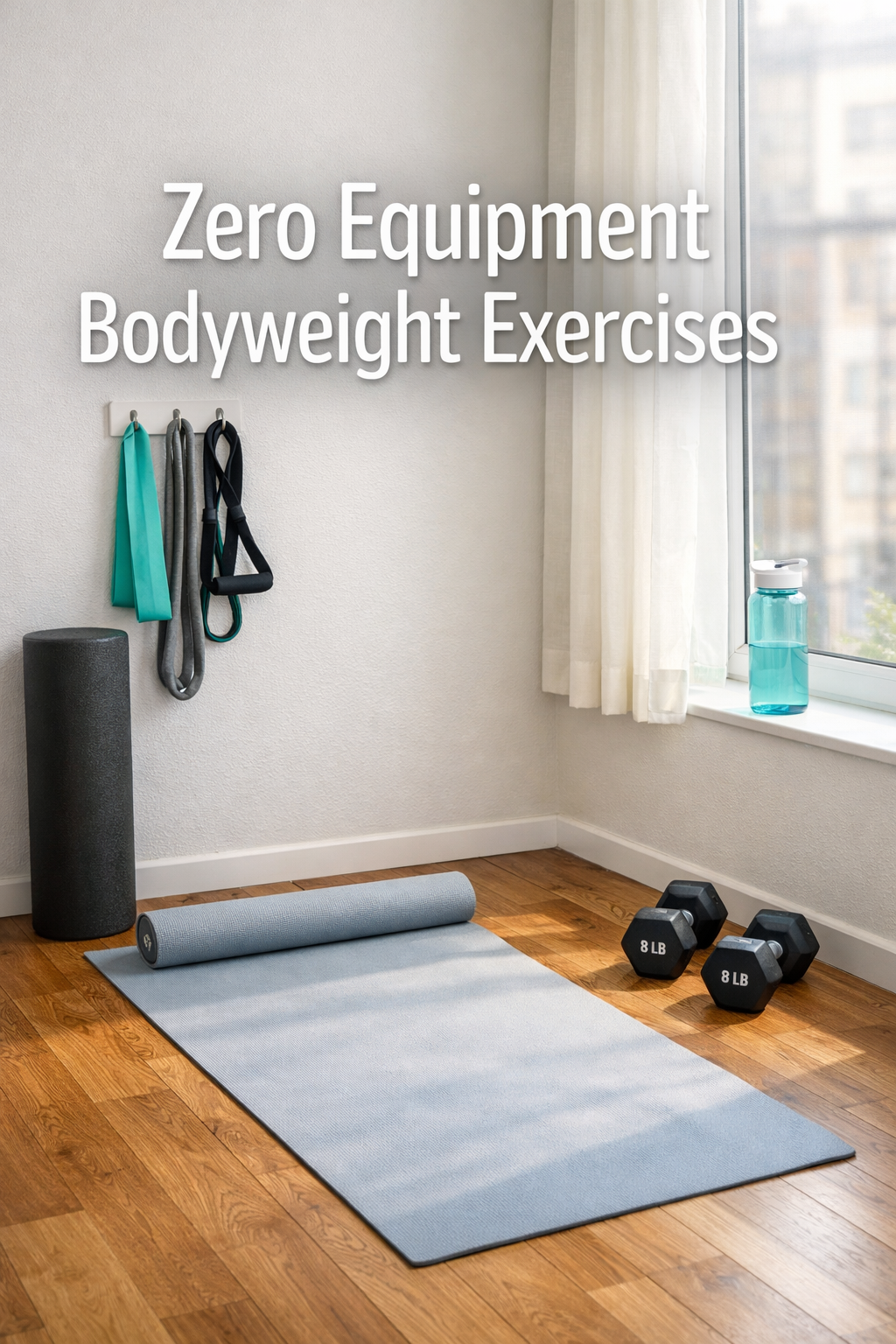
Let me share my favorite secret: bodyweight exercises are completely free and devastatingly effective. You don’t need a single piece of equipment to build strength, improve cardiovascular fitness, and transform your body composition.
The Complete Bodyweight Exercise Arsenal
Here’s a comprehensive list of exercises targeting every major muscle group:
Upper Body:
- Push-ups (standard, wide, diamond, decline)
- Tricep dips (using a chair or bench)
- Pike push-ups (shoulder focus)
- Plank variations (standard, side, up-down)
- Inverted rows (using a sturdy table)
Lower Body:
- Squats (bodyweight, jump, pistol, Bulgarian split)
- Lunges (forward, reverse, walking, jumping)
- Glute bridges (single-leg, elevated)
- Calf raises (single-leg for progression)
- Wall sits (isometric strength building)
Core:
- Crunches and sit-ups
- Bicycle crunches
- Leg raises
- Mountain climbers
- Russian twists
- Dead bugs
Full Body/Cardio:
- Burpees 💪
- Jumping jacks
- High knees
- Butt kicks
- Bear crawls
- Inchworms
Sample Weekly Bodyweight Workout Plan
| Day | Focus | Duration | Exercises |
|---|---|---|---|
| Monday | Upper Body | 30 min | Push-ups, Dips, Pike Push-ups, Planks |
| Tuesday | Lower Body | 30 min | Squats, Lunges, Glute Bridges, Calf Raises |
| Wednesday | Cardio/HIIT | 20 min | Burpees, Jumping Jacks, Mountain Climbers |
| Thursday | Core | 25 min | Planks, Leg Raises, Bicycle Crunches, Dead Bugs |
| Friday | Full Body | 35 min | Circuit combining all muscle groups |
| Saturday | Active Recovery | 30 min | Walking, Stretching, Yoga |
| Sunday | Rest | – | Complete rest or gentle stretching |
The beauty of bodyweight training is progressive overload without equipment. You can make exercises harder by:
- Increasing repetitions
- Slowing down the tempo
- Adding pauses at difficult points
- Progressing to single-leg/single-arm variations
- Incorporating plyometric (jumping) movements
- Reducing rest time between sets
Just like implementing frugal living tips that save money monthly, frugal fitness requires creativity and consistency rather than expensive investments.
Free Outdoor Fitness Spaces and Public Resources
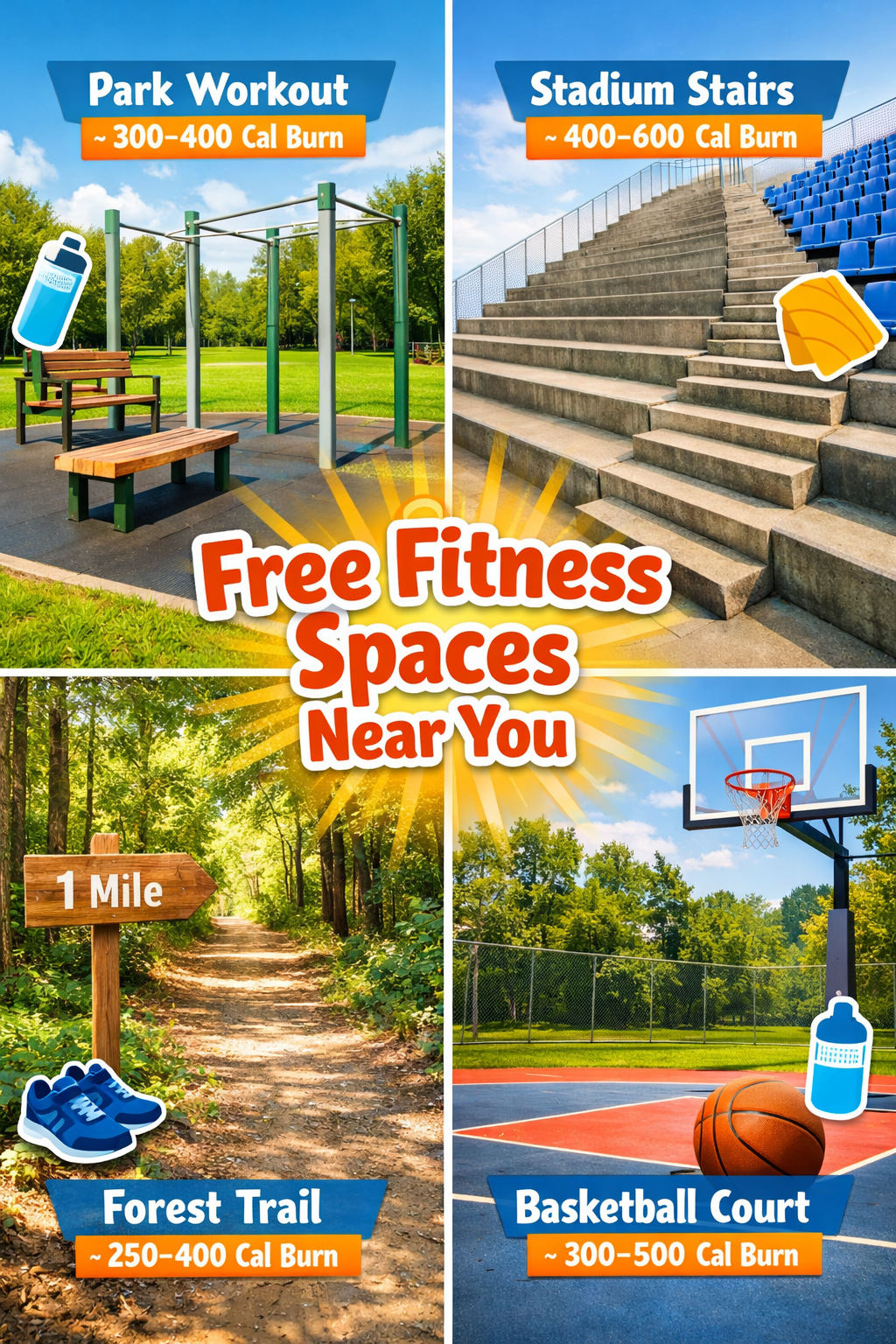
One of my biggest frugal fitness revelations came when I started exploring my community’s free fitness resources. You’d be amazed at what’s available once you start looking!
Public Parks and Recreation Areas
Most cities and towns offer incredible free fitness facilities:
Outdoor Fitness Equipment Parks 🏃♀️
Many municipalities have installed outdoor gym equipment in public parks. These typically include:
- Pull-up bars and dip stations
- Elliptical machines
- Stationary bikes
- Rowing machines
- Balance beams
- Stretching stations
Running and Walking Trails
Free cardio heaven! Most communities maintain trails perfect for:
- Running and jogging
- Power walking
- Interval training (sprint sections)
- Hill training for strength building
Sports Courts and Fields
Public basketball courts, tennis courts, soccer fields, and volleyball courts offer fantastic workout opportunities:
- Basketball shooting practice (cardio + coordination)
- Tennis wall practice (no partner needed)
- Field sprints and agility drills
- Bleacher workouts (step-ups, jumps, cardio)
Creative Use of Public Spaces
Think beyond traditional fitness areas:
Stadium Stairs
High school and college stadiums often allow public access. Stair climbing provides:
- Intense cardiovascular workout
- Lower body strengthening
- Calorie burning (100-150 calories per 10 minutes)
- Mental toughness training
Playground Equipment (yes, really!)
Adult playground workouts are trending for good reason:
- Monkey bars for pull-ups and grip strength
- Benches for step-ups and tricep dips
- Swing sets for core exercises
- Open spaces for bodyweight circuits
Beach and Sand Training
If you live near a beach, you have access to one of the best free fitness facilities:
- Sand running (burns 1.6x more calories than pavement)
- Beach volleyball
- Resistance training (sand provides natural resistance)
- Swimming (if applicable)
Community Programs and Free Classes
Many communities offer free or low-cost fitness programming:
- Recreation department classes: Often free or $5-10 per session
- Community center programs: Yoga, Zumba, senior fitness
- Running clubs: Free group runs with built-in accountability
- Outdoor boot camps: Many trainers offer free community workouts
- Library programs: Some libraries host fitness classes and workshops
I’ve found that these free community resources often provide better accountability and social connection than expensive gym memberships. Plus, exercising outdoors offers mental health benefits that indoor gyms simply can’t match.
Budget-Friendly Home Gym Equipment Under $100
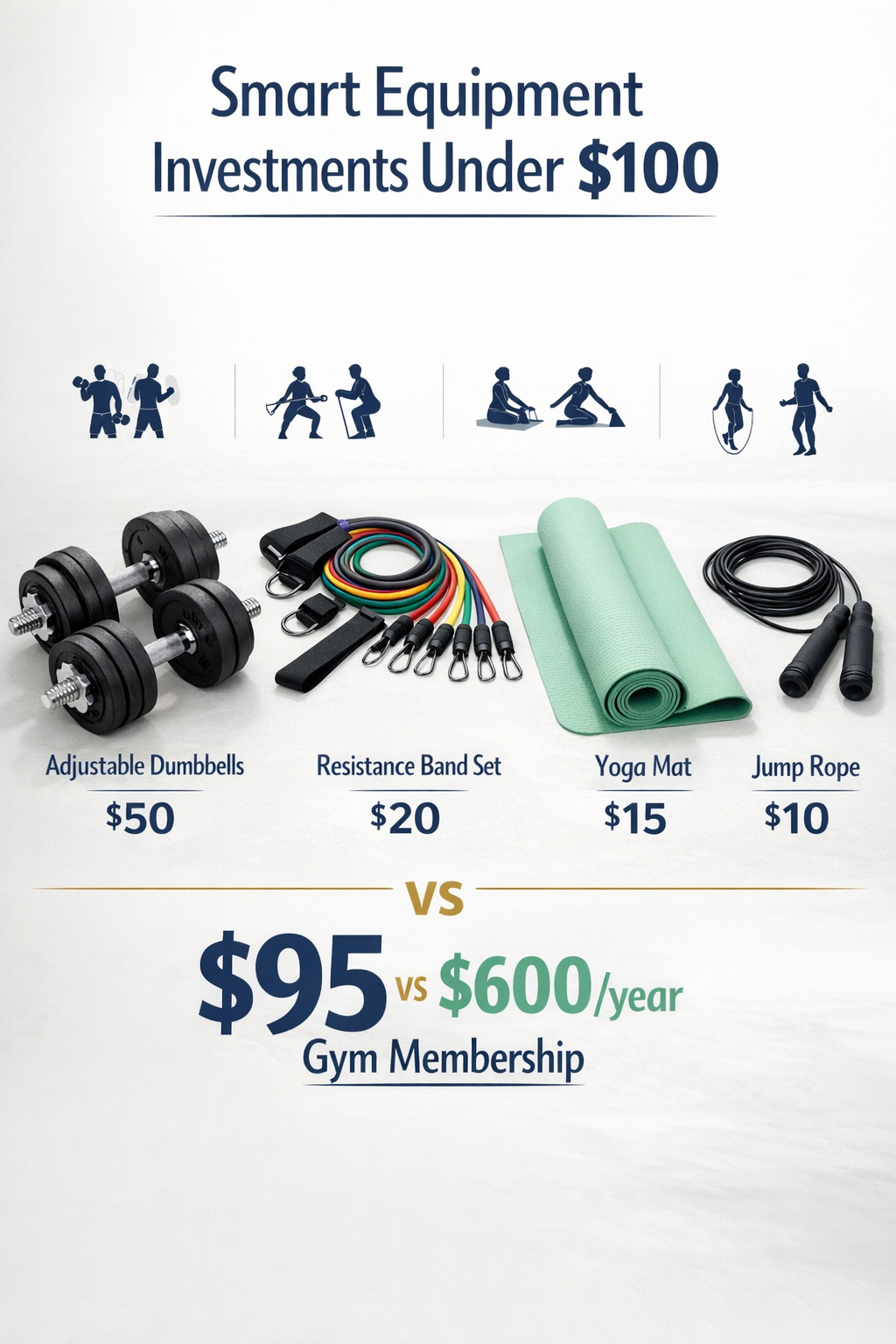
While bodyweight exercises and outdoor workouts can meet all your fitness needs, strategic equipment investments can add variety and progression to your frugal fitness routine. The key is choosing versatile, space-efficient equipment that delivers maximum value.
Despite overall market price increases, the budget home gym equipment segment remains strong in 2026, with excellent deals available through various channels[1]. Space constraints—not budget—are the primary limiting factor for most home gym owners[1], so prioritize compact, multi-functional items.
The Essential Frugal Home Gym (Total: $85-$95)
1. Resistance Bands Set ($15-$25) 💰
Arguably the best value in fitness equipment:
- Provides variable resistance from 5-150+ pounds
- Enables 100+ different exercises
- Portable and travel-friendly
- Takes up almost no storage space
- Perfect for all fitness levels
2. Adjustable Dumbbells or Standard Dumbbell Set ($30-$50)
Adjustable benches with modular attachment systems are gaining traction in 2026[1], but basic dumbbells remain essential:
- Start with 5-15 lb range for beginners
- Progress to 10-25 lb for intermediate
- Enable progressive overload for strength building
- Used for both upper and lower body exercises
3. Yoga Mat ($10-$20)
Not just for yoga:
- Provides cushioning for floor exercises
- Defines your workout space
- Useful for stretching and cool-downs
- Protects floors from equipment
4. Jump Rope ($8-$15)
Incredible cardio value:
- Burns 200+ calories in 15 minutes
- Improves coordination and footwork
- Portable and requires minimal space
- Adjustable for different heights
5. Foam Roller ($15-$25)
Recovery is crucial:
- Self-myofascial release (self-massage)
- Reduces muscle soreness
- Improves flexibility and range of motion
- Prevents injuries
Next-Level Budget Equipment ($100-$300)
If you want to expand your home gym gradually, consider these additions:
Pull-Up Bar ($25-$50)
Doorway-mounted or wall-mounted options provide:
- Upper body pulling exercises (often neglected)
- Core strengthening through hanging exercises
- Progression path from assisted to weighted pull-ups
Kettlebell ($30-$60)
Single kettlebell enables hundreds of exercises:
- Swings for explosive power and cardio
- Turkish get-ups for full-body strength
- Goblet squats for lower body
- One piece of equipment, endless possibilities
Adjustable Bench ($80-$150)
Smith machines and squat racks are predicted to be “the biggest thing again in 2026″[1], but an adjustable bench offers better value for budget-conscious buyers:
- Enables incline, decline, and flat exercises
- Dramatically increases dumbbell exercise variety
- More space-efficient than large rack systems
Where to Find Budget Equipment Deals
Amazon remains competitive for budget equipment, but don’t overlook:
- Facebook Marketplace: People constantly sell barely-used equipment
- Craigslist: Especially good for heavier items like benches
- Garage sales and estate sales: Often find equipment for 10-20% of retail
- End-of-year clearance sales: January and September offer best deals
- Dick’s Sporting Goods and Academy Sports: Regular sales on basics
- Walmart and Target: Competitive pricing on entry-level equipment
“For home gym owners, ceiling height and available space—not cost—are the primary limiting factors in equipment selection.” – Home Gym Market Analysis[1]
This means you should focus on equipment that fits your space rather than trying to replicate a commercial gym. Similar to how frugal grocery hacks help you save money by shopping smarter, frugal fitness equipment purchases require strategic thinking about value and versatility.
Free Digital Fitness Resources and Apps
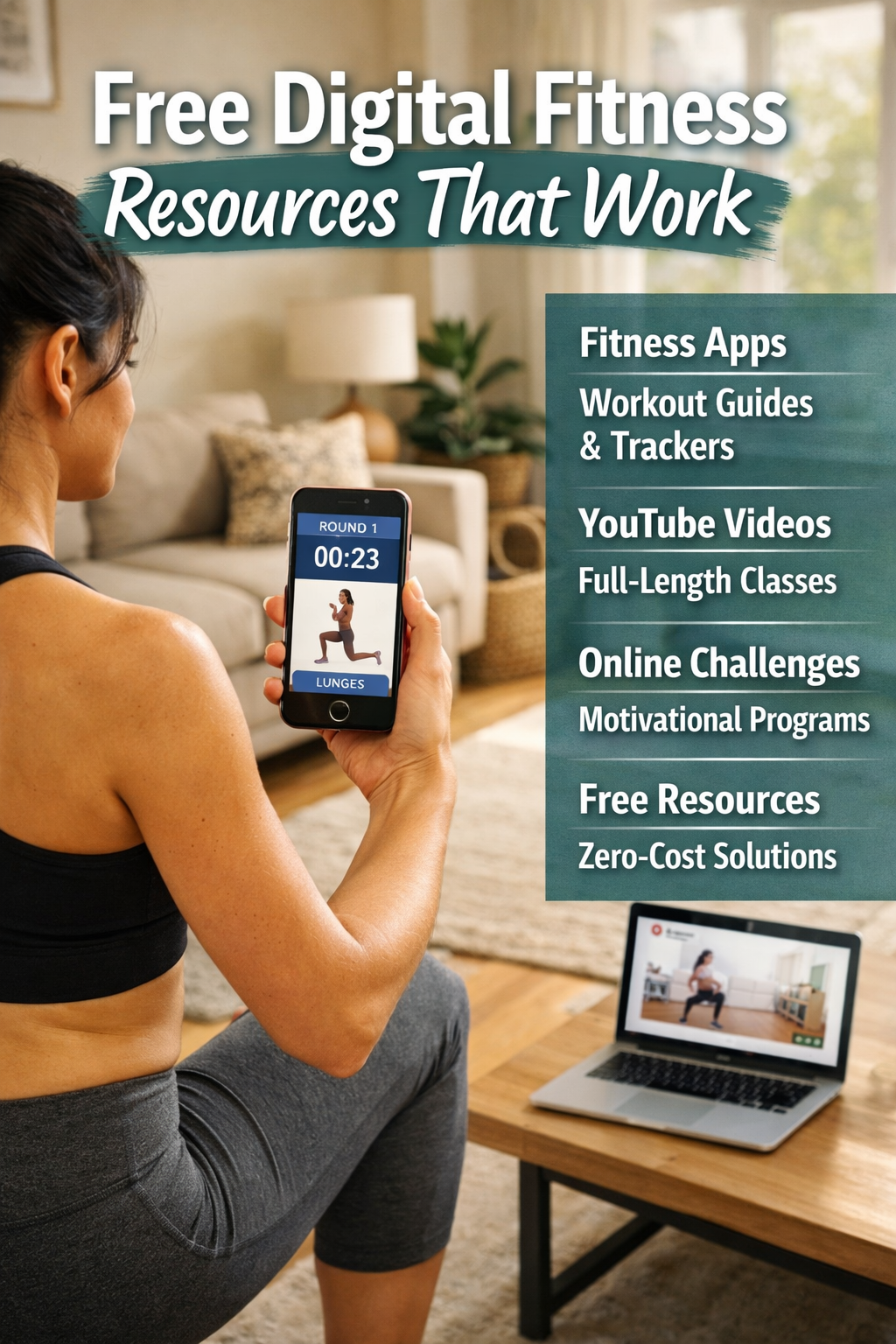
The digital fitness revolution has democratized access to professional-quality training. In 2026, you have access to world-class coaching, structured programs, and supportive communities—all for free or minimal cost.
Top Free Fitness Apps
1. Nike Training Club (100% Free)
- 190+ free workouts
- Programs for all fitness levels
- Bodyweight and equipment-based options
- Yoga and mobility training included
- No subscription required
2. FitOn (Free with Optional Premium)
- Unlimited free workouts
- Celebrity trainers
- Live and on-demand classes
- Community challenges
- Meal planning features
3. MyFitnessPal (Free Version Available)
- Calorie and macro tracking
- Huge food database
- Exercise logging
- Progress tracking
- Community support
4. Couch to 5K (C25K) (Free/$3)
- Structured running program
- Beginner-friendly progression
- Audio coaching during runs
- Proven results for new runners
5. Seven (Free with Ads)
- 7-minute science-based workouts
- No equipment needed
- Quick, effective sessions
- Perfect for busy schedules
YouTube Fitness Channels (Completely Free)
YouTube has become my go-to resource for frugal fitness. Here are channels I personally use:
For Strength Training:
- Fitness Blender: 600+ free full-length workouts
- ATHLEAN-X: Science-based training from a physical therapist
- Chloe Ting: Popular challenge programs with millions of success stories
For Yoga and Flexibility:
- Yoga with Adriene: 30-day programs and individual sessions
- Breathe and Flow: Power yoga and strength-building flows
For HIIT and Cardio:
- The Body Coach TV (Joe Wicks): High-energy workouts
- MadFit: Dance cardio and apartment-friendly routines
For Running:
- The Run Experience: Form tips and training advice
- Global Triathlon Network: Running technique and workouts
Personal Training Apps at Budget Prices
Subscription-based personal training services offer lower-cost alternatives to gym memberships[3]. Apps like Trainwell (formerly CoPilot) provide:
- Customized workout plans from real trainers
- Video demonstrations and form checks
- Adaptable programs that don’t require extensive equipment
- Monthly cost of $20-$40 (vs. $200+ for in-person training)
Free Online Communities and Accountability
Don’t underestimate the power of community support:
Reddit Communities:
- r/bodyweightfitness (2M+ members)
- r/fitness (10M+ members)
- r/xxfitness (women-focused)
- r/running
Facebook Groups:
- Local running clubs and fitness groups
- Equipment-specific communities
- Challenge groups (30-day programs)
Instagram and TikTok:
- Follow trainers for daily workout ideas
- Participate in challenges (#75Hard, #30DayChallenge)
- Free form tips and motivation
These digital resources provide the same guidance you’d get from expensive personal trainers, but at a fraction of the cost. Just as you might use budgeting apps and tools to manage your finances, free fitness apps help you manage your health without spending a fortune.
Creating Your Personalized Frugal Fitness Plan
Now that you understand the resources available, let’s create a sustainable frugal fitness plan tailored to your goals, schedule, and preferences.
Step 1: Define Your Fitness Goals
Be specific about what you want to achieve:
Strength Building:
- Focus on progressive bodyweight exercises
- Consider minimal equipment (resistance bands, dumbbells)
- Track repetitions and progression
Weight Loss:
- Emphasize cardio and HIIT workouts
- Combine exercise with calorie awareness
- Aim for 150+ minutes weekly activity
General Health and Wellness:
- Mix cardio, strength, and flexibility
- Focus on consistency over intensity
- Include stress-reducing activities like yoga
Athletic Performance:
- Sport-specific training
- Agility and speed work
- Functional movement patterns
Step 2: Assess Your Resources
Take inventory of what you have access to:
✓ Time availability: Morning, lunch, evening, or weekend workouts?
✓ Space: Indoor space for workouts? Outdoor areas nearby?
✓ Equipment: What do you already own? What could you borrow?
✓ Digital access: Smartphone, tablet, or computer for apps/videos?
✓ Community resources: Parks, trails, recreation centers nearby?
Step 3: Build Your Weekly Schedule
Create a realistic schedule you can maintain:
Beginner Plan (3-4 days/week):
- 2 days: Full-body bodyweight workouts (30 min)
- 1 day: Cardio (walking, jogging, YouTube video) (20-30 min)
- 1 day: Flexibility/yoga (20 min)
Intermediate Plan (4-5 days/week):
- 2 days: Upper/lower body split (30-40 min)
- 2 days: Cardio/HIIT (25-30 min)
- 1 day: Active recovery (yoga, walking, stretching)
Advanced Plan (5-6 days/week):
- 3 days: Strength training with progressive overload
- 2 days: High-intensity cardio or sport-specific training
- 1 day: Mobility and recovery work
Step 4: Track Progress Without Expensive Tools
You don’t need fancy fitness trackers:
Free Tracking Methods:
- Smartphone notes app (workout log)
- Paper journal (old-school but effective)
- Progress photos (every 2-4 weeks)
- Measurements (waist, hips, chest, arms)
- Performance metrics (push-ups in one set, mile time)
- How clothes fit (often better than scale weight)
Budget-Friendly Tech:
- Phone’s built-in step counter
- Free apps like MyFitnessPal
- Basic fitness tracker ($25-$40 on sale)
Step 5: Build Accountability Systems
Accountability dramatically improves success rates:
🎯 Find a workout buddy: Free and highly effective
🎯 Join online communities: Reddit, Facebook groups
🎯 Share goals publicly: Social media accountability
🎯 Create challenges: 30-day commitments with friends
🎯 Schedule workouts: Treat them like important appointments
Step 6: Plan for Obstacles and Setbacks
Weather issues? Have indoor backup workouts ready
Travel? Bodyweight routines work anywhere
Illness? Rest and resume without guilt
Motivation dips? Change routine, try new YouTube channel
Time crunches? 10-minute workouts count!
The key to frugal fitness success is the same as achieving financial freedom—it’s about consistent small actions over time, not expensive quick fixes.
Nutrition on a Budget: Fueling Your Frugal Fitness Journey
You can’t out-exercise a poor diet, but you also don’t need expensive meal plans or supplements to fuel your fitness goals. Smart nutrition supports your frugal fitness approach.
Budget-Friendly Protein Sources
Protein is essential for muscle recovery and building, but it doesn’t have to be expensive:
Cost-Effective Options (per serving):
- Eggs ($0.15-$0.30 each)
- Canned tuna ($0.75-$1.25 per can)
- Dried beans and lentils ($0.20-$0.40 per serving)
- Chicken thighs ($1.50-$2.50 per pound)
- Greek yogurt (on sale, $0.50-$1.00 per serving)
- Peanut butter ($0.15-$0.25 per serving)
- Cottage cheese ($0.75-$1.25 per serving)
- Canned chicken ($1.50-$2.00 per can)
Skip the Expensive Supplements
The supplement industry thrives on convincing you that you need their products. The truth? Most supplements are unnecessary:
What You Actually Need:
- Whole foods providing complete nutrition
- Adequate water (free from tap!)
- Sufficient sleep (completely free)
Skip These Unless Medically Necessary:
- Pre-workout drinks ($30-$50/month)
- Protein powders (whole food sources are cheaper)
- BCAAs (unnecessary if eating adequate protein)
- Fat burners (don’t work as advertised)
- Expensive multivitamins (basic ones work fine if needed)
Meal Prep for Fitness and Budget
Combining meal prep with frugal fitness saves both time and money:
Sunday Prep Strategy:
- Cook large batches of protein (chicken, ground turkey, hard-boiled eggs)
- Prepare complex carbs (rice, quinoa, sweet potatoes)
- Chop vegetables for the week
- Portion into containers
- Grab-and-go meals ready for busy workout days
This approach aligns perfectly with frugal grocery shopping strategies that help you save hundreds monthly.
Hydration Without Expensive Sports Drinks
Water is the best hydration for most workouts:
- Tap water is free and sufficient for workouts under 90 minutes
- Add lemon or cucumber for flavor (pennies per serving)
- Sports drinks only necessary for intense exercise over 90 minutes
- Homemade electrolyte drink: water + pinch of salt + splash of juice ($0.10 vs. $2.00 store-bought)
Staying Motivated Without Expensive Classes or Trainers
Motivation is often cited as the reason people pay for gym memberships and classes, but you can build powerful motivation systems for free.
Intrinsic Motivation Strategies
Connect to Your “Why”:
- Health improvements (energy, sleep, mood)
- Setting examples for children
- Longevity and quality of life
- Stress management
- Personal achievement
Celebrate Non-Scale Victories:
- Completing your first pull-up
- Running a mile without stopping
- Touching your toes for the first time
- Improved sleep quality
- Better mood and mental clarity
- Increased energy throughout the day
Free Accountability Methods
Challenge Yourself:
- 30-day consistency challenges
- Progressive goals (10 push-ups to 50)
- Virtual races (many are free to join)
- Personal records in any exercise
Visual Progress Tracking:
- Progress photos (phone camera)
- Workout calendar with X’s for completed days
- Before/after comparisons
- Measurement charts
Social Accountability:
- Instagram fitness account
- Workout buddy check-ins
- Family involvement
- Online community participation
Gamification Without Apps
Make fitness fun with free game-like elements:
🎮 Create point systems: 1 point per workout, reward at 30 points
🎮 Level up: Beginner → Intermediate → Advanced progressions
🎮 Achievement unlocks: New exercises after mastering basics
🎮 Streak tracking: How many consecutive days/weeks?
Dealing with Setbacks
Reframe “Failures”:
- Missed workout = opportunity to practice flexibility
- Slow progress = building sustainable habits
- Plateaus = time to try new approaches
Get Back on Track:
- Acknowledge the setback without judgment
- Identify what caused it
- Create a plan to prevent recurrence
- Start fresh immediately (don’t wait for Monday!)
Just as staying motivated while paying off debt requires mental strategies, frugal fitness success depends on building internal drive rather than relying on external (expensive) motivation.
The Long-Term Financial Impact of Frugal Fitness
Let’s talk numbers. The financial benefits of frugal fitness extend far beyond avoiding gym membership fees.
Direct Savings Calculation
Traditional Gym Approach (Annual Costs):
- Gym membership: $720 ($60/month)
- Initiation fee: $100 (amortized)
- Workout clothes and shoes: $200
- Supplements and protein: $360 ($30/month)
- Sports drinks and snacks: $120
- Total: $1,500/year
Frugal Fitness Approach (Annual Costs):
- Basic equipment (one-time): $95
- Workout clothes (minimal): $50
- Shoes (one pair): $60
- Total: $205 first year, $110 subsequent years
Annual Savings: $1,295+
Five-Year Savings: $5,655+
Indirect Financial Benefits
Health Improvements:
- Reduced medical expenses
- Lower insurance premiums (some insurers offer fitness discounts)
- Fewer sick days
- Reduced medication needs
- Better mental health (less therapy costs)
Productivity Gains:
- Improved focus and energy
- Better sleep quality
- Enhanced work performance
- Potential career advancement
Lifestyle Benefits:
- No commute to gym (saves gas/time)
- Flexible schedule (work out anytime)
- Family involvement (kids can join free workouts)
- Sustainable long-term habits
Investment Potential
What if you invested those gym membership savings?
$60/month invested at 7% annual return:
- After 5 years: $4,300
- After 10 years: $10,300
- After 20 years: $31,000
- After 30 years: $72,500
That gym membership could literally become your retirement fund! This aligns with smart money-saving strategies that compound over time.
The Compound Effect of Frugal Fitness
Health and wealth compound similarly:
Year 1: Build basic fitness habits, save $1,295
Year 2: Stronger habits, improved health, save $1,390
Year 3: Fitness becomes lifestyle, health benefits accumulate, save $1,390
Year 5: Significantly better health, $6,000+ saved, potential medical cost reductions
Year 10: Transformed health, $13,000+ saved, compounding health benefits
The longer you maintain frugal fitness habits, the more dramatic the financial and health returns become.
Common Frugal Fitness Mistakes to Avoid
Even budget-conscious fitness has pitfalls. Here’s what to watch out for:
Mistake #1: Buying Unnecessary Equipment
The Problem: Getting excited and purchasing equipment you won’t use
The Solution: Start with bodyweight exercises for 30 days before buying anything
The Rule: If you haven’t used it in 30 days, you probably don’t need it
Mistake #2: Following Unsustainable Programs
The Problem: Extreme challenges that burn you out
The Solution: Start with 3-4 workouts weekly and build gradually
Remember: Consistency beats intensity for long-term results
Mistake #3: Comparing Your Journey to Others
The Problem: Social media creates unrealistic expectations
The Solution: Focus on personal progress, not others’ highlight reels
Truth: Everyone’s fitness journey is unique and non-linear
Mistake #4: Neglecting Recovery
The Problem: Thinking more is always better
The Solution: Schedule rest days and prioritize sleep
Fact: Muscles grow during recovery, not during workouts
Mistake #5: Ignoring Form for Quantity
The Problem: Doing 100 sloppy push-ups instead of 20 perfect ones
The Solution: Watch form videos, start slow, prioritize quality
Result: Better results and injury prevention
Mistake #6: Expecting Immediate Results
The Problem: Quitting after 2 weeks without visible changes
The Solution: Commit to 12 weeks minimum before evaluating
Reality: Sustainable changes take time but last forever
Mistake #7: Skipping Warm-Ups and Cool-Downs
The Problem: Jumping straight into intense exercise
The Solution: 5-minute warm-up and 5-minute cool-down every session
Benefit: Injury prevention and better performance
Avoiding these mistakes is as important as avoiding common budgeting mistakes that derail financial progress.
Conclusion: Your Frugal Fitness Action Plan
You now have everything you need to start your frugal fitness journey today—no gym membership required, no expensive equipment necessary, and no excuses left.
The beauty of frugal fitness is that it removes the financial barriers that prevent so many people from prioritizing their health. You don’t need to wait until you can “afford” to get in shape. You can start right now, right where you are, with what you have.
Your Next Steps (Start Today!)
This Week:
- ✅ Choose 3 bodyweight exercises from each category (upper, lower, core)
- ✅ Download one free fitness app (Nike Training Club or FitOn)
- ✅ Identify one free outdoor space near you
- ✅ Schedule 3 specific workout times in your calendar
- ✅ Take “before” photos and measurements
This Month:
- ✅ Complete 12 workouts (3 per week)
- ✅ Try 3 different YouTube fitness channels
- ✅ Join one online fitness community
- ✅ Calculate your gym membership savings
- ✅ Establish a consistent workout time
This Year:
- ✅ Build a sustainable 4-5 day weekly routine
- ✅ Invest saved money into debt payoff or savings
- ✅ Achieve one major fitness milestone
- ✅ Help someone else start their frugal fitness journey
- ✅ Celebrate $1,000+ in gym membership savings
Final Thoughts
I’ve been practicing frugal fitness for over three years now, and I can honestly say it’s one of the best decisions I’ve made—for both my health and my bank account. The $1,295+ I save annually goes toward building wealth, paying off debt, and creating financial security for my family.
But more importantly, frugal fitness has taught me that I don’t need expensive things to achieve my goals. Whether it’s fitness, finances, or any other area of life, sustainable success comes from consistent effort and smart choices—not from spending money.
Your body doesn’t care about fancy gyms or expensive equipment. It responds to movement, challenge, and consistency. All of those things are completely free and available to you right now.
The question isn’t whether you can afford to get in shape. The question is: are you ready to start?
Remember, every fitness journey starts with a single workout. Make today that day. Your future self—and your bank account—will thank you. 💪